
Should I start Hydrocarbons practice with chapter questions or a full mock?
Start Hydrocarbons practice questions for NEET with a chapter set, not a full mock. Use topic-wise questions to repair reagent recall, mixed chapter questions to separate competing reactions, and full mocks to test performance across the syllabus. A full paper tests integration but spreads your effort too widely to be the first tool for repairing one weak chapter.
Below are six original, free, NEET-style Hydrocarbons MCQs with answers and explanations. These are original practice questions, not previous-year NEET questions. Attempt them before reading the answers: recognising a product is not the same as explaining why the stated conditions produce it.
How do topic-wise drills, mixed Hydrocarbons questions and full mocks compare?
Topic-wise drills test recall with clues, mixed chapter sets test reaction selection without topic headings, and full mocks test execution across subjects. Choose by the mistake you need to expose, not by the largest question count.
- Immediate purpose
- Topic-wise Hydrocarbons drills: retrieve a particular reaction rule.
- Mixed Hydrocarbons questions: choose among competing rules.
- Full-length NEET mocks: combine subject knowledge, timing and question selection.
- Amount of topic cueing
- Topic-wise drills: high. An “alkene addition” heading supplies a clue.
- Mixed questions: lower. That reaction-family clue disappears.
- Full mocks: no chapter headings, with questions across the syllabus.
- Mistakes exposed
- Topic-wise drills: forgotten reagents, conditions and products.
- Mixed questions: applying a remembered rule to the wrong conditions.
- Full mocks: slow switching, poor question selection and errors under time pressure.
- Main limitation
- Topic-wise drills: headings can make understanding look stronger than it is.
- Mixed questions: cannot establish whole-paper readiness.
- Full mocks: spread your effort across the syllabus rather than concentrating on one weak rule.
- Best preparation stage
- Topic-wise drills: learning or repairing the chapter.
- Mixed questions: revision after individual reactions are understood.
- Full mocks: whole-syllabus integration.
The official paper has 180 compulsory questions, 180 minutes and 720 marks, including 45 Chemistry questions. That does not establish a fixed Hydrocarbons question count. The six questions here are a free article resource, separate from any product offering.
Which practice format matches the mistake I actually make?
Failure to recall a rule needs targeted retrieval; confusion between remembered rules needs mixed practice. Pick by your error, not simply by your class or the number of papers you have completed.
- Class 11, learning the chapter: choose topic-wise practice if you cannot predict what a familiar reagent does without opening your notes. Retrieve the condition as well as the product.
- Class 12, revising: choose mixed questions if you know individual reactions but confuse addition, substitution or oxidation when they appear together.
- Dropper with a recurring error: return to targeted drills if you repeatedly miss a condition such as peroxide or ultraviolet light. Another full paper spreads practice across subjects instead of targeting that condition.
- Correct in chapter practice, weaker across subjects: use full mocks to test switching, question selection and whole-paper execution.
Use an observable readiness check: explain why your selected product forms and why a plausible alternative does not. A correct letter without that explanation may reflect recognition or guessing.
For parents, buying a larger bank does not by itself correct an unresolved reaction rule. First identify what the student is applying incorrectly.
Can I try six free Hydrocarbons practice questions for NEET now?
Attempt the six questions below without notes, and write a short reason beside each choice before checking the next section. Each question has one correct option. Record any condition you were unsure about, even if you felt confident about the answer.
Reaction-family labels are deliberately omitted beside individual questions so they cannot guide your choice. This small diagnostic set checks selected condition-dependent errors; it is not exhaustive chapter coverage.
Question 1. Propene reacts with hydrogen bromide in the absence of peroxide, under ordinary ionic addition conditions. Which compound is the major product?
- A. 1-bromopropane
- B. 2-bromopropane
- C. 1,2-dibromopropane
- D. Propan-2-ol
Question 2. Propene reacts with hydrogen bromide in the presence of an organic peroxide under conditions that initiate a radical chain reaction. Which compound is the major product?
- A. 2-bromopropane
- B. 1,2-dibromopropane
- C. 1-bromopropane
- D. Propane
Question 3. But-2-ene is treated with ozone, followed by zinc and water for reductive work-up. Which carbonyl compound is obtained?
- A. Ethanal
- B. Methanal
- C. Propanone
- D. Ethanoic acid
Question 4. Ethyne undergoes hydration with water in the presence of mercuric sulfate and sulfuric acid. Which compound is the final product after tautomerisation?
- A. Ethenol, also called vinyl alcohol
- B. Ethanol
- C. Ethanoic acid
- D. Ethanal
Question 5. Benzene reacts with bromine in the presence of ferric bromide, without ultraviolet irradiation. Which reaction class describes the formation of bromobenzene?
- A. Electrophilic addition
- B. Electrophilic substitution
- C. Nucleophilic substitution
- D. Free-radical substitution
Question 6. Ethane reacts with chlorine under ultraviolet light. Consider the formation of chloroethane, without asking about further chlorination products. Which mechanism operates?
- A. Electrophilic substitution
- B. Nucleophilic substitution
- C. Free-radical substitution
- D. Free-radical addition
Before scrolling, mark each response as explained, uncertain or guessed. Each answer must follow from its own substrate and conditions, not from a pattern in the options.
What conditions decide the answers to these six questions?
Peroxide changes the pathway in the first pair; the remaining questions turn on the ozonolysis work-up, hydration catalyst, ferric bromide and ultraviolet light. The hydrocarbon name alone is insufficient to select the product or mechanism.
Answer key: 1 B; 2 C; 3 A; 4 D; 5 B; 6 C.
Why does Question 1 give 2-bromopropane?
Without peroxide, hydrogen bromide adds to propene through the usual ionic, Markovnikov pathway. Protonation favours the more stable secondary carbocation rather than a primary carbocation; bromide then attacks to form 2-bromopropane.
The tempting answer, 1-bromopropane, belongs to the peroxide-initiated radical pathway. The question specifically removes that condition. Propan-2-ol would require hydration conditions, not hydrogen bromide.
Why does Question 2 give 1-bromopropane?
Peroxide initiation changes the mechanism to a radical chain reaction. A bromine radical adds to the terminal carbon of propene, leaving the more stable secondary carbon radical. That radical takes hydrogen from hydrogen bromide, producing 1-bromopropane through anti-Markovnikov addition.
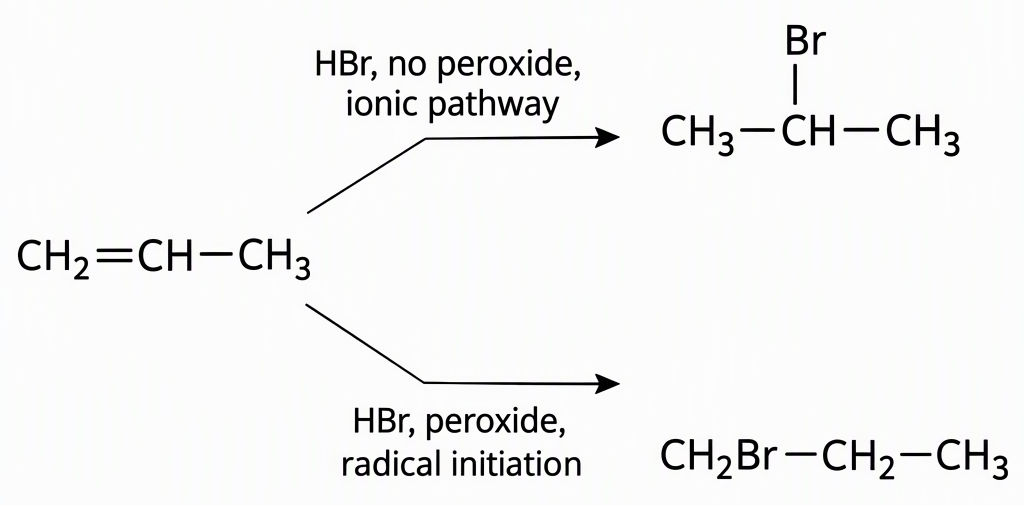
Choosing 2-bromopropane here applies the ionic rule despite the changed condition. The standard peroxide-effect rule applies to HBr, not indiscriminately to HCl and HI.
Why does Question 3 give ethanal?
Reductive ozonolysis of but-2-ene gives two molecules of ethanal. Each original double-bond carbon carries one hydrogen and one methyl group. Cleavage turns each into a carbonyl carbon while retaining those attached groups.
Ethanoic acid confuses reductive work-up with oxidative work-up. Zinc and water preserve the aldehyde product rather than converting it to the corresponding acid.
Why does Question 4 give ethanal rather than ethenol?
Ethanal is the final product because the initially formed enol, ethenol, tautomerises to the more stable carbonyl compound. Mercuric sulfate and sulfuric acid catalyse the hydration of ethyne.
Ethenol is a tempting intermediate, not the requested final product. Ethanol is also wrong: hydration is not hydrogenation, and no reducing condition is supplied.
Why is Question 5 electrophilic substitution?
Bromine replaces a ring hydrogen, and the substitution pathway restores aromaticity. Ferric bromide activates bromine for electrophilic attack on benzene; loss of a proton after that attack restores the aromatic ring.
Electrophilic addition is tempting if benzene is treated like an ordinary alkene. Simple addition would leave aromaticity disrupted rather than restore it.
Why is Question 6 free-radical substitution?
Ultraviolet light initiates homolytic cleavage of chlorine molecules, forming chlorine radicals. A chlorine radical removes hydrogen from ethane; the resulting ethyl radical reacts with chlorine to form chloroethane and regenerate a chlorine radical.
Free-radical addition is wrong because ethane has no multiple bond to add across. Chlorine replaces hydrogen: this is substitution.
These questions test reaction reasoning. They are neither predictions of the next NEET paper nor evidence of chapter weightage.
How should I turn each wrong answer into the next practice task?
Record the rule you misapplied, not just the correct option. Choose your next task according to whether you forgot the condition or remembered competing rules and selected the wrong one.
Use an error log with four fields:
- Substrate: for example, propene.
- Reagent and condition: hydrogen bromide, peroxide present, radical initiation.
- Mistaken rule: applied ordinary Markovnikov addition.
- Corrected rule: use the peroxide-initiated anti-Markovnikov pathway for hydrogen bromide.
If you forgot the reagent or condition, practise topic-wise retrieval, then attempt a fresh question on that rule. If you remembered both pathways but chose incorrectly, attempt mixed reaction questions without topic headings.
A guessed correct answer still needs a written reason before you count the concept as understood. Reattempting these questions checks recall of the correction, but it is not independent proof of mastery.
If scoring, use the official marking rule: award 4 marks for a correct answer, deduct 1 for a wrong answer, and award 0 for an unattempted question. This small-set score cannot predict a NEET rank.
When should I move from Hydrocarbons practice to a free full mock?
Move to a full mock when you can distinguish reaction conditions without relying on topic headings and explain why competing answers fail. Test whether that reasoning holds while switching subjects and managing a complete paper. Do not use a full mock as a substitute for repairing a known reaction error.
NEET JEEnius AI provides 30 free full-length mock tests a month. Each has 180 questions, 720 marks and 180 minutes, with 45 Physics, 45 Chemistry and 90 Biology questions, and provides a scored per-subject breakdown.
You must review individual Hydrocarbons mistakes yourself. A per-subject score does not provide chapter-level diagnosis, and the six questions in this article are separate from that mock-test offering.
Choose your next task from the error you identified: repair a forgotten reaction rule, attempt mixed chapter practice for selection errors, or sit a full mock to test whole-paper execution.
Next step: full-length mock tests on NEET JEEnius AI and sit a full 180-question, 720-mark, 180-minute paper, 45 Physics, 45 Chemistry and 90 Biology, and get a scored per-subject breakdown (30 free a month).
Related on NEET JEEnius AI: Glycolysis NEET 2026: Pyruvate Count From 206 Glucose.
Frequently asked questions
Should I practise Hydrocarbons chapter questions or take a full NEET mock?
Start with chapter questions when repairing a weak Hydrocarbons concept. Use topic-wise drills for forgotten reagents and conditions, then mixed questions to practise choosing between competing reactions. Move to full mocks when you can explain the products without topic headings and need to test whole-paper execution.
Are these Hydrocarbons questions NEET previous-year questions?
No. These are six original, free, NEET-style MCQs with answers and explanations, not previous-year questions. They test selected condition-dependent errors and do not provide exhaustive chapter coverage or predict chapter weightage.
What happens when propene reacts with HBr with and without peroxide?
Without peroxide, ordinary ionic addition of HBr to propene gives 2-bromopropane through the Markovnikov pathway. With peroxide under radical-chain conditions, the major product is 1-bromopropane through anti-Markovnikov addition. The standard peroxide-effect rule applies to HBr, not indiscriminately to HCl and HI.
How should I review wrong answers in Hydrocarbons practice?
Record the substrate, reagent and condition, mistaken rule, and corrected rule. If you forgot a condition, use topic-wise retrieval followed by a fresh question; if you confused remembered pathways, use mixed questions without topic headings. Treat a guessed correct answer as unresolved until you can explain why the product forms.