
Should I start with chapter MCQs, PYQs or full mocks?
Start with NCERT-aligned chapter MCQs if you need to find concept gaps. These six free original Human Reproduction practice questions for NEET include answers and explanations. They are not actual NEET questions.
Use chapter-wise previous-year questions (PYQs) to check how concepts have actually been tested. Choose full-length mocks to test recall within a mixed paper once you are ready for whole-paper practice. A full mock is not the most direct tool for repairing one weak chapter.
How do chapter MCQs, Human Reproduction PYQs and full mocks compare?
Chapter MCQs target concept gaps, PYQs show actual exam wording, and full mocks test mixed-paper recall. Choose by the mistake you need to investigate, not by the size of the question bank.
- Main job
- Original NCERT-aligned chapter MCQs: Find confusion between closely related concepts.
- Chapter-wise NEET PYQs: Examine how concepts appeared in actual papers.
- Full-length mocks: Test recall while switching subjects under time pressure.
- Best starting condition
- Chapter MCQs: You have read the relevant NCERT content.
- PYQs: You understand the basics but need exam-wording practice.
- Full mocks: You are ready for whole-paper practice.
- Chapter targeting
- Chapter MCQs: Direct, but these six cover selected concepts only.
- PYQs: Direct when questions are correctly sorted by chapter.
- Full mocks: The chapter mix is unspecified. No particular Human Reproduction question count is promised.
- Answer-review requirement
- Chapter MCQs: Connect each explanation to NCERT.
- PYQs: Check wording and answers against the corresponding official paper and final key at neet.nta.nic.in.
- Full mocks: Separate content, reading and time-management errors.
- Limitation
- Chapter MCQs: Focused practice, not complete chapter coverage.
- PYQs: Familiar answers can disguise weak understanding.
- Full mocks: Inefficient for repairing one isolated concept.
- What is free or supplied here
- Chapter MCQs: Six original questions below, with explanations.
- PYQs: Verification guidance, not a verified PYQ collection.
- Full mocks: For whole-paper practice, NEET JEEnius AI offers 30 free a month: each has 180 questions, 720 marks and 180 minutes, with 45 Physics, 45 Chemistry and 90 Biology questions, plus a scored per-subject breakdown.
What should Class 11, Class 12 students and droppers choose?
Pick according to your current error, not your class label. A dropper may need basic hormone revision, while a Class 12 student may be ready for mixed-paper work. Distinguish between not knowing a concept, misreading a question and struggling to recall familiar knowledge under time pressure.
- Class 11, studying the chapter early: Learn the relevant NCERT content before attempting a small chapter set. If oogenesis is still unfamiliar, reading its stages is more useful than guessing through questions. Do not use a full-paper score to judge an unfinished syllabus.
- Class 12, chapter completed but hormones confused: Start with focused MCQs. Review each hormone’s source, target and role. Repair confusion between LH, FSH and progesterone before moving to broader practice.
- Concepts understood, unfamiliar wording causes errors: Choose chapter-wise PYQs with checked keys. Underline qualifiers such as “incorrect”, “immediately after” and “secreted by”. Explain why the closest distractor fails, rather than merely recognising the correct statement.
- Dropper, repeated PYQs feel effortless: Attempt fresh chapter questions. Explain why every rejected option is wrong. Remembering an answer letter or sentence from an earlier attempt is recognition, not proof that you can apply the concept.
- Accurate in chapter sets, inaccurate in mixed papers: Prioritise full mocks. During review, separate missing knowledge from rushed reading and poor time allocation. For overlooked qualifiers late in a paper, reviewing mixed-paper errors is more direct than repeating isolated chapter sets.
Which six free Human Reproduction questions can I attempt now?
Attempt all six before checking the answer key. These are original, single-correct practice questions, not PYQs or predicted questions. Each has four options and tests an NCERT distinction.
Work without notes and record one option for each question. Flag guesses and any answer whose reasoning you cannot explain.
1. During sperm formation, which statement correctly distinguishes spermiogenesis from spermiation?
- A. Spermiogenesis releases spermatozoa from Sertoli cells; spermiation converts spermatids into spermatozoa.
- B. Spermiogenesis converts spermatids into spermatozoa; spermiation releases spermatozoa from Sertoli cells.
- C. Spermiogenesis forms spermatids by meiosis; spermiation converts them into spermatozoa.
- D. Spermiogenesis produces primary spermatocytes; spermiation completes their first meiotic division.
2. Which statement correctly describes the human secondary oocyte released at ovulation?
- A. It is arrested at prophase I and completes meiosis I after sperm entry.
- B. It is arrested at metaphase II and completes meiosis II during implantation.
- C. It has completed meiosis II before release from the ovary.
- D. It is arrested at metaphase II and completes meiosis II following sperm entry.
3. Which pairing correctly identifies the immediate trigger for ovulation and a major hormonal action after ovulation?
- A. LH surge triggers ovulation; corpus luteum progesterone supports the endometrium.
- B. Progesterone surge triggers ovulation; corpus luteum LH supports the endometrium.
- C. FSH surge triggers ovulation; corpus luteum hCG supports the endometrium.
- D. LH surge triggers ovulation; corpus luteum FSH supports the endometrium.
4. Which statement correctly pairs fertilisation and implantation with their usual sites in humans?
- A. Fertilisation occurs in the ovary; the blastocyst implants in the uterine endometrium.
- B. Fertilisation occurs in the ampullary-isthmic junction; the blastocyst implants in the cervix.
- C. Fertilisation occurs in the ampullary-isthmic junction; the blastocyst implants in the uterine endometrium.
- D. Fertilisation occurs in the uterine cavity; the blastocyst implants in the oviduct.
5. According to NCERT, which group consists entirely of hormones produced by the placenta?
- A. hCG, hPL, estrogens and relaxin
- B. hCG, hPL, estrogens and progestogens
- C. hCG, FSH, estrogens and progestogens
- D. LH, hPL, estrogens and progestogens
6. Which pairing correctly matches hormones with uterine contractions during parturition and milk production after childbirth, respectively?
- A. Oxytocin and progesterone
- B. Prolactin and oxytocin
- C. Progesterone and prolactin
- D. Oxytocin and prolactin
What are the answers, and what should I revise after each mistake?
The answer key is: 1 B, 2 D, 3 A, 4 C, 5 B, 6 D. Review correct guesses as carefully as wrong answers. Choosing the right option does not establish understanding if your explanation is wrong.
If you score the set, apply the official rule: award four marks for each correct answer, subtract one for each wrong answer and award zero for an unattempted question. This short, non-standardised chapter set cannot predict a NEET score or rank.
1. B: Transformation and release are different events.
Spermiogenesis transforms spermatids into spermatozoa. Spermiation is the release of spermatozoa from Sertoli cells into the seminiferous tubule lumen. Option A contains both correct events but reverses their names.
Revise: Spermatogenesis terminology. Write the sequence from spermatogonia to spermatozoa, then identify where meiosis, transformation and release occur. Do not confuse a change in cell form with a cell division.
2. D: Sperm entry prompts completion of meiosis II.
The secondary oocyte is arrested at metaphase II when released. Sperm entry induces completion of the second meiotic division, producing the ovum and second polar body. Option A describes the earlier arrest of the primary oocyte, not the ovulated secondary oocyte.
Revise: Oogenesis stages. Pair each cell name with its meiotic stage, arrest point and next event. Keep primary and secondary oocytes separate in your notes.
3. A: The LH surge triggers ovulation.
The LH surge causes rupture of the Graafian follicle and release of the secondary oocyte. After ovulation, the corpus luteum secretes substantial progesterone, which supports endometrial maintenance. Option B reverses the trigger and support roles and wrongly assigns LH secretion to the corpus luteum.
Revise: Menstrual hormone relationships. Track FSH and follicular development, LH and ovulation, then corpus luteum progesterone and the endometrium.
4. C: Fertilisation precedes implantation at a different site.
Fertilisation occurs at the ampullary-isthmic junction of the fallopian tube. Following cleavage and blastocyst formation, implantation occurs in the uterine endometrium. Option B gets fertilisation right but places normal implantation in the cervix.
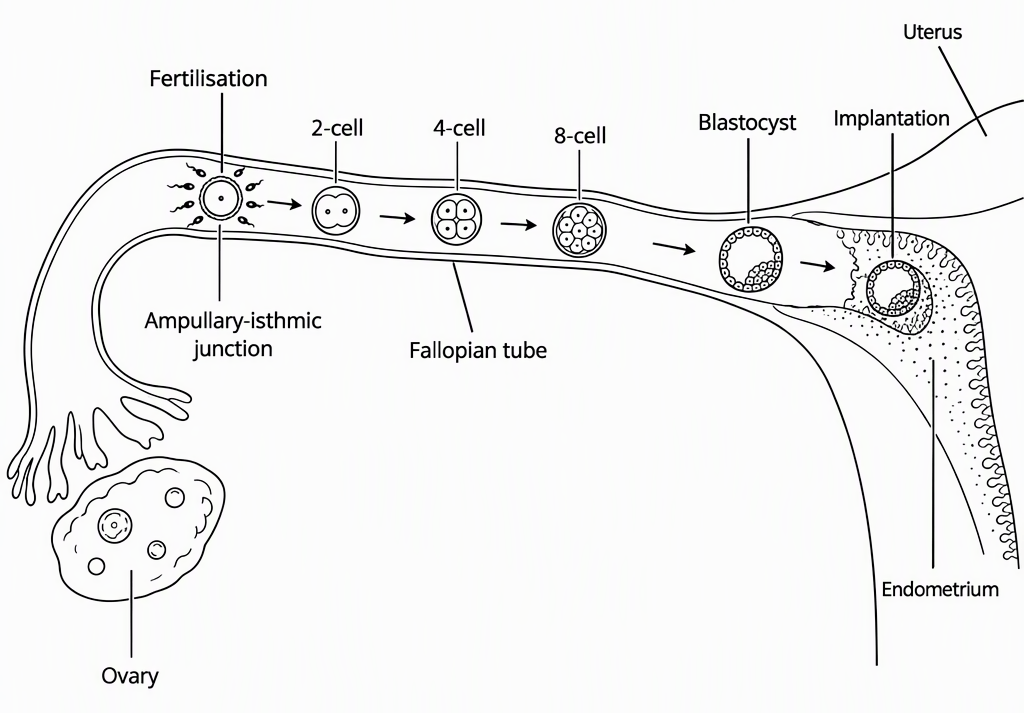
Revise: The fertilisation-to-implantation sequence. Arrange zygote, cleavage, morula, blastocyst and implantation in order, connecting each event to its location.
5. B: The placental list includes hCG and hPL.
NCERT lists hCG, hPL, estrogens and progestogens as placental hormones. Option A substitutes relaxin for progestogens. In NCERT’s account, relaxin is secreted by the ovary during the later phase of pregnancy.
Revise: Placental endocrine function. Match hormones to their stated sources rather than grouping every pregnancy-related hormone under the placenta.
6. D: Contractions and milk production need different hormones.
Oxytocin stimulates strong uterine contractions during parturition; prolactin supports milk production. Option B swaps those roles. Oxytocin also supports milk ejection, which must not be confused with milk production.
Revise: Parturition versus lactation. For every question, record wrong answers and correct guesses, check the relevant NCERT passage or figure, then explain the concept without looking before attempting fresh questions.
What should I practise next, and when is a free full mock useful?
Return to NCERT if a concept remains unclear; move to checked chapter PYQs when you can explain it without prompts. Then use mixed-paper practice to test recall alongside other chapters. Do not count repeated recognition of familiar answers as understanding.
These six questions sample selected concepts. They do not replace revision of reproductive anatomy, NCERT figures, embryonic development or the rest of the chapter.
For revision beyond this chapter, Human Physiology Practice Questions NEET: 6 Explained MCQs is a different practice set, not further Human Reproduction coverage. Before opening another set, write one specific task from today’s answers: “separate oocyte arrest stages” is actionable; “revise reproduction” is not.
When you are ready for whole-paper practice, NEET JEEnius AI’s 30 free full-length mocks a month, with a scored per-subject breakdown, are a useful next step. Use the breakdown to identify the subject needing review, then inspect individual mistakes yourself.
Frequently asked questions
Should I start Human Reproduction practice with MCQs, PYQs or mocks?
Start with NCERT-aligned chapter MCQs after reading the relevant content if you need to find concept gaps. Use chapter-wise PYQs to practise actual exam wording once the basics are clear. Choose full mocks when you are ready to test recall across a mixed paper.
Are these Human Reproduction questions actual NEET PYQs?
No. These are six original, single-correct, NCERT-aligned practice questions, not actual NEET questions or predictions. They cover selected concepts rather than the complete chapter.
How should I revise after getting Human Reproduction MCQs wrong?
Record wrong answers and correct guesses, then check the relevant NCERT passage or figure. Identify the precise confusion, such as oocyte arrest stages or milk production versus milk ejection. Explain the concept without notes before attempting fresh questions.
Can these six Human Reproduction questions predict my NEET score?
No; this short, non-standardised chapter set cannot predict a NEET score or rank. You can score it using four marks for each correct answer, minus one for each wrong answer and zero for each unattempted question. Use the results to identify revision needs, not estimate whole-paper performance.