
Should I start genetics practice with chapter questions or a full mock?
Start with explained, topic-wise MCQs, not a full mock, when your genetics concepts are weak. For genetics practice questions NEET students can learn from, check NCERT alignment and explanations before question-bank size. Free original questions with worked answers follow below; they are not official NEET previous-year questions.
Use NCERT-aligned topic questions to repair concepts, verified previous-year questions to check actual exam wording, and full-length mocks to test execution across the paper. A full-paper score is not a substitute for understanding why a genetics answer was wrong.
How do free topic MCQs, official PYQs and full mocks compare?
Topic MCQs are the best choice for isolating a genetics weakness. Official PYQs show how a concept was examined; mocks test knowledge and execution across the whole paper. Check free topic questions for NCERT alignment, clear assumptions and defensible answers before relying on them.
- Original NCERT-aligned topic MCQs
- Best use: Repair one concept through focused attempts and explanations.
- Prerequisite: Study the relevant NCERT concept first.
- Review: Check the explanation and why competing options fail.
- Limitation: Quality varies; “free” does not establish reliability.
- Isolating genetics weaknesses: Strongest choice when questions target the same mechanism.
- Genetics questions identified in publicly released official NEET papers
- Best use: Check actual past wording and application.
- Prerequisite: Understand the topic well enough to attempt without relying on remembered answers.
- Review: Use the matching official key, then reconstruct the reasoning. A key alone does not teach it.
- Limitation: Remembered answers can hide weak understanding.
- Isolating genetics weaknesses: Useful when you select relevant questions and explain your answers.
- NEET JEEnius AI full-length mocks
- Best use: Practise whole-paper execution.
- Prerequisite: Enough syllabus coverage to make a whole-paper attempt useful.
- Review: Use the scored per-subject breakdown, then review mistakes yourself. This is not a genetics-specific diagnostic report.
- Limitation: The total score mixes genetics errors with other subjects and execution problems.
- Isolating genetics weaknesses: Less direct because genetics is embedded within the complete paper.
For the whole-paper stage, NEET JEEnius AI offers 30 free full-length mocks a month. Each has 180 questions, 720 marks and 180 minutes, with 45 Physics, 45 Chemistry and 90 Biology questions, plus a scored per-subject breakdown.
What should Class 11, Class 12 students and droppers choose?
Choose by what you can explain without options, not by your school year alone. A dropper who remembers answers needs unseen questions to test reasoning. A Class 12 student who solves crosses correctly but misreads exam wording should move to verified PYQs.
- Class 11, studying ahead: Establish chromosome behaviour and meiosis first. Know how homologous chromosomes separate before treating unfamiliar inheritance questions as a performance test.
- Class 12, just finished inheritance: Choose focused questions. Write the parental cross or the pedigree inference before looking at the options.
- Comfortable with chapter exercises, unfamiliar with exam wording: Attempt verified genetics PYQs before consulting the matching official key. Explain how the wording connects to the concept.
- Dropper who remembers PYQ answers: Choose unseen original questions. Explain rejected options instead of treating recognition as mastery.
- Accurate in isolated genetics practice, losing marks in complete papers: Choose full-length mocks. Review question selection, rushed reading, time use and answer marking across the paper.
For parents: A larger practice allowance is not automatically more useful. A smaller set reviewed properly can expose a misconception that a long sequence of unchecked answers leaves untouched.
Which free genetics MCQs can I attempt now?
Attempt these five original, single-correct MCQs before reading the answers in the next section. They use established NCERT genetics concepts and are not official NEET PYQs or predictions. Record a brief reason for every choice and mark guesses separately. Use this set to identify errors, not predict a percentile or declare exam readiness.
Question 1: What does a recessive offspring reveal?
In a plant species, tallness is completely dominant over dwarfness. A tall plant of unknown genotype is crossed with a dwarf plant. Among the offspring, at least one dwarf plant appears. Assume ordinary Mendelian inheritance and no mutation. Which conclusion follows?
- A. The tall parent is homozygous dominant.
- B. The tall parent is heterozygous.
- C. The dwarf parent is heterozygous.
- D. The tall parent's genotype remains completely unresolved.
Question 2: Can different genotypes produce distinct phenotypes?
In snapdragon, homozygous red-flowered and homozygous white-flowered plants produce pink heterozygotes. Two pink plants are crossed. Which statement correctly describes the expected offspring?
- A. There are three genotypes but only two phenotypes.
- B. Every offspring is heterozygous because both parents are pink.
- C. There are three genotypes and three phenotypes, with matching expected proportions.
- D. Red and white offspring have the same genotype but different environments.
Question 3: Which inheritance pattern fits this family?
Two unaffected parents have an affected daughter and an unaffected son. Assume a single-gene trait, complete penetrance, no new mutation and correct parentage. Of the following inheritance patterns, which alone is compatible with this family?
- A. Autosomal dominant.
- B. Autosomal recessive.
- C. X-linked recessive.
- D. X-linked dominant.
Question 4: Which statement separates transcription from replication?
A student claims that RNA polymerase copies both DNA strands into one RNA molecule during transcription of a gene. Which correction is accurate?
- A. Both strands must be copied into the same RNA.
- B. DNA polymerase makes the RNA transcript.
- C. Transcription produces a complete new DNA double helix.
- D. One DNA strand serves as the template for a particular transcription unit; RNA polymerase joins ribonucleotides.
Question 5: What changes when the lac repressor binds an inducer?
Consider the NCERT lac-operon model. A functional repressor is blocking the operator. A suitable inducer binds and inactivates the repressor. Assume the promoter, structural genes, RNA polymerase and substrates are functional, with all other conditions unchanged. What follows?
- A. The repressor binds the operator more strongly.
- B. RNA polymerase can transcribe the structural genes.
- C. The inducer itself synthesises the mRNA.
- D. The structural genes are removed from the chromosome.
What are the answers, and what does each mistake mean?
The key is 1 B, 2 C, 3 B, 4 D and 5 B. Check your written reason against the mechanism below, not just the answer letter. A correct guess and a reasoned correct answer both earn marks in an exam, but a guess leaves the reasoning untested.
1. B: The tall parent is heterozygous.
The dwarf parent contributes only the recessive allele. A dwarf offspring must receive another recessive allele from the tall parent, which must therefore carry both alleles. Its gametes carry either allele; the dwarf parent's gametes carry only the recessive allele.
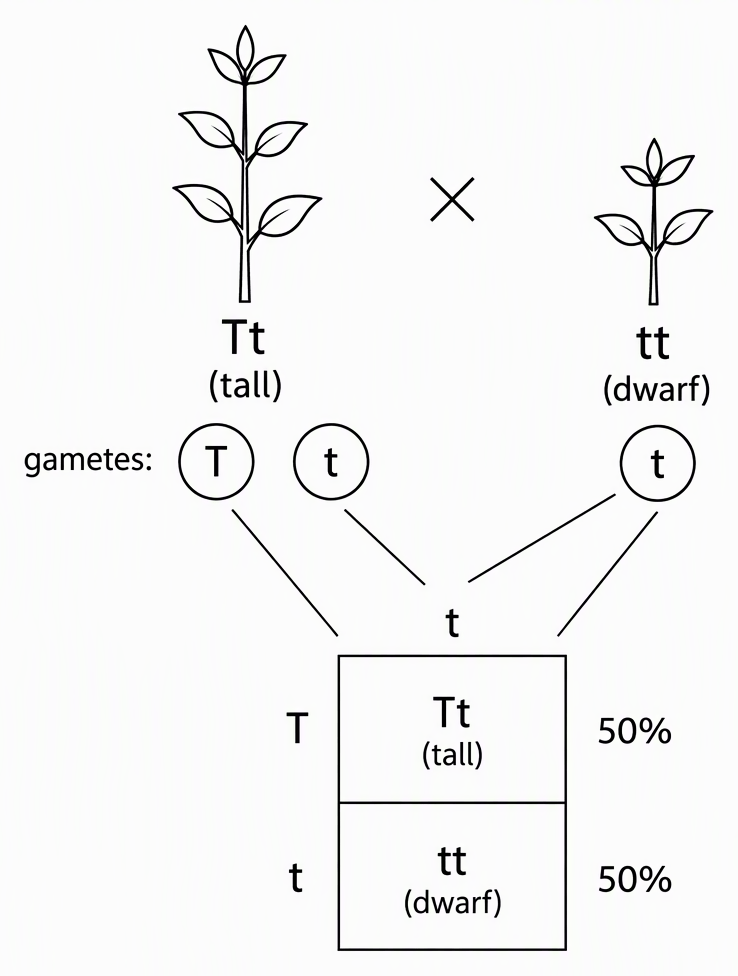
Mendelian segregation gives equal expected proportions, not guaranteed equal counts in a small offspring sample. Here, the presence of a dwarf offspring establishes the inference.
Error label: segregation error. If allele separation is unclear, Review prophase-I stages and chromosome behaviour.
2. C: Three genotypes correspond to three phenotypes.
Let the red and white alleles be represented by R and W. Each pink parent produces gametes carrying R or W.
The homozygotes are red and white; the heterozygote is pink. Genotype and phenotype proportions match because incomplete dominance makes the heterozygote distinguishable. These proportions follow from allele segregation and random fertilisation, not a guarantee for a small family.
Error label: genotype–phenotype confusion. Do not transfer the complete-dominance phenotype ratio to this cross.
3. B: Autosomal recessive inheritance fits.
Both unaffected parents can be carriers and produce an affected daughter. Their gametes can carry either the normal or recessive allele.
These are expected proportions under Mendelian inheritance. X-linked recessive inheritance fails because an affected daughter would need the recessive allele from her father, who would then be affected. Both dominant options fail under complete penetrance and no new mutation.
Error label: unsupported pedigree inference. Use every stated assumption, not only the affected child's presence.
4. D: RNA polymerase uses one template strand for that transcription unit.
It joins ribonucleotides complementary to the template to build RNA. During replication, both parental DNA strands serve as templates for new DNA strands. The other options confuse the enzyme, product or template arrangement.
Error label: molecular-process confusion. Revise template, enzyme and product together.
5. B: Removing repressor blockage permits transcription.
Inducer binding prevents the repressor from blocking the operator, allowing RNA polymerase to transcribe under the stated conditions. The inducer neither makes RNA nor removes genes.
Error label: regulatory-mechanism confusion. Trace the sequence: inducer binds repressor, operator blockage ends, transcription becomes possible.
What should I practise next, and when can a free full mock help?
Repair the error first; use a full mock to test whole-paper execution. If an explanation introduced an unfamiliar concept, return to that NCERT topic before attempting more mixed questions. Treat a correct guess as unfinished revision until you can explain the answer without options.
- Recall gap: Revisit the relevant definition or mechanism, then explain it in your own words.
- Reasoning gap: If the concept was familiar but the cross or inference failed, solve another unseen question requiring the same reasoning. Write the steps.
- Reading error: Record the missed qualifier, such as “unaffected” or “complete penetrance”. Practise reading the full stem before examining options.
- Exam-wording gap: Use official papers and their matching official answer keys. An unsourced worksheet labelled “PYQ” is not authenticated exam material.
Move to a full-length mock when you want to test genetics within whole-paper execution. The current paper has 180 compulsory questions in 180 minutes, with no optional Section B. The overall average of one minute per question is not a prescribed limit for every genetics question.
At that stage, NEET JEEnius AI's 30 free full-length mocks a month with scored per-subject breakdowns provide a whole-paper practice option, not a replacement for concept repair.
Choose your next practice task from the type of error you made, not from the number of questions a resource advertises.
Next step: full-length mock tests on NEET JEEnius AI and sit a full 180-question, 720-mark, 180-minute paper, 45 Physics, 45 Chemistry and 90 Biology, and get a scored per-subject breakdown (30 free a month).
Frequently asked questions
Should I start NEET genetics practice with chapter questions or full mocks?
Start with explained, topic-wise MCQs if your genetics concepts are weak. Study the relevant NCERT concept first, then attempt questions and explain why the competing options fail. Full mocks test whole-paper execution, not genetics understanding in isolation.
Are these genetics questions official NEET PYQs?
No, these five MCQs are original questions based on established NCERT genetics concepts. They are neither official NEET previous-year questions nor predictions. For verified PYQ practice, use publicly released official papers and their matching official answer keys.
How should I review a genetics question I guessed correctly?
Mark the answer as a guess and compare your reasoning with the worked explanation. Treat it as unfinished revision until you can explain the answer without options. A correct guess earns exam marks but does not establish understanding.
When should I move from genetics MCQs to full-length NEET mocks?
Move to full mocks when you have enough syllabus coverage and want to test genetics within whole-paper execution. If you solve isolated genetics questions accurately but lose marks in complete papers, review rushed reading, question selection, time use and answer marking. NEET JEEnius AI offers 30 free full-length mocks a month with scored per-subject breakdowns, not genetics-specific diagnostic reports.