
Which equilibrium practice questions should I use first for NEET?
Use chapter MCQs to repair unstable concepts, verified NEET PYQs to check exam-style application, and full mocks to test Chemistry within the complete paper. For free equilibrium practice questions NEET students can attempt immediately, the six original chemical and ionic equilibrium MCQs below include explanations and need no download. Full mocks supplement chapter practice; they do not replace it.
Choosing the wrong equilibrium expression needs focused repair. Solving correctly in isolation but losing accuracy across a complete paper needs whole-paper practice.
How do topicwise MCQs, verified PYQs and full mocks compare?
Topicwise MCQs isolate a principle, verified PYQs test past-paper application, and full mocks test accuracy across subjects. Choose the format that addresses your current errors. Neither past papers nor full mocks guarantee systematic coverage of every equilibrium subtopic.
- Best use
- Original topicwise MCQs here: Identify chemical and ionic equilibrium misconceptions.
- Verified NEET equilibrium PYQs: Check application against actual past-paper demands.
- NEET JEEnius AI full-length mocks: Test Chemistry within a complete paper.
- Control over subtopic coverage
- Original MCQs: Expressions, reaction quotient, compression, acid strength, buffers and solubility.
- Verified PYQs: Coverage depends on what past papers asked.
- Full mocks: No guaranteed coverage of every equilibrium subtopic.
- Feedback available
- Original MCQs: Correct reasoning and the misconception behind a tempting distractor.
- Verified PYQs: An official answer key establishes the accepted answer, but may not teach the reasoning.
- Full mocks: A scored per-subject breakdown.
- Exam context
- Original MCQs: Isolated, single-correct conceptual questions.
- Verified PYQs: Actual past questions, with original wording and a traceable official answer key.
- Full mocks: 180 questions, 720 marks and 180 minutes, with 45 Physics, 45 Chemistry and 90 Biology questions.
- Access information
- Original MCQs: Free in this article, with explanations. They are not previous-year questions.
- Verified PYQs: Check the source, original wording and corresponding official key. No external collection is endorsed here as free, complete or error-free.
- Full mocks: NEET JEEnius AI provides 30 free full-length mocks a month.
- Principal limitation
- Original MCQs: This conceptual set cannot establish calculation readiness.
- Verified PYQs: Remembered answers can disguise weak reasoning; past papers do not systematically cover every subtopic.
- Full mocks: The supplied facts do not establish an equilibrium-only bank, chapter-level analytics, worked solutions or a fixed number of equilibrium questions per mock.
For original papers and official answer keys, use material traceable to NTA at neet.nta.nic.in. A question labelled “NEET PYQ” without that provenance is not enough.
Which format should Class 11 students, Class 12 students and droppers choose?
Start with the task you cannot yet do reliably, not the largest question bank. Learning the chapter calls for separate subtopic practice. Revision calls for diagnosis before repair; accurate chapter-level work calls for practice within the complete paper.
- Class 11, learning equilibrium: Start with separate chemical and ionic sets. Write the governing expression before substituting, then move to mixed practice.
- Class 12, revising an older chapter: Attempt the diagnostic below without notes. Repair only the concepts exposed by errors, then attempt verified PYQs.
- Dropper who remembers PYQ answers: Explain the correct choice and reject every distractor. Then solve unfamiliar original questions to test whether you can apply the rule elsewhere.
- Accurate in chapter practice, weak in complete papers: Use full mocks for subject allocation, question selection and sustained accuracy.
- Repeated weak-acid, buffer or solubility errors: Return to the relevant ionic-equilibrium model. Repeating full mocks is an inefficient repair.
- Parents choosing a resource: A free full mock is useful assessment. Its Chemistry score alone cannot establish which equilibrium concept needs teaching.
Can you solve these free chemical equilibrium MCQs?
These three original, single-correct questions test expressions, reaction direction and compression. They are not NEET PYQs. Choose one option per question before reading the explanations. Write a short reason beside each answer so that a lucky guess does not look like understanding.
Use this gaseous equilibrium for Questions 1 and 3, assuming ideal-gas behaviour:
Question 1. Which is the correct concentration-based equilibrium expression?
- A
- B
- C
- D
Question 2. At a fixed temperature, the reaction quotient is smaller than the equilibrium constant. Which statement follows?
- A: The net reaction proceeds in reverse.
- B: The system is already at equilibrium.
- C: The net reaction proceeds forward until equilibrium is restored.
- D: The forward reaction must be fast.
Question 3. An equilibrium mixture undergoes a decrease in volume at constant temperature. What happens after re-equilibration?
- A: Ammonia formation is favoured, and the equilibrium constant remains unchanged.
- B: Ammonia formation is favoured because the equilibrium constant increases.
- C: Reactant formation is favoured, and the equilibrium constant remains unchanged.
- D: Composition cannot change because temperature is unchanged.
Why are these chemical equilibrium answers correct?
The answers are 1 B, 2 C and 3 A. Balanced coefficients determine the powers in the expression, the reaction quotient determines net direction, and compression favours the side with fewer gaseous moles. None of these rules tells you how quickly equilibrium is reached.
Question 1: B. Put product concentrations above reactant concentrations, raising each to its balanced coefficient. Option C keeps the correct ratio but drops the powers; those powers are part of the expression, not optional notation.
Question 2: C. The reaction quotient is below its equilibrium value, so the net change is forward. Option D confuses direction with speed: a favourable direction does not mean a fast reaction.
Question 3: A. The reactant side has four gaseous moles per balanced reaction, while the product side has two. Compression favours ammonia formation; at unchanged temperature, the equilibrium constant stays unchanged.
Option B mistakes a pressure-driven composition change for a change in the constant. A catalyst changes the rate of approach to equilibrium, not the equilibrium constant or equilibrium composition under otherwise unchanged conditions.
Can you solve these free ionic equilibrium MCQs?
These three original, single-correct questions test acid dissociation, buffer response and solubility. They are not NEET PYQs. Identify the species present and the assumptions allowed before choosing an answer. Attempt all three before reading the explanations below.
Question 4. A fully dissociated monoprotic strong acid and a monoprotic weak acid have equal analytical concentrations at the same temperature. Their concentrations are high enough to neglect water autoionisation. Which statement is correct?
- A: Both have equal pH because their analytical concentrations are equal.
- B: The weak acid has lower pH.
- C: Their equilibrium hydrogen-ion concentrations must be equal.
- D: The strong acid has lower pH.
Question 5. A small amount of HCl is added to an acetic acid/acetate buffer without exhausting the acetate. Which statement best describes the result?
- A: Acetic acid consumes most added hydrogen ions, and pH rises.
- B: Acetate consumes most added hydrogen ions, and pH decreases slightly.
- C: Acetate consumes added hydrogen ions, and pH remains exactly constant.
- D: All added hydrogen ions remain free, causing a large pH fall.
Question 6. Compare the equilibrium solubility of silver chloride in pure water and in dilute sodium chloride solution at the same temperature. Neglect complex formation and activity effects. Which statement is correct?
- A: Solubility and solubility product both decrease in sodium chloride solution.
- B: Solubility increases, while the solubility product remains unchanged.
- C: Solubility decreases, while the solubility product remains unchanged.
- D: Solubility remains unchanged because the solubility product is unchanged.
Why are these ionic equilibrium answers correct?
The answers are 4 D, 5 B and 6 C. Distinguish what you initially add from what exists at equilibrium. Equal analytical concentrations need not give equal hydrogen-ion concentrations, and an unchanged equilibrium constant does not require unchanged composition or solubility.
Question 4: D. Analytical concentration is the total acid introduced per unit volume. The strong acid dissociates fully, while the weak acid dissociates partly, so the strong acid produces a higher equilibrium hydrogen-ion concentration and has lower pH.
Option A mistakes equal starting concentrations for equal dissociation. Acid strength and acid concentration are different properties.
Question 5: B. Acetate reacts with most of the added hydrogen ions to form acetic acid. The buffer resists a large pH change, but acetate decreases and acetic acid increases, so pH falls slightly.
Option C turns “resists change” into “prevents change completely.” A buffer has limited capacity; its pH is not fixed regardless of what is added.
Question 6: C. Dissolved sodium chloride supplies a common ion, chloride. Less silver chloride dissolves before the equilibrium ion product reaches the same solubility product.
Solubility is the amount of solid that dissolves per unit volume under the stated conditions. The solubility product is the equilibrium constant for dissolution; at the same temperature it remains unchanged under the question’s assumptions.
Option D confuses these quantities. Option A incorrectly makes the constant change with added chloride.
Success here checks foundations, not calculation readiness. Practise these calculation skills next:
- Equilibrium concentrations from the concentration-based constant.
- Conversion between pressure-based and concentration-based constants.
- Weak-acid or weak-base approximations.
- Buffer composition changes.
- Molar solubility from the solubility product.
How should your mistakes decide your next free practice session?
Choose your next task from the reason for each error, not a score threshold from six questions. You may self-score with NEET marking: award 4 marks for a correct answer, deduct 1 for an incorrect answer, and award 0 for an unattempted question. Do not convert this mini-set result into a predicted NEET score or rank.
Keep a compact error log using these fields. This is your own record, not an automatically generated product report.
- Subtopic: Buffer response to added acid.
- Chosen answer: Question 5, C.
- Correct reasoning: Acetate is consumed; acetic acid increases; pH falls slightly.
- Mistake type: Concept error, treating resistance as zero change.
- Next action: Reattempt without the explanation, then solve an unfamiliar buffer-composition question.
Match the correction to the error:
- Concept error: Restate the governing rule and explain why the distractor fails.
- Setup error: Identify species, write the reaction and check assumptions before substituting.
- Calculation error: Keep the correct model, then check algebra, units, powers and logarithms.
- Unsupported guess: Treat the answer as unresolved, even if the option was correct.
Chemical-equilibrium errors call for rebuilding the expression or comparing the reaction quotient with the equilibrium constant. Ionic-equilibrium errors call for identifying species, reactions and valid assumptions before selecting a formula.
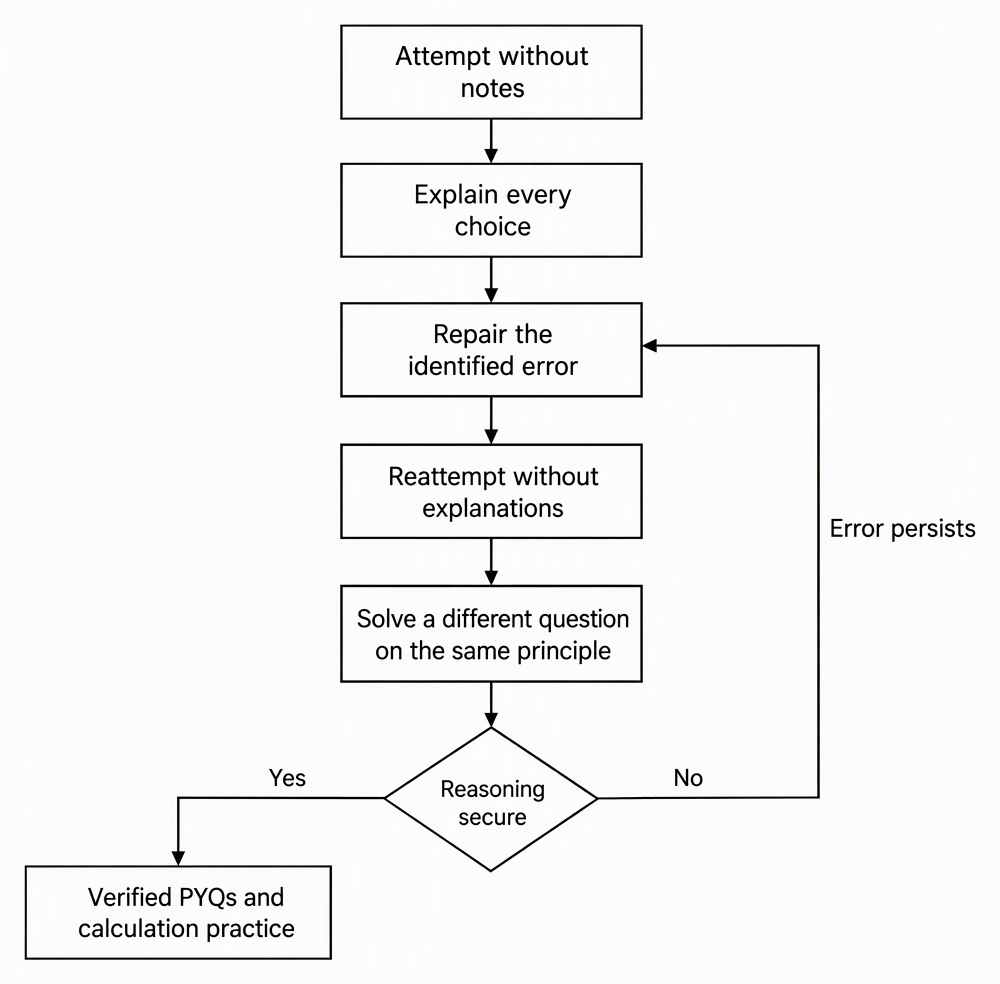
Reattempt missed questions without seeing the explanation, then solve a different question testing the same principle. Remembering a correction does not establish that you can apply it elsewhere.
For whole-paper practice, the current structure is 180 compulsory questions in 180 minutes, with no optional Section B. NEET JEEnius AI offers 30 free full-length mocks a month with scored per-subject breakdowns when that is your next learning task.
- Buffer or solubility error: Repair that ionic model next.
- Correct choice without a reason: Reattempt and reject every distractor.
- Secure concepts and calculations, but poor accuracy across subjects: Make your next session a full mock.
Next step: full-length mock tests on NEET JEEnius AI and sit a full 180-question, 720-mark, 180-minute paper, 45 Physics, 45 Chemistry and 90 Biology, and get a scored per-subject breakdown (30 free a month).
Related on NEET JEEnius AI: Frog Anatomy NEET 2026: 10 Pairs of Cranial Nerves.
Frequently asked questions
Where can I practise equilibrium questions for NEET for free?
This article provides six free, original MCQs with explanations: three on chemical equilibrium and three on ionic equilibrium. They cover equilibrium expressions, reaction direction, compression, acid strength, buffers and solubility. No download is required.
Are these equilibrium questions actual NEET PYQs?
No, these six questions are original conceptual MCQs, not previous-year questions. For verified NEET PYQs, check the original wording and corresponding official answer key using material traceable to NTA at neet.nta.nic.in.
Are six equilibrium MCQs enough for NEET preparation?
No, this set checks foundations but cannot establish calculation readiness. Follow it with equilibrium-concentration calculations, conversions between pressure-based and concentration-based constants, weak-acid or weak-base approximations, buffer calculations and molar-solubility problems.
Should I solve equilibrium chapter questions or full NEET mocks?
Use chapter questions to repair specific concept, setup or calculation errors. Move to full mocks when your chapter-level reasoning and calculations are secure but accuracy across the complete paper needs work. NEET JEEnius AI offers 30 free full-length mocks a month with scored per-subject breakdowns; these supplement rather than replace chapter practice.