
Should I start Electrostatics practice with topic questions, PYQs or mocks?
For free Electrostatics practice questions for NEET, start with topic-wise MCQs and worked explanations if you confuse field, potential, force and energy. Use verified NEET PYQs to check historical exam framing, not predict the next paper. Choose full mocks for mixed-subject decisions and pacing, not as the first remedy for unresolved concepts.
Below is a free original six-question mini-set with answers separated, not an official paper or PYQ collection.
How do topic-wise MCQs, NEET PYQs and full mocks compare?
Topic drills isolate concept errors; verified PYQs check exam framing; full mocks test selection and pacing. Choose the format that exposes your present mistake. A correct answer based on memory or guessing does not establish understanding.
- Original topic-wise MCQs
- Best use: Repair one distinction, such as scalar potential versus vector field.
- Prerequisite: Learn the relevant concept before attempting its drill.
- Explanation needed: The governing principle, calculation and reason a tempting option fails.
- Diagnostic value: Isolates the source of a concept or sign error.
- Timing relevance: Establish sound reasoning before practising for speed.
- Main limitation: A chapter label can make the required formula too obvious.
- Access: This article’s original set is free.
- Verified NEET PYQs
- Best use: Check actual historical question style and wording.
- Prerequisite: Enough chapter knowledge to attempt without copying a solution.
- Explanation needed: A reliable answer key plus reasoning for rejected options.
- Diagnostic value: Tests understanding when wording changes.
- Timing relevance: Useful for timed solving when answers are not already remembered.
- Main limitation: Repeated exposure can turn solving into recall.
- Access: Check the source’s provenance, answer-key reliability and access restrictions.
- Full-length NEET mocks
- Best use: Practise question selection, subject switching and pacing.
- Prerequisite: Sufficient syllabus coverage for a meaningful mixed-paper attempt.
- Explanation needed: Review attempted, skipped and guessed questions afterward.
- Diagnostic value: Exposes execution problems under a whole-paper clock.
- Timing relevance: Direct practice for managing a complete paper.
- Main limitation: No individual mock guarantees coverage of every Electrostatics weakness.
- Access: NEET JEEnius AI offers 30 free full-length mocks a month, each with 180 questions, 720 marks, 180 minutes and a scored per-subject breakdown.
Availability and format are separate issues. “Free” does not establish that a question is an authentic PYQ or that its answer is reliable.
Which Electrostatics practice should I choose right now?
Choose from your solving errors, not your class or dropper label alone. Wrong principles need topic repair; remembered answers need unseen questions; correct chapter work with poor mixed-paper performance calls for mocks.
- Class 11, studying ahead: Learn the relevant Electrostatics concept before taking its drill. Difficulty with material you have not yet studied is not evidence of weak Class 11 preparation.
- Class 12, substituting correctly but losing signs: Start with field-versus-potential and force-versus-energy drills. Before calculating, state whether the quantity is a vector or scalar and what determines its direction or sign.
- Familiar examples work, changed wording does not: Use verified PYQs. Explain why each rejected option is wrong, rather than matching the question to a solved example.
- Dropper who remembers PYQ answers: Attempt unseen original questions first. A correct repeated answer demonstrates familiarity, not necessarily the ability to reconstruct the reasoning.
- Chapter questions work, mixed papers do not: Move to full mocks. Review questions attempted in the wrong order, long unproductive attempts and avoidable reading errors.
Prefer explanations that name the principle before substituting values. A solution that jumps straight to an option cannot tell you whether your method was valid.
Can I attempt free Electrostatics practice questions for NEET now?
Attempt these six original, single-correct practice MCQs before checking the explanations. Record both your option and the principle used, such as superposition or charge conservation. Mark any guess, even if it later matches the key.
This short set is diagnostic, not exhaustive chapter coverage. Its symbolic situations test concept distinctions, not lengthy calculation.
1. What happens to the force when separation doubles?
Two fixed point charges initially exert the following force magnitude:
They are repositioned at twice their original separation and held fixed again. Neither charge changes. What is the new force magnitude?
2. What are the field and potential at the midpoint?
Two equal positive point charges are separated in vacuum:
Take potential at infinity as zero. Using the Coulomb constant below, select the midpoint’s electric-field magnitude and potential.
3. What does an external charge imply about flux?
A single nonzero point charge lies outside a closed Gaussian surface. No charge lies inside it. Which statement is correct?
- A: Net flux is zero, so the electric field vanishes everywhere on the surface.
- B: Net flux is zero, but the local electric field need not vanish.
- C: Net flux must be positive because the charge produces a field.
- D: Net flux depends only on the surface’s area.
4. How much work does the electrostatic field do?
A test charge moves between two points at the same electric potential. What is the work done by the electrostatic field?
- A: Always positive.
- B: Always negative.
- C: Zero only if the path is straight.
- D: Zero for any path between those points.
5. What changes when a dielectric enters a disconnected capacitor?
An ideal charged parallel-plate capacitor is disconnected from its battery. A dielectric completely fills its gap without changing plate geometry or allowing charge leakage. Its relative permittivity is:
The initial capacitance, voltage and stored energy are:
Which gives their final values?
6. Which dipole orientation is stable?
An electric dipole can rotate freely in a nonzero uniform electric field. Which orientation of its dipole moment gives stable equilibrium?
- A: Parallel to the field.
- B: Antiparallel to the field.
- C: Perpendicular to the field.
- D: Every orientation, because the net force is zero.
What are the answers, and what does each mistake reveal?
The answer key is 1 A, 2 C, 3 B, 4 D, 5 C, 6 A. Check your written principle as carefully as your letter. Flag correct guesses for review; a wrong answer with a sound setup may need an algebra repair rather than a concept lesson.
1. A: Separation enters as an inverse square.
The charges remain unchanged, so only separation changes in Coulomb’s law. Doubling it gives:
Option B treats the relationship as inverse-linear. Options C and D wrongly increase the force when the charges move farther apart. Changing separation is not the same as changing a charge.
2. C: Field cancels as a vector; potential adds as a scalar.
At the midpoint, each positive charge produces a field directed away from itself. These fields have equal magnitudes and opposite directions, while both potential contributions are positive.
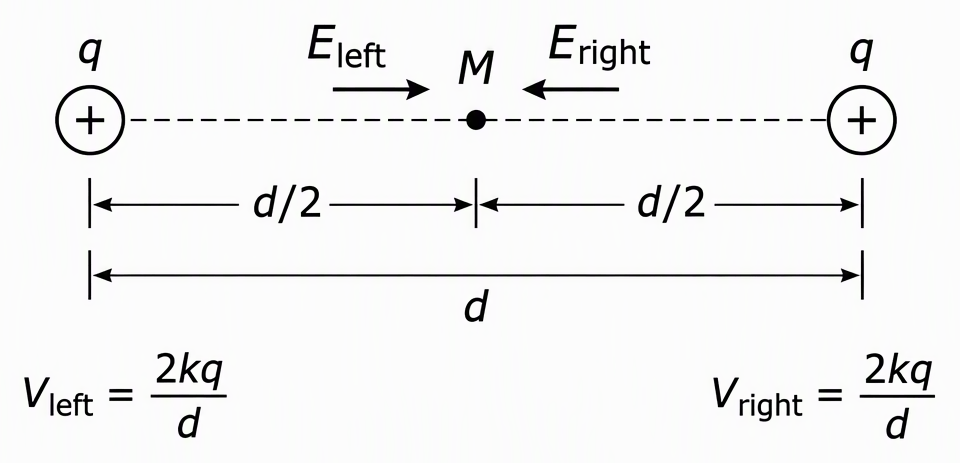
The Coulomb constant is defined above. Option A incorrectly transfers vector cancellation to potential. Option D adds field magnitudes while ignoring their opposite directions.
3. B: Zero net flux does not mean zero local field.
Gauss’s law gives net flux as enclosed charge divided by vacuum permittivity. No charge is enclosed here:
The external charge still produces a local field; inward and outward flux contributions cancel. Option A confuses the total flux through the surface with the field at each point.
4. D: Equal endpoint potentials give zero field work.
Work done by the field equals the test charge multiplied by initial potential minus final potential. Equal potentials therefore give:
Electrostatic work depends on endpoints, not the path. Option C incorrectly requires a straight path. The electric field itself need not be zero on an equipotential surface.
5. C: Disconnection fixes charge, not voltage.
With no leakage or battery connection, the plate charge stays fixed. Complete dielectric insertion increases capacitance:
Option B applies the constant-voltage condition of a battery-connected capacitor. Option D reverses the dielectric’s effect on capacitance.
6. A: Stable equilibrium requires minimum energy, not merely zero torque.
The torque magnitude and potential energy depend on the angle between the dipole moment and field. Using their magnitudes and that angle:
Parallel alignment has minimum energy, so a small angular displacement produces a restoring torque. Antiparallel alignment also has zero torque, but maximum energy, making it unstable. Option B misses that distinction; option D confuses zero net force with zero rotational effect.
What should I practise next, and when should I take a full mock?
Repair each error, then test the same distinction with an unseen question. Move to full mocks when chapter reasoning is dependable but mixed-paper selection or pacing is costing you marks. A timed paper tests execution; it does not replace learning the difference between field and potential.
- Label the error: concept, vector/sign, algebra/unit or question-reading. Label correct guesses too.
- Revisit the idea: Explain the distinction in words before writing a formula.
- Solve an unseen question: Change the arrangement or constraint, not just the numerical values.
- Return to verified PYQs: Attempt without seeing the year or solution first, verify against a reliable key, then explain why the other options fail.
Extend practice beyond this mini-set to continuous charge distributions, symmetry-based Gauss-law applications and capacitor combinations. These are follow-up areas, not an exhaustive syllabus list. For repairs across chapters, use NEET Physics Revision Strategy: A 30-Day Repair Plan.
The current full paper has 180 compulsory questions in 180 minutes: 45 Physics, 45 Chemistry and 90 Biology. There is no optional Section B. The whole-paper average of one minute per question is a planning reference, not a compulsory limit for each Physics question.
If you self-score, use the official scheme: +4 correct, -1 incorrect and 0 unattempted. Do not convert this mini-set’s result into a predicted NEET score.
Once the concept repairs hold on unseen questions, use a full paper to examine execution. NEET JEEnius AI offers 30 free full-length mocks a month with a scored per-subject breakdown, without any promise of a fixed Electrostatics question count or chapter-level analytics. After the paper, select one question you mishandled and write down the exact decision to change next time.
Next step: full-length mock tests on NEET JEEnius AI and sit a full 180-question, 720-mark, 180-minute paper, 45 Physics, 45 Chemistry and 90 Biology, and get a scored per-subject breakdown (30 free a month).
Frequently asked questions
Should I start NEET Electrostatics practice with topic questions or PYQs?
Start with topic-wise questions and worked explanations if you confuse field, potential, force and energy. Use verified NEET PYQs once you can apply the concepts independently, to check historical exam wording and framing. If you remember PYQ answers, attempt unseen original questions to test your reasoning.
Where can I find free Electrostatics questions for NEET with answers?
This article provides six free original, single-correct Electrostatics MCQs, followed by a separate answer key and worked explanations. They cover force, field and potential, flux, electrostatic work, capacitors and dipoles. The set is diagnostic practice, not an official paper, PYQ collection or exhaustive chapter test.
What happens when a dielectric is inserted into a disconnected capacitor?
For an ideal capacitor with no charge leakage, disconnection keeps the plate charge fixed. If a dielectric of relative permittivity K completely fills the gap without changing plate geometry, capacitance becomes K times its initial value. Voltage and stored energy each fall to 1/K of their initial values.
When should I move from Electrostatics chapter questions to full NEET mocks?
Move to full mocks when your chapter reasoning holds on unseen questions but mixed-paper selection or pacing is costing marks. Review attempted, skipped and guessed questions to identify execution errors. Full mocks test whole-paper decisions; they do not replace repairing unresolved Electrostatics concepts.