
Which Environmental Issues questions should I practise first for NEET?
Use original chapter MCQs to diagnose concepts, authenticated older PYQs to inspect past question construction, and full-length mocks to test whole-paper execution. For free Environmental Issues practice questions, NEET students can attempt the original MCQs below, then check the explained answers. A legacy Environmental Issues chapter label does not establish inclusion in your target-year NEET syllabus.
Do not begin by completing an old chapter bank. First check what you understand, then check which concepts belong on your current revision list. Conceptual usefulness is not proof of syllabus relevance.
How do chapter MCQs compare with older PYQs and full-length mocks?
Chapter MCQs isolate understanding; older PYQs show historical exam wording; mocks test performance across subjects. Choose the format that addresses your current problem. Use these criteria rather than question-bank size or unsupported website rankings.
- Immediate usefulness
- Original MCQs here: Attempt now, then use the explanations to identify misconceptions.
- Authenticated older PYQs: Useful once the source and answer key are verified.
- Full-length mocks: Useful with enough syllabus coverage to attempt a whole paper meaningfully.
- Concept isolation
- Original MCQs here: Each targets a specific distinction.
- Authenticated older PYQs: May combine ideas rather than isolate your weakness.
- Full-length mocks: Mix subjects and topics, so errors need sorting afterwards.
- Evidence of past exam wording
- Original MCQs here: None. These are original practice, not PYQs.
- Authenticated older PYQs: Show wording from an identifiable past paper.
- Full-length mocks: Mock status alone does not establish past-paper provenance.
- Syllabus-check burden
- Original MCQs here: Match each legacy concept against the official target-year syllabus.
- Authenticated older PYQs: Historical appearance does not prove current inclusion.
- Full-length mocks: Check stated coverage. A full mock need not contain Environmental Issues questions.
- Explanation requirements
- Original MCQs here: Explain the mechanism and the strongest distractor.
- Authenticated older PYQs: Check the official key where available, then require sound reasoning.
- Full-length mocks: Review wrong answers, uncertain correct answers and time-consuming decisions.
- Whole-paper suitability
- Original MCQs here: Cannot judge pacing across subjects.
- Authenticated older PYQs: An isolated chapter selection cannot test whole-paper execution.
- Full-length mocks: Test pacing, subject balance and guessing decisions.
An older PYQ needs an identifiable exam paper and question reference, including the booklet or paper code where relevant. A “NEET question” label without a traceable source is insufficient. Original questions must be labelled as original.
When whole-paper practice is the right next step, NEET JEEnius AI offers 30 free full-length mocks a month, each with 180 questions, 720 marks and 180 minutes: 45 Physics, 45 Chemistry and 90 Biology questions, with a scored per-subject breakdown. That offer is for full-length mocks, not evidence of a free Environmental Issues bank.
Should Class 11 students, Class 12 students and droppers choose differently?
Choose by readiness and the error you need to fix, not by class label. A Class 11 learner studying ahead and a Class 12 student revising may need the same concept check. Use these formats as a sequence when needed, not as competing products.
- Class 11 learners studying ahead: Choose original MCQs after studying a concept if closely related terms still blur together.
- Class 12 students revising: Use original MCQs to expose weak distinctions. Once you can explain the mechanisms, choose authenticated older PYQs to inspect past question framing, after checking relevance.
- Droppers using old coaching modules: Check the target-year syllabus before repeating the entire Environmental Issues exercise.
- Students with sufficient syllabus coverage: Choose full-length mocks to diagnose whole-paper pacing, subject imbalance or costly guessing.
- Parents choosing resources: Buying or completing a larger bank does not repair a concept gap or make outdated coverage relevant. Check what the student learned from the last error, not just the question count.
Can I try free Environmental Issues MCQs before seeing the answers?
Attempt the questions below and write a short reason beside each choice before checking the answers. Every question has one correct option. These are original practice questions, not NEET PYQs or predicted exam questions.
Scope note: These questions cover legacy Environmental Issues concepts. The supplied information does not establish their inclusion in your target-year syllabus. Match the concepts against the official target-year syllabus available through neet.nta.nic.in before treating this whole set as compulsory NEET revision.
Question 1. Fertiliser runoff enters a lake. Which sequence best explains how nutrient enrichment can eventually reduce dissolved oxygen?
- A. Nitrate and phosphate directly consume oxygen as soon as they dissolve.
- B. Nutrient enrichment promotes algal growth; decomposition of increased organic matter raises microbial oxygen demand.
- C. Nutrients prevent all photosynthesis, so the lake immediately loses its oxygen source.
- D. Algal growth permanently increases oxygen at every depth, preventing oxygen depletion.
Question 2. Under comparable standard test conditions, a water sample has a higher biochemical oxygen demand, or BOD. What does this most directly indicate?
- A. The sample necessarily contains a higher concentration of every pollutant.
- B. The sample necessarily has more dissolved oxygen available for fish.
- C. The sample contains more ozone dissolved from the atmosphere.
- D. Microorganisms require more oxygen to break down biodegradable organic matter in the sample.
Question 3. A persistent, poorly eliminated pollutant enters an aquatic food chain. Which observation best demonstrates biomagnification?
- A. Its concentration increases from plankton to small fish to fish-eating birds.
- B. Its concentration increases in one fish as that fish ages.
- C. Its concentration decreases at each successive trophic level.
- D. Its total mass increases only because the lake contains more water.
Question 4. Why does depletion of stratospheric ozone pose a biological risk?
- A. It removes the main gas responsible for retaining outgoing infrared radiation.
- B. It directly increases nitrate and phosphate concentrations in lakes.
- C. It reduces atmospheric screening of harmful ultraviolet radiation.
- D. It prevents oxygen from dissolving in surface water.
Question 5. Which statement best describes the greenhouse effect?
- A. Greenhouse gases mainly protect organisms by absorbing incoming ultraviolet radiation.
- B. Greenhouse gases absorb and emit outgoing infrared radiation, reducing heat loss to space at a given surface temperature.
- C. The greenhouse effect occurs only when the stratospheric ozone layer is depleted.
- D. Greenhouse gases warm Earth mainly by releasing oxygen during decomposition.
What are the answers, and which misconception does each reveal?
The correct choices are 1 B, 2 D, 3 A, 4 C and 5 B. Check whether your reason identifies the mechanism and rules out the tempting alternative. A correct guess does not establish understanding.
Why is B correct for eutrophication?
Nutrient enrichment can increase algal growth; decomposition of the resulting organic matter can raise microbial oxygen demand. If oxygen consumption exceeds replenishment, dissolved oxygen falls. Nutrients promote growth rather than directly consuming oxygen merely by dissolving.
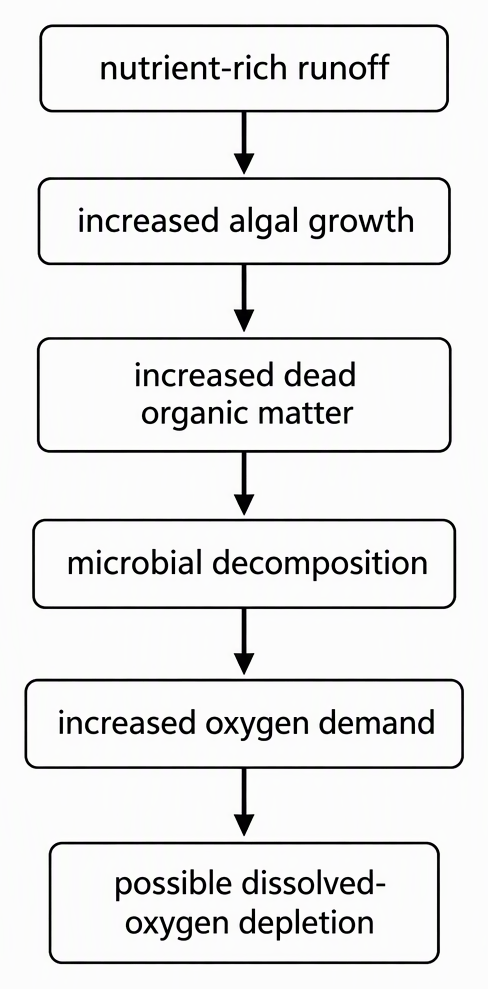
Option A identifies nutrient input but skips the biological steps. Option D also fails: photosynthesis produces oxygen but does not guarantee adequate oxygen throughout the lake.
- Error-log label: Nutrient input confused with decomposition-driven oxygen demand.
Why is D correct for BOD?
BOD measures oxygen demand associated with microbial breakdown of biodegradable organic matter under specified test conditions. A higher result indicates greater demand in that test, not a direct measurement of every pollutant.
Option B confuses oxygen needed with oxygen available. High demand does not mean fish have more oxygen; it can contribute to oxygen depletion.
- Error-log label: Oxygen demand confused with dissolved oxygen supply.
Why is A correct for biomagnification?
Biomagnification is increasing pollutant concentration across successive trophic levels. Persistent pollutants that are poorly metabolised or eliminated can pass through feeding relationships and reach higher concentrations in consumers higher in the food chain.
Option B describes bioaccumulation within one organism over time. The deciding distinction is whether concentrations are compared within an individual or across trophic levels.
- Error-log label: Bioaccumulation confused with biomagnification.
Why is C correct for ozone depletion?
Stratospheric ozone absorbs harmful ultraviolet radiation, so depletion weakens that screening. This differs from heat retention through the absorption and emission of infrared radiation by greenhouse gases.
Option A substitutes the greenhouse mechanism for ozone’s UV-screening role. Although ozone also has radiative effects, the biological risk asked about here concerns increased ultraviolet exposure.
- Error-log label: UV screening confused with heat retention.
Why is B correct for the greenhouse effect?
Greenhouse gases absorb and emit infrared radiation, reducing heat loss to space at a given surface temperature compared with an atmosphere without that absorption. This is not the same process as stratospheric ozone screening incoming UV.
Option C wrongly makes ozone depletion a requirement: the greenhouse effect exists without an ozone hole. Option A swaps infrared heat transfer for UV protection.
- Error-log label: Greenhouse effect incorrectly made dependent on ozone depletion.
What should I do after checking this practice set?
Correct the cause of each error before choosing a larger test. Attempt, explain your reasoning, classify the error, revisit the concept and retry without the answer. Use the retry to check whether you can explain both the correct option and the strongest distractor.
- Attempt: Record your option and whether you knew it or guessed.
- Explain: Write one sentence describing the mechanism, not “I remembered B”.
- Classify: Separate a concept error from a misread qualifier or unsupported guess.
- Repair: Apply the matching correction below.
- Retry: Cover the explanation, solve again and reject the strongest distractor explicitly.
- Concept error: Revisit the underlying concept, explain the distinction in your own words, then attempt another question on it.
- Misread qualifier: Identify the word that changed the task, such as “directly”, “concentration” or “successive”. Check that word before selecting.
- Unsupported guessing: State the evidence for eliminating each option. Familiarity with a term is not evidence.
For a detailed checking routine, use NEET Silly Mistakes: Find the Cause and Fix the Check. To score this attempt, apply the official rule: award 4 marks for each correct answer, deduct 1 for each wrong answer, and give 0 for each unattempted question. This short set cannot establish a NEET rank, percentile or admission chance.
Stay with concept practice if your reasoning remains weak. Choose authenticated, relevant older PYQs when concepts are secure, and full mocks when the difficulty is performance across subjects.
For that whole-paper step, NEET JEEnius AI’s 30 free full-length mocks a month are an option, not a claim of chapterwise Environmental Issues access. Before scheduling another legacy exercise, match its concepts against the official target-year syllabus: question-bank size and old chapter labels are not substitutes for checking relevance.
Next step: full-length mock tests on NEET JEEnius AI and sit a full 180-question, 720-mark, 180-minute paper, 45 Physics, 45 Chemistry and 90 Biology, and get a scored per-subject breakdown (30 free a month).
Frequently asked questions
Are these Environmental Issues questions NEET PYQs?
No. These five MCQs are original practice questions, not NEET PYQs or predicted exam questions. An authenticated older PYQ needs an identifiable exam paper and question reference, including the paper or booklet code where relevant.
Is Environmental Issues included in my NEET syllabus?
This article does not establish inclusion in your target-year NEET syllabus. Match each legacy Environmental Issues concept against the official target-year syllabus available through neet.nta.nic.in. An old chapter label or past exam appearance does not prove current inclusion.
Should I practise chapter MCQs, PYQs or full-length mocks first?
Start with original chapter MCQs when you need to diagnose conceptual weaknesses. Once your reasoning is secure, use authenticated, syllabus-relevant older PYQs to study past question framing. Choose full-length mocks when you have enough syllabus coverage and need to test pacing, subject balance and guessing decisions.
How should I score and review these five MCQs?
Award 4 marks for each correct answer, deduct 1 for each wrong answer and give 0 for each unattempted question. Review wrong answers and correct guesses by classifying the cause as a concept error, misread qualifier or unsupported guess. Repair the weakness, then retry without the explanation and explicitly reject the strongest distractor.