
Should I start GOC practice with explained questions or a full mock?
Start with worked topicwise questions if a GOC concept is weak, not a full mock. This page includes six free original general organic chemistry practice questions for NEET with answers and explanations. They are author-created practice, not official PYQs or verified NEET JEEnius AI question-bank items.
Use worked MCQs to repair concepts, verified NEET previous-year questions to check exam relevance, and full-length mocks to test recall across subjects under time pressure. A full mock is useful for integration but inefficient as the first tool for repairing one GOC concept.
How do worked GOC questions, official PYQs and free full mocks compare?
Choose worked questions for concept repair, PYQs for past-paper framing, and mocks for whole-paper execution. The comparison follows the same order throughout: this page’s worked questions; verified official PYQs with final answer keys; NEET JEEnius AI full-length mocks.
- Purpose: This page provides focused concept checks; PYQs test recognition in actual past questions; mocks test recall, subject switching and time management.
- GOC targeting: This page targets selected GOC ideas; PYQs require you to locate relevant questions; mocks cover all three subjects, with no guaranteed GOC question count or claimed GOC filter.
- Answer support: This page supplies worked explanations; an official final key identifies the accepted answer but does not teach the reasoning; mocks provide a scored per-subject breakdown, without a claim here about worked solutions.
- Exam-context realism: This page isolates concepts; PYQs preserve authentic past-paper wording; mocks provide 180 questions, 720 marks and 180 minutes, split into 45 Physics, 45 Chemistry and 90 Biology questions.
- Free access: These six questions are available here; use official papers and final keys through NTA’s resources, starting at neet.nta.nic.in; the platform provides 30 free full-length mocks a month.
- Principal limitation: These six questions do not cover all GOC; a PYQ answer letter cannot diagnose your reasoning; a subject-level mock score cannot isolate a GOC weakness.
An online practice resource is not evidence of the official exam delivery mode. NEET used offline pen-and-paper OMR through 2026. For your attempt, consult neet.nta.nic.in rather than inferring the mode from a practice website.
Which practice route should I choose in Class 11, Class 12 or a drop year?
Choose by your reasoning errors, not your batch label. A dropper may need resonance repair, while a Class 11 student may be ready for selected PYQs. Explaining rejected options is a better readiness check than recognising familiar questions.
- Class 11, confusing induction with resonance: Start with worked topicwise questions. Before checking options, explain whether electron withdrawal occurs through sigma bonds or electrons delocalise through a conjugated system.
- Class 12, understanding concepts but missing unfamiliar wording: Use verified PYQs. Classify every error by concept rather than writing only “silly mistake”.
- Dropper, strong on familiar chapter questions but weak in mixed papers: Prioritise full mocks. Return to focused GOC practice where review reveals a conceptual gap.
A correct guess does not finish a concept. If you cannot explain why the strongest distractor fails, mark the question for review even when your letter matches the key.
Parents can ask, “Why did you reject that option?” This checks reasoning rather than only how many questions were completed.
Can I try free GOC questions before reading the answers?
Attempt the six single-correct MCQs below, each with four options, before reading the explanations in the next section. Record your chosen letter and a short reason, and mark any guesses.
These author-created questions sample core reasoning skills. They are neither a complete chapter test nor a prediction of NEET difficulty.
1. Which statement correctly compares acidity in water?
- A. Chloroethanoic acid is more acidic because chlorine withdraws electron density.
- B. Chloroethanoic acid is more acidic because chlorine donates electron density.
- C. Ethanoic acid is more acidic because its methyl group withdraws electron density.
- D. Ethanoic acid is more acidic because its methyl group donates electron density.
2. Which conjugate base has its negative charge delocalised into an aromatic ring?
- A. Methoxide.
- B. Ethoxide.
- C. Isopropoxide.
- D. Phenoxide.
3. Which is the most stable simple alkyl carbocation under comparable conditions? Consider only the species listed, with no resonance-stabilised carbocations.
- A. Methyl carbocation.
- B. Ethyl carbocation.
- C. Isopropyl carbocation.
- D. Tert-butyl carbocation.
4. Which species can accept an electron pair at an electron-deficient boron centre?
- A. Boron trifluoride, BF₃.
- B. Ammonia, NH₃.
- C. Hydroxide ion, OH⁻.
- D. Cyanide ion, CN⁻.
5. What forms when the chlorine–chlorine bond undergoes homolytic cleavage?
- A. One chloride ion and one chlorine cation.
- B. Two neutral chlorine radicals.
- C. One chlorine radical and one chloride ion.
- D. Two chloride ions.
6. Which statement correctly compares basicity in aqueous solution?
- A. Aniline is more basic because an aromatic ring always increases nitrogen’s attraction for a proton.
- B. Methylamine is more basic because its nitrogen lone pair is more available for protonation.
- C. Methylamine is more basic because nitrogen in aniline has no lone pair.
- D. Both are equally basic because both contain an amino group.
Why are these answers correct, and which mistakes do they expose?
The correct options are 1A, 2D, 3D, 4A, 5B and 6B. Check your reason against each explanation, not just your letter against the key. A correct choice based on a false rule still needs repair.
1. Answer A. Error tag: inductive effect.
Chlorine withdraws electron density through the sigma framework. This stabilises chloroacetate relative to acetate, making chloroethanoic acid more acidic in water. Compare the conjugate bases rather than judging the neutral acids alone.
Option B selects the right acid for the wrong reason. Chlorine’s lone pairs do not make it an electron donor through the intervening saturated carbon in this comparison.
2. Answer D. Error tag: resonance.
Phenoxide has an oxygen lone pair conjugated with the aromatic ring. Its resonance contributors place negative charge on oxygen and at the ring’s ortho and para positions, showing delocalisation rather than charge fixed entirely on oxygen.
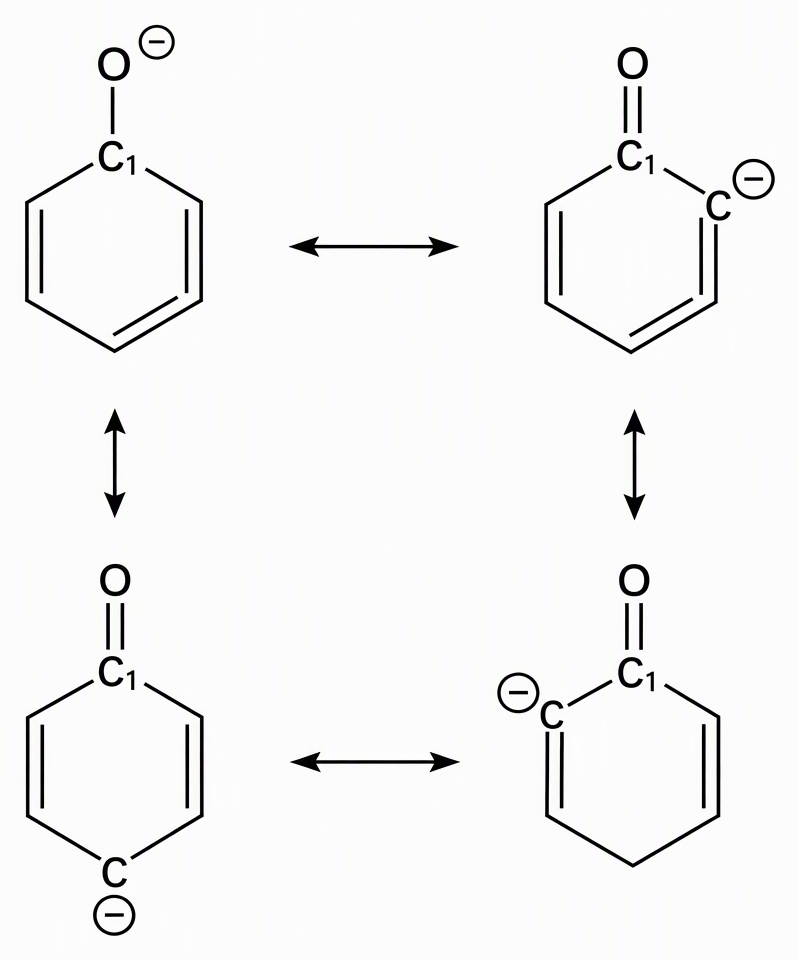
Isopropoxide is tempting if you confuse extra alkyl groups with resonance. Its alkyl groups do not provide an aromatic conjugated system. This does not mean every resonance-stabilised species is more stable than every species without resonance.
3. Answer D. Error tag: carbocation stability.
Hyperconjugation and electron donation from alkyl groups stabilise the electron-deficient carbon. For these simple alkyl carbocations under comparable conditions, the order is:
Isopropyl is the closest distractor, but tert-butyl has greater stabilisation in this comparison. Do not extend this order to allylic, benzylic or other carbocations.
4. Answer A. Error tag: electrophile recognition.
Boron in BF₃ has an incomplete octet and can accept an electron pair. That makes BF₃ a Lewis acid and an electrophile despite its overall electrical neutrality.
Ammonia is tempting because it participates in acid–base reactions. Its nitrogen lone pair makes it an electron-pair donor, not the boron-centred acceptor requested here.
5. Answer B. Error tag: bond fission.
Homolysis gives each chlorine atom one electron from the shared bonding pair. The products are two neutral chlorine radicals, each with an unpaired electron.
Option A describes heterolysis: one fragment receives both bonding electrons, producing oppositely charged fragments. Track where both electrons go, not just whether the bond breaks.
6. Answer B. Error tag: basicity.
Aniline is less basic than methylamine in water because its nitrogen lone pair is delocalised into the aromatic ring. It is therefore less available for protonation than methylamine’s nitrogen lone pair.
Option C chooses the correct stronger base but falsely claims aniline’s nitrogen has no lone pair. The lone pair exists; delocalisation changes its availability. An amino group alone does not guarantee equal basicity.
What should I practise after this diagnostic?
Repair guessed and incorrect answers before moving to another set. Label each response confident with a reason, guessed or incorrect. Review correct guesses and correct answers supported by false explanations.
Keep a compact error log:
- Concept: Basicity.
- Mistaken reasoning: “Aniline has no nitrogen lone pair.”
- Corrected rule: “The lone pair exists but is less available because of delocalisation.”
- Fresh transfer question: Compare ethylamine and aniline, then explain which lone pair is more available.
If you misapplied a rule, revisit it and attempt a structurally different example. Memorising “option B” or the original molecule pair does not test whether you can apply the rule elsewhere.
For PYQs, require a traceable official paper and its final answer key. Do not label an unattributed coaching question as a PYQ. Move to mixed-paper practice once you can justify choices without answer cues.
Use the official marking scheme when reviewing mock scores. Separate reasoning mistakes from questions left unattempted under time pressure.
What else should I know about free GOC practice for NEET?
Free material can support effective practice when it combines accurate questions, explanations and systematic review. Payment is not the deciding factor, and no resource can promise selection or a particular score. Judge a worksheet by whether it helps you identify and correct a reasoning error.
Are these questions official NEET PYQs?
No. They are original, author-created practice questions, not official PYQs or verified platform question-bank items. For authentic past questions, use a traceable official paper and final key.
How many GOC questions will NEET contain?
No official fixed GOC question count is supplied here. GOC ideas also support reasoning in other organic chemistry questions, so chapter labels do not capture every use of resonance, acidity or electrophile recognition. Check official information at neet.nta.nic.in rather than treating practice-set counts as weightage.
Is a free GOC PDF with only answer letters useful?
It is useful for testing, but weaker for diagnosing conceptual mistakes. Prefer explanations that identify the governing rule and show why a tempting distractor fails.
Should droppers begin with full mocks?
Not merely because they are droppers. Begin with mocks when concepts are secure but mixed-paper execution is weak; use worked questions when the reasoning itself breaks down.
Before your next session, choose one guessed or incorrect answer above. Write the corrected rule, then solve a fresh example without looking at the options first.
A NEET JEEnius AI full-length mock can then provide a scored per-subject breakdown. Treat Chemistry’s score as a broad performance check, not a GOC diagnosis; inspect the relevant mistakes separately.
Next step: full-length mock tests on NEET JEEnius AI and sit a full 180-question, 720-mark, 180-minute paper, 45 Physics, 45 Chemistry and 90 Biology, and get a scored per-subject breakdown (30 free a month).
Related on NEET JEEnius AI: Classification of Animals NEET 2026: The Crocodile Exception.
Frequently asked questions
Should I start GOC practice with solved questions or full mocks?
Start with worked topicwise questions when a GOC concept is weak. Use verified NEET PYQs to check past-paper framing, and move to full mocks when you need to test recall, subject switching and time management.
Are these GOC questions official NEET PYQs?
No. These six MCQs are original, author-created practice questions, not official PYQs or verified NEET JEEnius AI question-bank items. For authentic PYQs, use a traceable official paper and its final answer key.
How should I review mistakes in GOC practice questions?
Mark each response as confident with a reason, guessed or incorrect, and review correct answers supported by faulty reasoning too. Record the concept, mistaken reasoning and corrected rule in an error log. Then solve a structurally different example to check whether you can apply the rule.
How many GOC questions will NEET have?
This article does not establish an official fixed GOC question count. GOC concepts also support other organic chemistry questions, so practice-set counts should not be treated as chapter weightage. Check official information at neet.nta.nic.in.