
Should I start with chapter MCQs, PYQs or full mocks?
Choose solved chapter MCQs to repair concepts, verified previous-year questions to understand actual exam phrasing, and full mocks to test execution across subjects. For free electromagnetic waves practice questions NEET students can solve immediately, an original set with explanations appears below.
Use that sequence according to your weak spot, not because one format is universally best. Full mocks test mixed-paper execution and do not guarantee Electromagnetic Waves coverage.
How do free chapter MCQs compare with NEET PYQs and full mocks?
Chapter questions isolate understanding, PYQs expose actual exam wording, and mocks test whole-paper decisions. Choose by the problem you need to diagnose, not by question-bank size.
- Best use
- This page’s original solved MCQs: Repair a specific concept.
- Verified NEET PYQs: Study authentic question phrasing.
- NEET JEEnius AI full-length mocks: Practise whole-paper execution, with 30 free full-length mocks a month and a scored per-subject breakdown.
- Electromagnetic Waves coverage
- Chapter MCQs: Five focused questions below.
- PYQs: Depends on the verified questions available.
- Full mocks: Do not assume this chapter appears in every paper.
- Explanation availability
- Chapter MCQs: Worked explanations on this page.
- PYQs: An official answer key alone is not a worked explanation.
- Full mocks: The documented scored breakdown does not establish worked solutions.
- Exam authenticity
- Chapter MCQs: Author-created, not past-paper questions.
- PYQs: Authentic when checked against official papers and final answer keys.
- Full mocks: Exam-format practice, not official past papers.
- Ability to isolate a weak concept
- Chapter MCQs: Each question targets a named concept.
- PYQs: Useful when grouped by concept and reviewed.
- Full mocks: Require separating conceptual errors from execution mistakes.
- Main limitation
- Chapter MCQs: Cannot establish full-paper readiness.
- PYQs: Remembered answers can hide weak reasoning.
- Full mocks: Not a chapter-teaching substitute.
Which practice route should I pick right now?
Choose by what you can explain, not your class label or the number of resources you own. If field directions confuse you, repair the concept. If you understand them but make mistakes while switching subjects, choose mixed-paper practice.
- Class 11, studying ahead: First check that wave terminology, wavelength, frequency, and basic electric and magnetic fields are familiar. Then use solved chapter MCQs. Do not use a full mock to teach yourself unfamiliar chapter ideas.
- Class 12, chapter just completed: Attempt the original set below without looking at the answers. Use the explanations to identify the misconception behind each error, rather than copying the correct option.
- Familiar questions correct, unfamiliar wording troublesome: Prioritise verified PYQs. Explain why every rejected option is wrong, especially when two options differ by one word.
- Dropper, chapter understood but mixed-paper marks slipping: Choose full mocks and review Physics mistakes. Repeating the same chapter sheet does not test question selection or reading under mixed-paper conditions.
- PYQ answer letters already memorised: Switch to fresh original questions. Recognising an answer is not the same as being able to defend it.
Can I solve five free Electromagnetic Waves MCQs before checking the answers?
Attempt all five single-correct questions before checking the answer key below. Every question is original NEET-style practice, not a PYQ, an official question or a prediction.
Record your option and a short reason. Mark any answer you guessed so that a correct letter does not hide uncertain reasoning.
Question 1: Original NEET-style practice
For a plane electromagnetic wave travelling in vacuum, which statement is correct?
- A. Electric and magnetic fields are parallel.
- B. The electric field is parallel to propagation.
- C. Both fields are perpendicular to each other and to propagation.
- D. The magnetic field is parallel to propagation.
Question 2: Original NEET-style practice
A radio wave and an X-ray travel through vacuum. Which quantity is the same for both?
- A. Frequency.
- B. Wavelength.
- C. Photon energy.
- D. Propagation speed.
Question 3: Original NEET-style practice
Which sequence is in increasing order of frequency?
- A. Infrared, microwaves, ultraviolet, X-rays.
- B. Microwaves, infrared, ultraviolet, X-rays.
- C. X-rays, ultraviolet, infrared, microwaves.
- D. Microwaves, ultraviolet, infrared, X-rays.
Question 4: Original NEET-style practice
For a plane electromagnetic wave in vacuum, what does the following ratio of electric-field amplitude to magnetic-field amplitude equal? The symbols denote electric-field amplitude, magnetic-field amplitude and vacuum light speed, respectively.
- A.
- B.
- C.
- D.
Question 5: Original NEET-style practice
In Maxwell’s description of a charging capacitor, the displacement-current contribution in the gap is associated with what?
- A. Conduction electrons crossing the dielectric gap.
- B. Constant electric flux.
- C. Changing electric flux.
- D. The capacitor’s net charge remaining zero.
What are the correct answers and why are the other options wrong?
The answer key is 1: C, 2: D, 3: B, 4: A, 5: C. Check your reasons as carefully as your letters. Review a correct option chosen through faulty reasoning just as you would a wrong answer.
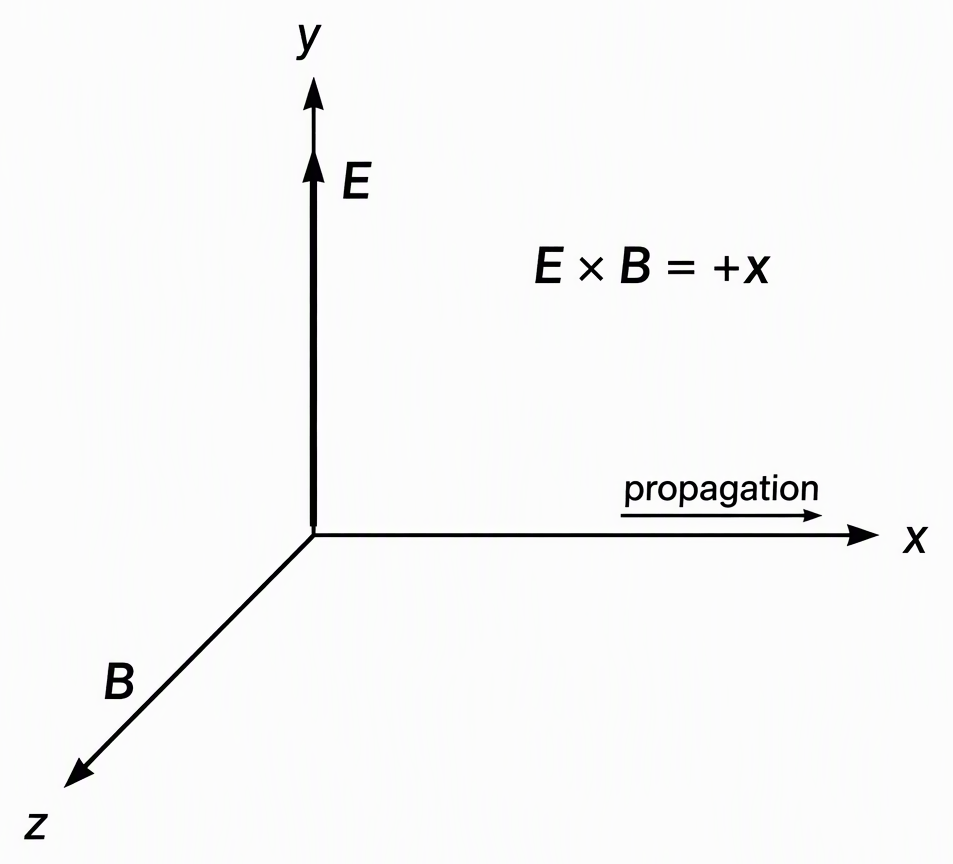
1. C: Both fields are transverse
For a plane electromagnetic wave in vacuum, the electric field, magnetic field and propagation direction are mutually perpendicular. Neither field points along the direction of travel.
Option A is tempting because the fields oscillate together, in phase. That describes timing, not spatial direction: two oscillations can reach their maxima together while pointing along perpendicular axes. Options B and D incorrectly make one field longitudinal.
2. D: Vacuum speed is common
Radio waves and X-rays are both electromagnetic waves, so they have the same propagation speed in vacuum. Their frequencies, wavelengths and photon energies differ.
Option B confuses equal speed with equal wavelength. At the same speed, higher frequency corresponds to shorter wavelength; X-rays have higher frequencies than radio waves.
3. B: Microwaves come before infrared
For these four regions, increasing frequency runs from microwaves to infrared to ultraviolet to X-rays. Read “increasing” before comparing the options.
Option A is the closest distractor: its final two entries are correctly placed, but its first two are reversed. Option C gives decreasing frequency, while Option D incorrectly places ultraviolet before infrared. Check each neighbouring pair rather than choosing an option because its final entry looks right.
4. A: Electric-field amplitude equals light speed times magnetic-field amplitude
For a plane electromagnetic wave in vacuum, use the amplitude relation below. The symbols are defined in the question.
Option B answers the reversed ratio. Option D is wrong: oscillating in phase does not mean the fields have equal numerical amplitudes, and their SI units differ. Option C does not follow from the amplitude relation.
5. C: The electric flux changes
During charging, the electric field between ideal capacitor plates changes, so the electric flux changes. Maxwell’s displacement-current contribution accounts for this changing flux in the gap.
Option A is tempting because conduction current flows in the connecting wires. But conduction charge does not need to cross an ideal capacitor’s insulating gap. Constant electric flux gives no displacement-current contribution, while zero net charge on the capacitor does not establish whether its electric flux is changing.
How should I use my wrong answers to choose the next exercise?
Repair the concept behind each wrong or guessed answer before collecting another question set. Write the deciding principle, explain the tempting distractor, and try a fresh variation. Five original questions cannot establish chapter mastery or predict a NEET score.
- Question 1, geometry: Draw and label propagation, electric-field and magnetic-field directions as mutually perpendicular. State that an electromagnetic wave is transverse. If either field points along propagation, correct the arrangement.
- Question 2, vacuum speed: Separate speed, frequency and wavelength in your notes. Explain why equal vacuum speed does not mean equal frequency or wavelength, using radio waves and X-rays.
- Question 3, spectrum: Write the conventional increasing-frequency order: radio waves, microwaves, infrared, visible light, ultraviolet, X-rays, gamma rays. Reverse that order when asked for increasing wavelength.
- Question 4, amplitudes: Check whether electric-field or magnetic-field amplitude is in the numerator, and whether the wave is specified to be in vacuum. Write the amplitude relation first, then rearrange it.
- Question 5, capacitor: Distinguish conduction current in the wires from the displacement-current contribution associated with changing electric flux in the gap.
If you confuse changing electric flux with electromagnetic induction, use Electromagnetic Induction Practice Questions NEET: 5 Solved MCQs. It covers a different chapter, including ideas involving changing magnetic flux, so keep the two mechanisms separate.
Keep a guessed correct answer on your review list. Before considering the concept repaired, state the deciding principle without reading the solution.
When should I move from chapter practice to a free full mock?
Move to a full mock when you can explain your chapter answers and need to assess decisions across a mixed paper. Overall syllabus coverage also matters. If much of the paper is unfamiliar, interpret the result as a mix of coverage gaps and execution errors, not an Electromagnetic Waves verdict.
The current paper has 180 compulsory single-correct questions with no optional Section B. Compulsory means there is no question-choice section, not that leaving an answer blank is impossible. Marking adds 4 marks for a correct answer, deducts 1 for a wrong answer, and awards 0 for an unattempted question.
For that next step, NEET JEEnius AI offers 30 free full-length mock tests a month, each with 180 questions, 720 marks and 180 minutes. The split is 45 Physics, 45 Chemistry and 90 Biology questions, with a scored per-subject breakdown.
The whole-paper average is one minute per question, not a mandatory time limit for every Electromagnetic Waves question. Afterward, classify Physics errors as missing concepts, misread options or time decisions. Use that review to plan your next study session: attempt, explain, repair, then test in a mixed paper.
Next step: full-length mock tests on NEET JEEnius AI and sit a full 180-question, 720-mark, 180-minute paper, 45 Physics, 45 Chemistry and 90 Biology, and get a scored per-subject breakdown (30 free a month).
Frequently asked questions
Should I solve Electromagnetic Waves chapter MCQs, PYQs or full mocks first?
Start with solved chapter MCQs if you cannot explain the concepts. Use verified NEET PYQs to practise authentic exam wording, and full mocks to test decisions across subjects once your syllabus coverage supports them. Full mocks do not guarantee Electromagnetic Waves coverage.
Are these Electromagnetic Waves questions actual NEET PYQs?
No. All five questions are original NEET-style practice, not official past-paper questions or predictions. Each has a worked explanation covering the correct answer and the distractors.
What is the ratio of electric-field amplitude to magnetic-field amplitude in an electromagnetic wave?
For a plane electromagnetic wave in vacuum, E0/B0 = c, where c is the speed of light in vacuum. Write E0 = cB0 before rearranging the ratio. The fields oscillating in phase does not mean their amplitudes are numerically equal.
What causes displacement current in a charging capacitor?
The displacement-current contribution in the capacitor gap is associated with changing electric flux. Conduction current flows in the connecting wires, but conduction charge need not cross the ideal insulating gap. Constant electric flux gives no displacement-current contribution.