
Should I start Human Physiology practice with chapter-wise questions, PYQs or mocks?
For free Human Physiology practice questions for NEET, start chapter-wise, check yourself with verified PYQs, then move to full mocks. Use chapter-wise MCQs to repair concepts, verified PYQs to study past exam wording and full mocks to practise whole-paper execution. A full mock is not the most efficient first tool for fixing one physiology misconception.
The comparison below helps you choose a practice format, not a website. Six original, free MCQs with complete explanations follow, so you can attempt and review a starter set without leaving this page.
How do chapter-wise MCQs, verified PYQs and full mocks compare?
Chapter-wise MCQs isolate concept gaps; verified previous-year questions show actual past testing; full mocks test execution across subjects. Choose based on your current errors. Check that free practice includes explanations, not just an option key.
- Best use
- Chapter-wise MCQs: Find and repair a narrow concept gap.
- Verified NEET previous-year questions: Study how an idea was tested in an actual paper.
- Full-length mock tests: Practise subject switching, pacing and whole-paper decisions.
- Ability to isolate a weak concept
- Chapter-wise MCQs: Strong when questions target one mechanism.
- Verified NEET previous-year questions: Useful when grouped by concept, but coverage depends on past papers.
- Full-length mock tests: Limited because a paper samples many topics.
- Relevance to past exam wording
- Chapter-wise MCQs: Depends on the question writer.
- Verified NEET previous-year questions: Direct evidence of past wording.
- Full-length mock tests: Simulated wording, not evidence of what appeared.
- Whole-paper timing practice
- Chapter-wise MCQs: Cannot reproduce it.
- Verified NEET previous-year questions: Can provide it as a complete, timed paper, allowing for pattern differences.
- Full-length mock tests: Their main purpose.
- Answer-checking requirements
- Chapter-wise MCQs: Check the mechanism against NCERT, not just the supplied key.
- Verified NEET previous-year questions: Verify the paper and final official key; use NCERT to understand the answer.
- Full-length mock tests: Review the key, reasoning and subject-level performance.
- Main limitation
- Chapter-wise MCQs: A recently revised chapter can make recall look like understanding.
- Verified NEET previous-year questions: Remembered answers can exaggerate readiness; older papers may include material outside the current syllabus.
- Full-length mock tests: They do not guarantee targeted Human Physiology coverage.
A correct-option key tells you which choice earns marks. A teaching explanation explains the mechanism and why a tempting alternative fails. A free key alone may leave your misconception unresolved.
Which practice format should a Class 11 student, Class 12 student or dropper choose?
Your error pattern decides, not your class or the price of the resource. A dropper may need chapter-wise concept repair, while a Class 11 student may be ready for mixed physiology. Match your next task to one of these situations.
- Class 11, just studied breathing: Begin with chapter-wise questions. Explain how increasing thoracic volume changes lung pressure before moving to mixed physiology.
- Class 12, weak Class 11 recall: Attempt a mixed physiology diagnostic. Return to the specific NCERT concepts behind errors rather than rereading every chapter.
- Dropper, recognises PYQ answers: Cover the options and justify the answer first. Then use unfamiliar, syllabus-aligned MCQs to check whether you can apply the concept.
- Accurate in isolated physiology, disorganised across the paper: Prioritise full mocks and subject-level review. More isolated physiology practice does not directly fix subject switching or poor time allocation.
Can I try free Human Physiology practice questions for NEET here?
Attempt these six original, single-correct MCQs before reading the key. These are practice questions, not PYQs or questions claimed to have appeared in NEET. They test standard NCERT physiology concepts; check your wider question collection against the current official syllabus at neet.nta.nic.in.
This is a starter diagnostic, not comprehensive coverage or a predictor of your final score. Record your chosen option and mark every guess, including answers you later discover were correct.
1. During normal inspiration, which sequence allows air to enter the lungs?
- A. Thoracic volume decreases, intrapulmonary pressure rises above atmospheric pressure, and air enters.
- B. Thoracic volume increases, intrapulmonary pressure falls below atmospheric pressure, and air enters.
- C. Thoracic volume increases, intrapulmonary pressure rises above atmospheric pressure, and air enters.
- D. Thoracic volume decreases, intrapulmonary pressure falls below atmospheric pressure, and air enters.
2. During the ejection phase of ventricular systole, blood flows from the left ventricle into the aorta. Which valve arrangement permits this flow and prevents backflow into the left atrium?
- A. Mitral valve open; aortic semilunar valve closed.
- B. Mitral valve open; aortic semilunar valve open.
- C. Mitral valve closed; aortic semilunar valve open.
- D. Tricuspid valve closed; aortic semilunar valve closed.
3. Increased ADH secretion in a healthy person most directly promotes which response?
- A. Greater water reabsorption from distal nephron regions, reducing water loss in urine.
- B. Reduced water permeability of collecting ducts, producing a larger volume of dilute urine.
- C. Greater water movement from blood into collecting ducts, conserving body water.
- D. Complete cessation of glomerular filtration, preventing urine formation.
4. A skeletal muscle sarcomere shortens during contraction. Which change is consistent with sliding-filament theory?
- A. Actin filaments shorten while myosin filaments retain their length.
- B. The A band shortens while the I band remains unchanged.
- C. Actin and myosin filaments both shorten, reducing the distance between Z lines.
- D. The I band narrows and the H zone decreases, while the A band retains its length.
5. At a stimulated region of an axonal membrane, the rapid depolarising phase of an action potential is primarily caused by which event?
- A. Potassium ions rapidly enter the axon.
- B. Sodium ions rapidly enter the axon through opened sodium channels.
- C. Sodium ions rapidly leave the axon through opened sodium channels.
- D. The sodium-potassium pump reverses its direction.
6. After a carbohydrate-rich meal, increased insulin secretion helps lower blood glucose mainly by which action?
- A. Stimulating liver glycogen breakdown and glucose release.
- B. Inhibiting glucose uptake by muscle and adipose cells.
- C. Promoting glucose uptake by muscle and adipose cells and glycogen formation.
- D. Increasing glucose production from non-carbohydrate sources in the liver.
What are the answers, and which misconceptions do they reveal?
The correct options are 1 B, 2 C, 3 A, 4 D, 5 B and 6 C. Check the reasoning even when your option matches. A correct answer based on the wrong explanation remains a weak point.
1. B: Increased volume lowers intrapulmonary pressure.
During inspiration, diaphragm contraction and rib movement increase thoracic volume. The lungs expand, and intrapulmonary pressure falls below atmospheric pressure, so air flows into them.
C reverses the pressure change: expanding the lungs does not raise their pressure above atmospheric pressure during normal inspiration. Separate the three variables: thoracic volume increases, intrapulmonary pressure decreases, and airflow is inward. Revise Breathing and Exchange of Gases: Mechanism of Breathing.
2. C: The mitral valve closes while the aortic semilunar valve opens.
During left ventricular ejection, ventricular pressure exceeds aortic pressure, opening the aortic semilunar valve. The closed mitral, or bicuspid, valve prevents blood from returning to the left atrium.
B wrongly leaves both valves open. Atrioventricular valves do not remain open throughout ventricular contraction; their closure prevents backward flow into the atria. Revise Body Fluids and Circulation: Human Circulatory System and Cardiac Cycle.
3. A: ADH increases water reabsorption in distal nephron regions.
ADH acts on the distal tubule and collecting duct, promoting water reabsorption into the body. Less water is lost in urine; ADH does not need to stop filtration to conserve water.
B reverses the effect: reduced collecting-duct water permeability would reduce water recovery and favour dilute urine. Reabsorption moves substances from tubular fluid towards blood; secretion moves them in the opposite direction. Revise Excretory Products and their Elimination: Regulation of Kidney Function.
4. D: Bands change because overlap increases, not because filaments shorten.
Thin filaments slide over thick filaments, bringing the Z lines closer. The I band narrows and the H zone decreases, potentially disappearing, while the A band remains constant because thick-filament length remains constant.
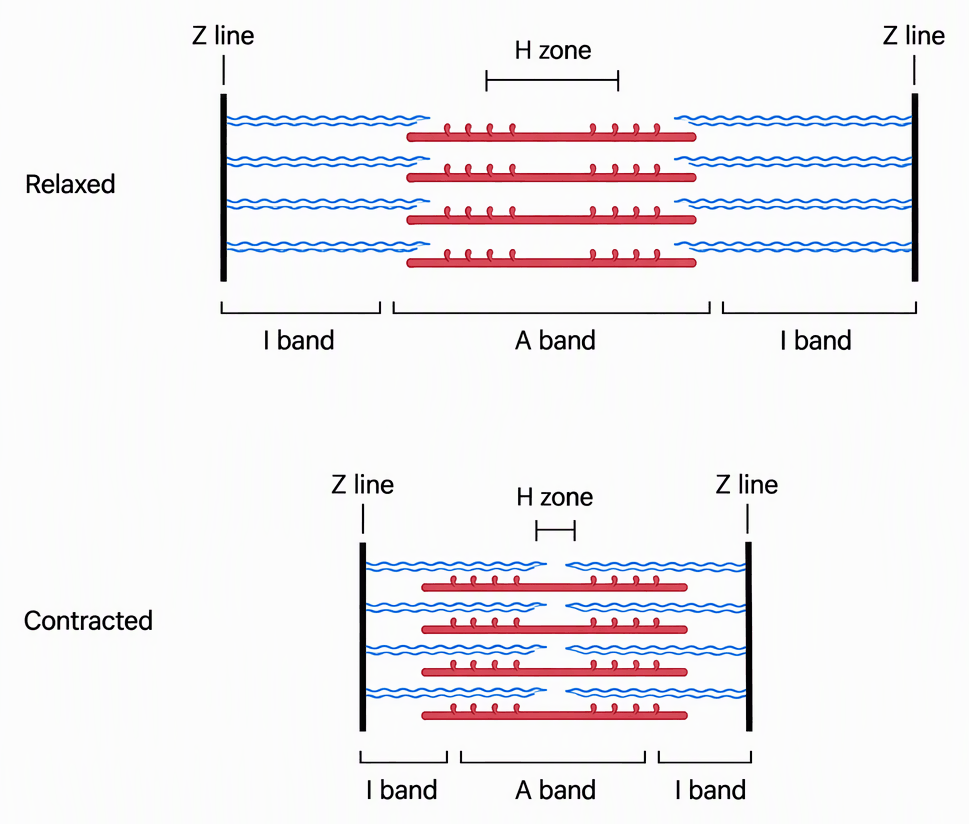
C is the central misconception: actin and myosin do not both shrink. Sarcomere shortening comes from changed relative positions and increased overlap, not reduced filament length. Revise Locomotion and Movement: Mechanism of Muscle Contraction.
5. B: Sodium entry depolarises the stimulated membrane.
Opening sodium channels increases sodium permeability at the stimulated axonal region. Sodium moves inward down its electrochemical gradient, making the inside less negative and then positive relative to the outside.
D confuses gradient maintenance with the rapid membrane event. The sodium-potassium pump maintains ionic gradients over time; reversal of that pump does not generate rapid depolarisation. Revise Neural Control and Coordination: Generation and Conduction of Nerve Impulse.
6. C: Insulin promotes glucose uptake and storage.
Insulin from pancreatic beta cells promotes glucose uptake by target cells, including muscle and adipose cells. It also supports glycogen formation in liver and muscle, helping reduce circulating glucose.
A describes an opposing response: liver glycogen breakdown releases glucose rather than storing it. Insulin and glucagon participate in glucose regulation but have opposing effects on blood glucose. Revise Chemical Coordination and Integration: Pancreas and Mechanism of Hormone Action.
How should I use my result to choose the next practice session?
Choose by the reason behind each error, not by a score threshold. Apply the official marking rule: award 4 marks for each correct answer, deduct 1 for each wrong answer, and award 0 for an unattempted question. This small-set score cannot predict your NEET rank or total.
Classify each uncertain response before choosing more questions:
- Missing concept: You could not explain the mechanism. Read that NCERT subsection, then attempt fresh chapter-wise questions.
- Confused terminology: You mixed up terms such as reabsorption and secretion. Write their directions or functions separately, then check them with a fresh item.
- Misread qualifier: You missed words such as “inspiration”, “ejection” or “depolarising”. Review verified PYQs carefully and identify the condition that determines each answer.
- Unsupported guess: You chose without a defensible reason. Treat guessed-correct answers as unresolved knowledge checks, not secure mastery.
Whole-paper pacing problems require evidence from a whole paper. If physiology is accurate in isolation but time allocation breaks down across subjects, move to full mocks rather than drawing timing conclusions from these six questions.
Keep a review record: concept tested; reason for the error; corrected rule; result on a later fresh question. Before calling any question a PYQ, verify both its paper and final official key, then check older material against the current syllabus at neet.nta.nic.in.
When are NEET JEEnius AI’s free full mocks the right next step?
Use them after targeted revision, when your next problem is executing a complete paper. NEET JEEnius AI offers 30 free full-length mock tests a month, with a scored per-subject breakdown. That supports whole-paper review; it does not establish chapter-level diagnosis or physiology-specific analytics.
Each mock contains 180 questions for 720 marks in 180 minutes: 45 Physics, 45 Chemistry and 90 Biology questions. Biology supplies half the questions and marks, but Human Physiology is only part of Biology, so this is not a verified dedicated physiology question bank.
Practise the current compulsory-question format, with no optional section. Once you can explain your corrected physiology answers, use a full mock to check subject-level accuracy and pacing, then choose the next revision task from the errors you actually made.
Next step: full-length mock tests on NEET JEEnius AI and sit a full 180-question, 720-mark, 180-minute paper, 45 Physics, 45 Chemistry and 90 Biology, and get a scored per-subject breakdown (30 free a month).
Related on NEET JEEnius AI: Placentation NEET 2026: Matching Types and Plant Examples.
Frequently asked questions
Should I start NEET Human Physiology practice with chapter-wise questions or PYQs?
Start with chapter-wise questions when you need to repair a specific concept. Then use verified PYQs to study actual exam wording, checking both the paper and final official answer key. Move to full mocks when your main task is whole-paper accuracy and pacing.
Are these free Human Physiology questions actual NEET PYQs?
No. These six questions are original, single-correct practice MCQs covering standard NCERT physiology concepts, with complete explanations. They form a starter diagnostic, not comprehensive coverage or a prediction of your NEET score.
How should I review wrong answers in Human Physiology MCQs?
Classify each error as a missing concept, confused terminology, misread qualifier or unsupported guess. Revise the relevant NCERT subsection, write the corrected rule and test it on a fresh question. Treat guessed-correct answers as unresolved knowledge checks rather than secure mastery.
When should I switch from physiology MCQs to full NEET mocks?
Switch after targeted revision when you can explain your physiology answers but need to test subject switching and time allocation across a complete paper. NEET JEEnius AI offers 30 free full-length mocks a month with scored per-subject breakdowns. These are whole-paper practice tests, not a dedicated physiology question bank.