
Should I practise Gravitation questions or take a full NEET mock first?
Start with worked chapter MCQs if your formulas or concepts are uncertain. These Gravitation practice questions for NEET include six original questions and worked answers, free to read on this page.
Choose a full mock when your main problem is recall, pacing or switching between subjects across the syllabus. Use the chapter set to check understanding, not to judge full-paper readiness.
What do chapter MCQs test that a full-length mock cannot isolate?
Worked chapter questions expose conceptual errors; a full mock tests recall and pacing across subjects. When those are your main problems, NEET JEEnius AI offers 30 free full-length mocks a month; these are whole-paper tests, not dedicated Gravitation tests.
- Scope
- Worked Gravitation set on this page: Six questions sampling selected Gravitation concepts.
- NEET JEEnius AI full-length mocks: Physics, Chemistry and Biology together.
- Format
- Worked set: Original single-correct MCQs, followed by worked explanations.
- Full-length mocks: 180 compulsory single-correct questions, 720 marks and 180 minutes: 45 Physics, 45 Chemistry and 90 Biology questions.
- Feedback
- Worked set: Question-level reasoning and diagnosis of common mistakes.
- Full-length mocks: A scored per-subject breakdown.
- Best use
- Worked set: Isolating conceptual errors before mixed practice.
- Full-length mocks: Testing full-paper execution.
- Access
- Worked set: Free to read here.
- Full-length mocks: 30 free a month.
- Limitation
- Worked set: Too short to establish chapter mastery.
- Full-length mocks: No guaranteed number of Gravitation questions.
Which option should Class 11, Class 12 students and droppers choose?
Choose by the error you need to fix, not by your class or attempt number. A dropper can need concept repair; a Class 11 student can understand Gravitation but lack the wider syllabus preparation needed for a useful full mock.
- Class 11, chapter just completed: Begin with the worked set. Check what each formula assumes before attempting mixed-paper practice.
- Class 12, revising older Physics: Use the set to expose forgotten relationships, then return to mixed questions. Recognition can hide weak recall.
- Dropper, formulas remembered but energies confused: Choose chapter repair. Another full mock is not a substitute for understanding potential, potential energy and total orbital energy.
- Student solving unfamiliar chapter questions correctly but losing time across subjects: Choose a full-length mock. The problem is execution rather than this chapter alone.
Remembered answers are not evidence of transferable understanding. Explain why the rejected options fail, not merely which option is correct.
Do not use a fixed score threshold for being “mock-ready”. Judge your reasoning, syllabus preparation and the purpose of the next session.
Can I try free Gravitation practice questions for NEET now?
Solve these six original NEET-style MCQs before checking the answer section. They are not authenticated previous-year questions or predictions of chapter weightage. Each has one correct option, and its stated assumptions are part of the problem.
Before reading any solution, mark your response reasoned, guessed or recalled from familiarity. Keep that label even if your guess turns out correct.
1. How does gravitational force change when separation increases?
Two point masses remain unchanged. Their centre-to-centre separation increases by the scale factor below. Choose the new force in terms of the old force.
2. What is gravity at a depth inside a uniform Earth?
Assume Earth is a uniform-density sphere. Find the gravitational acceleration at the stated depth below its surface, ignoring rotation.
3. Does gravitational potential increase farther from a spherical mass?
Outside an isolated spherical mass, gravitational potential is defined as zero at infinity. A test point moves outward from one finite distance to a greater distance, both measured from the centre. Choose the statement that describes its gravitational potential.
- A. It becomes less negative, so its value increases and its magnitude decreases.
- B. It becomes more negative, so its magnitude increases.
- C. It becomes positive as soon as the point moves outward.
- D. It stays constant because the source mass is unchanged.
4. How does local escape speed compare with circular orbital speed?
Compare the minimum escape speed and circular orbital speed at the same distance from the centre, outside a spherical body. Neglect atmosphere, propulsion after launch and all other bodies.
5. How does orbital period change with circular-orbit radius?
Two satellites have negligible masses compared with the same central spherical body. Both follow circular orbits. Choose the ratio of their periods from the given centre-to-centre orbital radii.
6. What is the total energy of a satellite in circular orbit?
A satellite follows a circular orbit around a much more massive spherical body. Take gravitational potential energy as zero at infinity. Choose the satellite’s total mechanical energy, not either energy component separately.
What are the answers, and why do the other options fail?
Answer key: 1 B, 2 D, 3 A, 4 C, 5 B, 6 D.
Identify the faulty step, not just the correct option. A guessed correct answer still needs review, and six correct answers do not establish complete chapter coverage or predict a NEET score.
Why is question 1 an inverse-square scaling problem?
B is correct: fixed masses leave separation as the only changing quantity. Forming a ratio cancels the masses and gravitational constant.
Error label: inverse-square scaling. A forgets to square the scale factor; C reverses the ratio. Greater separation must reduce the attractive force.
Why does question 2 require the uniform-density assumption?
D is correct: inside this model, only the mass enclosed within the current radius contributes to the net field. Outer spherical shells contribute zero net field there.
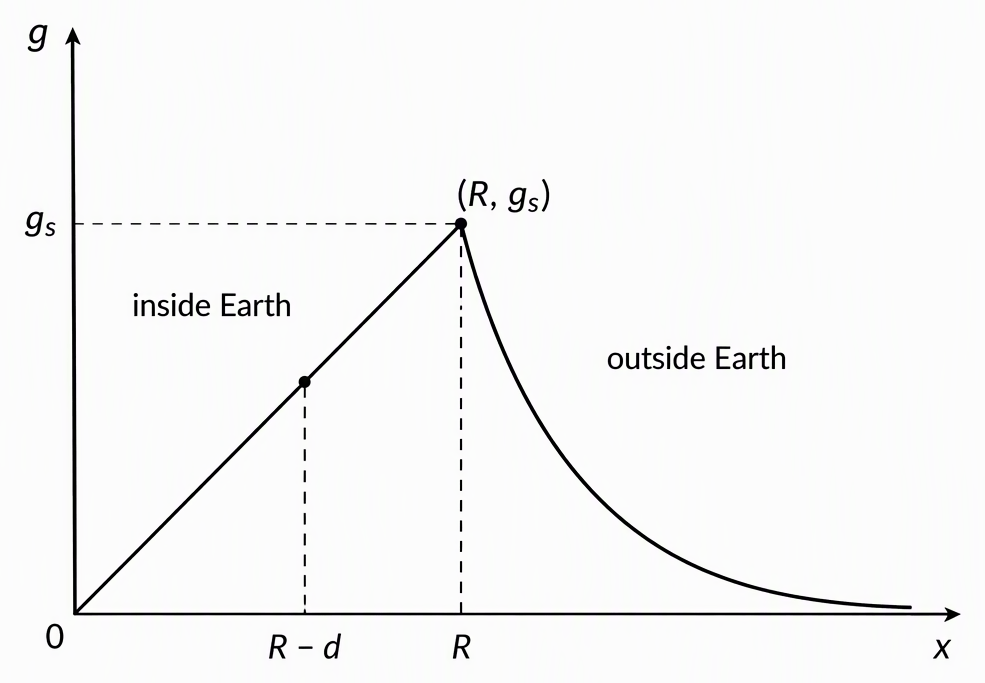
Error label: model assumption. A incorrectly uses Earth’s entire mass at an interior point. The linear depth relationship requires uniform density; it is not the outside-Earth inverse-square relationship.
Why does gravitational potential increase in question 3?
A is correct: increasing distance makes the negative potential approach zero from below. Its value increases while its absolute magnitude decreases.
Error label: sign convention. B reverses the trend: a larger denominator reduces the magnitude, making the potential less negative. Potential is energy per unit mass, measured in joules per kilogram; potential energy includes the test mass and is measured in joules.
Why is question 4 not a factor of two in speed?
C is correct: circular motion and minimum escape give different expressions for the square of speed. Taking their ratio requires a square root.
Error label: speed relationship. A transfers the factor of two in squared speed directly to speed. Both expressions must use the same centre-to-centre radius, not altitude above the surface.
Why does question 5 need a square root?
B is correct: Kepler’s third law relates the square of the period to the cube of orbital radius. The central mass is unchanged.
Error label: period scaling. A stops at the squared-period ratio. D gives a shorter period for the larger orbit, reversing the physical trend.
Why is question 6 negative but not equal to potential energy?
D is correct: total energy includes positive kinetic energy and negative potential energy. Their magnitudes are not equal in a circular orbit.
Error label: energy bookkeeping. A gives potential energy alone; B gives kinetic energy alone. Negative total energy indicates a bound orbit under the chosen zero at infinity.
What should I do after reviewing this diagnostic?
Repair concept errors; use a full mock for broader execution problems. Check the reasoned, guessed or recalled from familiarity labels you recorded before reading each solution. A remembered answer is weaker evidence than a correct explanation of an unfamiliar variant.
- Concept error: Revisit the relevant derivation or assumption, then solve a changed problem. Immediate repetition of the same answer is not mastery.
- Repeated algebra or sign errors: Write the symbolic relationship before substituting quantities. Check units and limiting cases, such as gravity at the centre under the uniform-density model.
- Energy bookkeeping weakness: Use Work, Energy and Power: Variable Friction as related mechanics practice, not as another Gravitation resource.
- Broader execution problem: Take a full 180-question, 180-minute mock and review its scored per-subject breakdown. Look for where time pressure disrupted recall or decisions.
Apply the official marking rule when reviewing attempts:
Use that rule to understand the cost of an unsupported guess. Do not convert this chapter result into a predicted rank or full-paper score.
Does this short set cover every Gravitation question?
No. A short diagnostic samples concepts; it cannot cover every possible Gravitation question. Use your errors to choose what to repair, rather than treating six correct option letters as proof of mastery.
Are these NEET previous-year questions?
No. These are original practice questions, not authenticated NEET PYQs. They teach standard relationships without making any claim about future chapter weightage.
Is knowing every formula enough?
No. Formula recall does not establish command of assumptions, signs or unfamiliar applications. Explain why the strongest distractor fails, then change a condition and check whether your method still applies.
Does the free mock allowance include dedicated Gravitation tests?
The verified allowance is 30 free full-length mocks a month, not a dedicated chapter-test feature. If a concept remains uncertain, make your next task one unfamiliar variant of it.
When unfamiliar chapter problems are manageable but pacing across subjects is not, use a NEET JEEnius AI full-length mock and review the scored per-subject breakdown.
Next step: full-length mock tests on NEET JEEnius AI and sit a full 180-question, 720-mark, 180-minute paper, 45 Physics, 45 Chemistry and 90 Biology, and get a scored per-subject breakdown (30 free a month).
Frequently asked questions
Should I practise Gravitation questions or take a full NEET mock first?
Start with worked chapter questions if your Gravitation formulas, assumptions or concepts are uncertain. Choose a full mock when your main difficulty is recall, pacing or switching between subjects across the syllabus. Base the choice on your errors and syllabus preparation, not a fixed chapter-score threshold.
Are these Gravitation questions NEET previous-year questions?
No. These six questions are original NEET-style, single-correct MCQs, not authenticated previous-year questions. They sample standard Gravitation concepts without predicting future chapter weightage.
Is solving all six Gravitation questions correctly enough for NEET?
No. Six correct answers do not establish complete chapter coverage or predict your NEET score. Explain why the rejected options fail, then solve unfamiliar variants to check whether your understanding transfers.
Does NEET JEEnius AI offer free Gravitation chapter tests?
The verified allowance is 30 free full-length mocks a month, not a dedicated Gravitation chapter-test feature. This article separately provides six free worked Gravitation MCQs. Full-length mocks cover Physics, Chemistry and Biology, with no guaranteed number of Gravitation questions.