
Should I start kinematics practice with a chapter set or a full mock?
Start with a chapter set of free kinematics practice questions for NEET, not a full mock, if you still make conceptual or calculation errors. The original questions, answer key and explanations below are readable without payment. Use verified NEET previous-year questions for exam-style calibration and full mocks for application across subjects. A full mock tests overall readiness but is inefficient for repairing one chapter. No route alone guarantees mastery.
Which free kinematics practice route fits my needs?
Choose the on-page set to diagnose chapter errors, verified PYQs to check exam-style application, and full-paper practice to test performance across subjects. These are complementary stages: use the feedback from one to decide whether you need repair or broader practice.
- Chapter focus
- On-page MCQs: Six questions targeting selected kinematics concepts.
- Verified NEET PYQs: Actual exam questions selected for kinematics.
- NEET JEEnius AI mocks: Full-paper practice across Physics, Chemistry and Biology.
- Question provenance
- On-page MCQs: Original NEET-style practice, not actual NEET questions or a complete chapter bank.
- Verified PYQs: Wording and answers traceable to official papers and answer keys.
- Mocks: Practice papers, not official papers.
- Explanation availability
- On-page MCQs: Every answer is explained below.
- Verified PYQs: Worked explanations require separate checking; an official key establishes the answer, not the reasoning.
- Mocks: Only the scored per-subject breakdown is verified here; do not assume worked explanations.
- Time commitment
- On-page MCQs: A short attempt followed by error review.
- Verified PYQs: Depends on the questions selected.
- Mocks: Each paper has 180 questions, 720 marks and 180 minutes.
- Useful feedback
- On-page MCQs: Explains common wrong options and gives repair tasks.
- Verified PYQs: Shows how a concept becomes an actual single-correct exam question.
- Mocks: Scored per-subject breakdown; more detailed feedback is unverified.
- Free-access conditions
- On-page MCQs: Questions and complete solutions are visible here.
- Verified PYQs: Use official papers and keys; check access to separately supplied explanations before starting.
- Mocks: 30 free full-length mocks a month.
- Main limitation
- On-page MCQs: Samples concepts without covering the whole chapter.
- Verified PYQs: Topic sorting needs checking; official papers are not an official chapter-filtered bank.
- Mocks: A subject score does not isolate a kinematics weakness.
Who should choose chapter questions, PYQs or full mocks?
Choose by your errors, not your class. Start here if you confuse distance with displacement, read graph height instead of slope, or use constant-acceleration equations without checking their condition. Choose verified PYQs when you understand these ideas but need actual NEET question framing. Choose full mocks when chapter practice is reasonably secure but subject switching, question selection or overall time use breaks down.
- Class 11 beginner: You know the motion equations but give a negative answer for total distance. Attempt the on-page set, then rebuild the distinction between a signed change in position and total path length.
- Class 12 revision student: You explain velocity–time graphs correctly but hesitate when a question combines words and a graph. Choose verified PYQs and identify what each sentence contributes before calculating.
- Dropper: You solve chapter questions reliably but spend too long rescuing difficult Physics questions during mixed practice. Full mocks are the better next tool for examining question selection and time use.
A dropper who repeatedly loses signs should return to targeted practice, not add more full mocks. Repeating a paper format does not repair a faulty direction convention.
A low Physics mock score alone does not identify kinematics as the cause. Inspect the wrong and omitted questions before assigning chapter revision.
Can I try free NEET-style kinematics MCQs with solutions here?
Attempt these six original NEET-style single-correct MCQs without notes, then check the worked solutions below. They are not PYQs, and each has exactly one correct option under its stated conditions. This short set samples concepts rather than covering all of kinematics.
Write your direction convention, method and option beside each answer. Mark uncertain correct answers for review: guessing the right option does not establish that you understand the method.
1. Distance versus displacement
A particle travels along a straight road, first east and then west. East is positive, and the length scale is positive. Its successive legs are:
Which ordered pair gives total distance and signed displacement?
2. Average speed
A cyclist covers two successive legs of equal positive length. The speed is constant on each leg, with no stop between them:
What is the average speed over the complete journey?
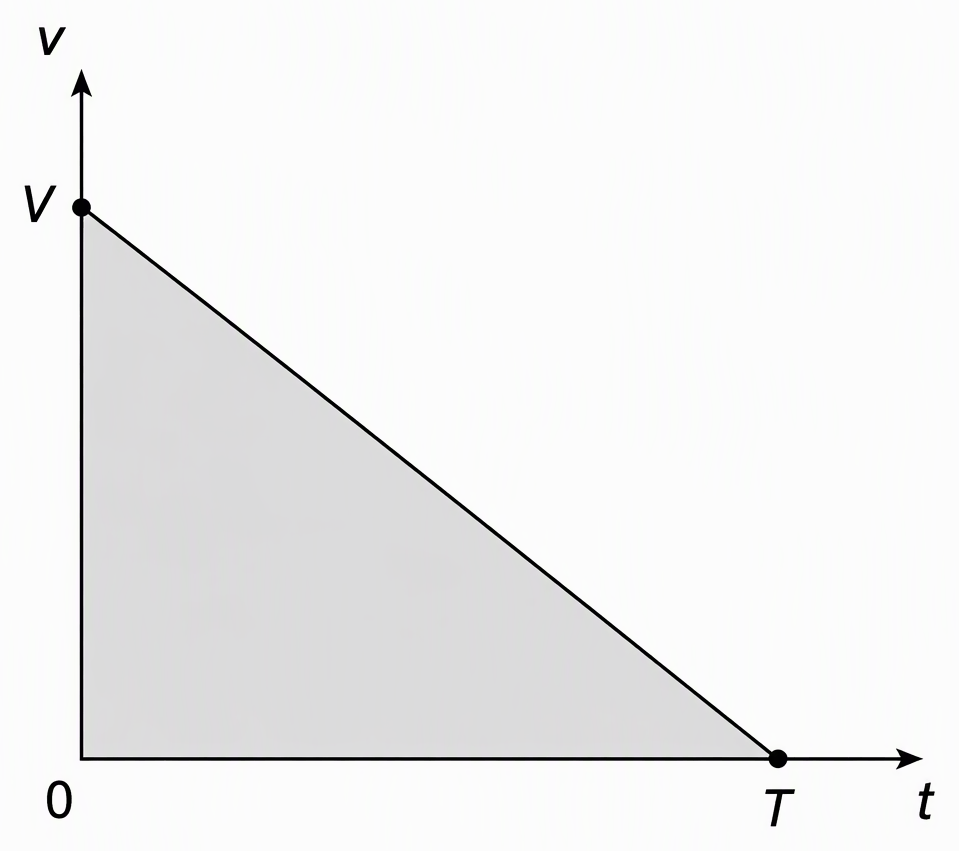
3. Velocity–time graph
A particle’s velocity decreases in a straight line from a positive initial velocity to zero at a positive final time:
What is its displacement during this interval?
4. Constant acceleration
A particle initially moves in the positive direction. Its acceleration remains constant and negative throughout the stated interval:
What is its signed displacement?
5. Projectile motion
A projectile is launched above the horizontal and returns to its launch level. Air resistance is negligible, and gravitational acceleration is constant and vertically downward:
What is its speed at the highest point?
6. Relative velocity
Two vehicles move along the same straight east–west road. Ground-frame velocities are given below, with east positive:
What is the signed velocity of vehicle A measured by an observer travelling in vehicle B?
What are the answers, and what do my mistakes mean?
The answer key is 1 A, 2 B, 3 C, 4 D, 5 B, 6 C. Check your reasoning as well as your letter: a sound setup followed by bad arithmetic needs a different repair from choosing the wrong physical quantity. Missing the requested direction or observer is a reading error, not necessarily a conceptual gap.
1. Add path lengths, but subtract opposite displacements.
Both legs contribute positively to distance. The westward leg contributes negatively to displacement:
Option B treats displacement magnitude as distance, a conceptual error. Repair: redraw the two legs and calculate path length and final-minus-initial position separately.
2. Divide total distance by total time.
Equal distances do not take equal times at unequal speeds. Calculate each travel time before combining them:
Option A averages speeds as though the time intervals were equal. Repair: list distance, speed and time for each leg; if this setup was correct, inspect the fraction algebra instead.
3. Displacement is signed area under a velocity–time graph.
The region is a triangle above the time axis. Its area gives positive displacement:
Option A is the slope, which gives acceleration. Velocity multiplied by time has length units; velocity divided by time does not. Repair: label graph height, slope and area with their physical quantities and units.
4. Keep the acceleration’s negative sign.
Constant acceleration makes the displacement equation applicable. Substitute the signed acceleration, not its positive magnitude:
Option B results from using positive acceleration. Repair: write the direction convention and signed inputs before substitution; a correct setup with a wrong final fraction is an algebra error.
5. Only the vertical component becomes zero at the top.
With no horizontal acceleration, horizontal velocity stays unchanged. Speed at the highest point is therefore:
Option D mistakes zero vertical velocity for zero total velocity. Repair: separate horizontal and vertical components before applying a projectile formula.
6. Subtract the observer’s signed velocity.
The observer travels with B. Subtract B’s ground-frame velocity from A’s:
The positive sign means east in B’s frame. Option A subtracts speed magnitudes and loses B’s negative sign. Repair: write “object minus observer”; choosing D may mean you reversed the requested observer.
What should I practise next, and when does a free mock help?
Move to mixed practice when you can justify the method and reject the distractors, not merely recognise a previously seen answer. First separate conceptual errors, calculation errors and misread conditions so you know what to repair.
- Attempt without notes. Preserve your working.
- Inspect the reasoning behind each error. Include uncertain correct answers.
- Redo missed questions with the solution hidden. Explain why the tempting alternative fails.
- Try a fresh verified PYQ on the same concept. Match its claimed paper year, wording, options and diagrams against the official paper, then check the corresponding official answer key. Start with neet.nta.nic.in for official material; do not trust a year label alone.
Are the solutions free, and can this set predict my NEET score?
All six worked solutions are on this page without payment. The set cannot predict your NEET score, percentile or readiness cutoff. For NEET-format attempts, use the official marking rule: +4 correct, -1 wrong and 0 unattempted, while recording wrong answers and omissions separately.
For later full-paper practice, NEET JEEnius AI offers 30 free mocks a month, each with 45 Physics, 45 Chemistry and 90 Biology questions, plus a scored per-subject breakdown. The official format’s 180 compulsory questions in 180 minutes does not require identical time for every Physics question. Before your next full paper, redo one missed question here and explain every rejected option without looking at the solution.
Next step: full-length mock tests on NEET JEEnius AI and sit a full 180-question, 720-mark, 180-minute paper, 45 Physics, 45 Chemistry and 90 Biology, and get a scored per-subject breakdown (30 free a month).
Related on NEET JEEnius AI: Phylum Chordata NEET 2026: Symmetry Question Explained.
Frequently asked questions
Where can I practise free kinematics questions for NEET with solutions?
This article provides six original NEET-style single-correct MCQs, an answer key and complete worked solutions without payment. The questions cover distance and displacement, average speed, velocity–time graphs, constant acceleration, projectile motion and relative velocity.
Are these kinematics questions actual NEET PYQs?
No. These are original NEET-style practice questions, not actual NEET questions or a complete chapter bank. For verified PYQs, match the wording, options and diagrams against official papers and check the corresponding official answer keys.
Should I practise kinematics chapter questions or take a full NEET mock?
Start with chapter questions if you still make conceptual or calculation errors in kinematics. Use verified PYQs when you understand the concepts but need actual exam framing. Choose full mocks when chapter practice is reasonably secure and you need to work on subject switching, question selection or overall time use.
Can these six kinematics questions predict my NEET score?
No, this short set cannot predict your NEET score, percentile or readiness cutoff. It samples selected concepts and helps identify errors that need repair. Review uncertain correct answers as well as wrong answers, because guessing correctly does not establish understanding.