What does the Phylum Chordata NEET 2026 symmetry question actually test?
Answer C is correct: Statement I is true, but Statement II is false because echinoderm larvae are bilateral, not radial. The Phylum Chordata NEET 2026 question tests symmetry across life stages, not chordate classification. The supplied question is from Biology, Code-50, in NEET 2026 held on 21 June 2026.
The question bank lists it under Phylum Chordata and Diversity in Living World, but the tested facts concern symmetry and Echinodermata in NCERT Class 11 Biology, Chapter 4, Animal Kingdom. “Medium” is the bank’s difficulty classification, not an official NTA rating.
The complete question, in fresh wording:
- Statement I: An organism is radially symmetrical when every plane containing its central body axis divides it into matching halves.
- Statement II: Echinoderms show radial symmetry in both their larval and adult forms.
Choose the correct truth pair:
Why is Statement I correct according to NCERT?
The statement contains both conditions in NCERT’s definition: the dividing plane passes through the central body axis, and it separates the body into two identical halves. Neither condition can be dropped.
Read “any plane” together with “passing through the central axis.” It does not mean an arbitrary cut anywhere through the animal. An off-centre cut is not the test described here.
Check the wording in two parts:
- Location of the plane: through the central axis.
- Result of division: two matching halves.
Both parts agree with NCERT, so Statement I is true. In bilateral symmetry, only one plane divides the body into matching right and left halves. The distinction is the number of suitable planes, not simply whether two halves can be produced.
Why is Statement II false for echinoderm larvae?
Adult echinoderms are radially symmetrical, but their larvae are bilaterally symmetrical. Statement II assigns the adult characteristic to both stages. Following the supplied solution, check its two claims separately: adults are radial, and larvae are radial.
NCERT distinguishes these stages. The larva has bilateral symmetry before metamorphosis; the adult has radial symmetry.
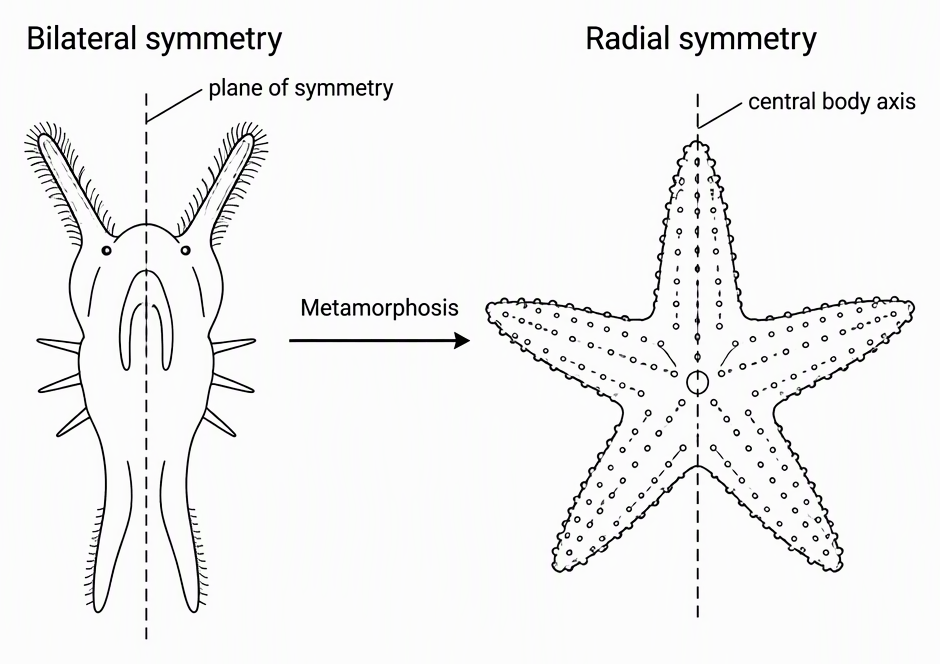
The stage-by-stage check is:
- Adult echinoderm: radial symmetry. The adult claim is true.
- Echinoderm larva: bilateral symmetry. The larval claim is false.
The word “both” requires two correct claims. Confirming the adult half is not enough: the larval claim must also agree with NCERT. Here, it does not.
Because one component is wrong, Statement II is false. Its correct adult claim cannot rescue the complete statement; judge every stage named, not just the stage that matches your first recalled fact.
How do the two truth values give answer C?
Statement I is true and Statement II is false, so answer C is correct: Statement I is correct and Statement II is incorrect. Use those results to eliminate the alternatives.
- Reject A: it incorrectly accepts Statement II.
- Reject B: Statement I is correct.
- Reject D: it reverses both truth values.
If a correct answer earns four marks and an incorrect answer earns minus one, changing C to A costs:
That is a scoring consequence, not the proof. The factual check is: radial definition correct; adult radial; larva bilateral.
How does ignoring the life stage lead to option A?
Option A follows from applying an adult characteristic to the entire life cycle. The faulty method starts with “echinoderms are radial” but drops the qualifier “adult”. That turns a stage-specific fact into a false general claim.
The error develops in this sequence:
- Recall radial symmetry in adult echinoderms.
- Apply that feature to larvae as well.
- Accept Statement II.
- Combine it with the correct Statement I and select A.
This is not a failure to recognise the phylum. It is a failure to check the named stages.
Repair the method by underlining “both adults and larvae”. Write “radial” beside adults and “bilateral” beside larvae, then judge the whole statement.
Use this rule for other statement questions: before accepting “both” or “all”, verify every named stage or group separately.
Can you apply the same method to three Animal Kingdom questions?
Check the symmetry criterion, each life stage and each named group separately. These are original chapter-linked practice questions, not additional verified NEET PYQs.
- Which symmetry describes a body divisible into matching right and left halves through only one plane?
Answer: B, bilateral symmetry. The deciding words are “only one plane” and “right and left halves”. Radial symmetry allows any plane through the central axis to produce matching halves; an asymmetrical body does not meet the stated criterion.
- What is the correct larva-to-adult symmetry sequence in echinoderms?
Answer: B, bilateral to radial. Check each stage independently: the larva is bilateral, and the adult is radial. Keep the direction larva to adult fixed when matching the sequence to an option.
- Are these claims about chordates and adult echinoderms correct?
- Statement I: Chordates are bilaterally symmetrical.
- Statement II: Adult echinoderms are bilaterally symmetrical.
Use the same truth-pair options:
Answer: C, first true and second false. Chordates are bilateral, whereas adult echinoderms are radial. Comparing their symmetry does not place Echinodermata within Chordata.
For your next statement question, mark every life-stage word first. Write a separate fact beside each stage or group, assign the truth values, and only then select the option.
Next step: the past-paper archive on NEET JEEnius AI and search past NEET papers by year, subject or chapter, each with a worked solution (100 free searches a month).
Keep going with Co-ordination Compounds NEET 2005: Option C Explained.
Frequently asked questions
Why is option C correct in the NEET 2026 symmetry question?
Statement I correctly defines radial symmetry using planes passing through the central body axis. Statement II is false because echinoderm larvae are bilateral, while adults are radial. This gives I true and II false, which matches option C.
Are echinoderm larvae radial or bilateral?
Echinoderm larvae are bilaterally symmetrical, whereas adult echinoderms are radially symmetrical. The larva-to-adult sequence is bilateral to radial, so a statement assigning radial symmetry to both stages is false.
What is the NCERT definition of radial symmetry?
In radial symmetry, any plane passing through the central body axis divides the body into two identical halves. The plane must pass through that axis; an arbitrary off-centre cut does not satisfy the definition. In bilateral symmetry, only one plane produces matching right and left halves.
Why does a Phylum Chordata question ask about echinoderms?
The supplied question bank lists the question under Phylum Chordata and Diversity in Living World, but it tests symmetry and echinoderm life stages. These facts belong to NCERT Class 11 Biology, Chapter 4, Animal Kingdom. The bank label does not place Echinodermata within Chordata.