Electromagnetic waves NEET 2026: which statement is incorrect?
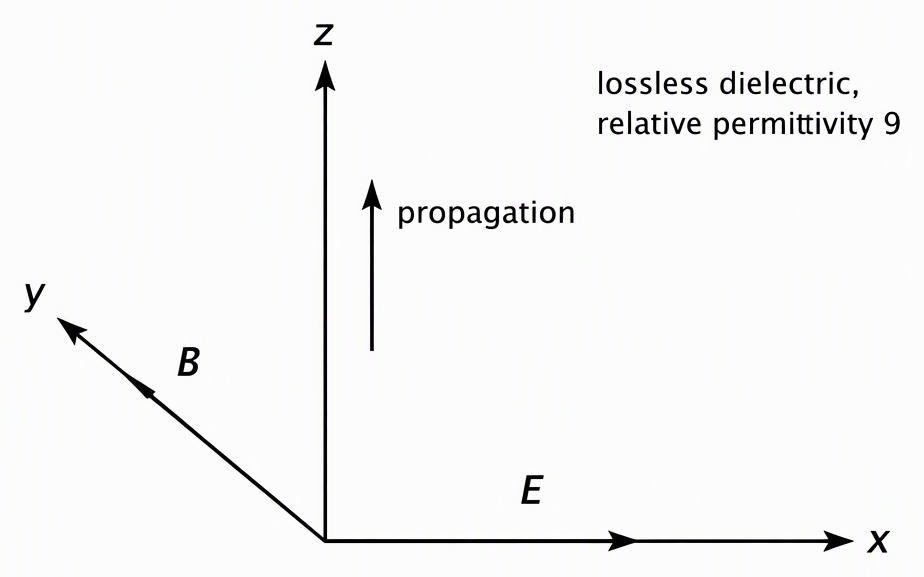
B is the official incorrect statement in this electromagnetic waves NEET 2026 question: the medium wavelength is 100 m, not 300 m. The wave travels through a lossless dielectric with relative permittivity 9. Its electric field oscillates along the x-axis, while its phase depends on position along the z-axis and time.
The supplied electric field is:
The four choices assert:
- A: The speed inside the dielectric is:
- B: The wavelength inside it is:
- C: The printed magnetic-field expression is:
- D: The wave travels towards positive z.
The supplied question bank tags this as medium difficulty, with a 90-second target, not a measured student average. The task asks for the incorrect statement.
How do you calculate the speed in the dielectric?
The speed is one-third of the vacuum speed, making A true. The official solution treats the dielectric as non-magnetic. Losslessness alone does not establish this assumption.
For a non-magnetic dielectric, use:
The speed symbols distinguish the two environments:
Substituting gives:
A correctly states the speed inside this medium. Since the question asks for the incorrect statement, do not select A.
How do you extract frequency and calculate wavelength?
The frequency is one million hertz, and the wavelength inside the dielectric is 100 m. Compare the supplied phase with the standard travelling-wave phase. The coefficient of time gives angular frequency, not frequency in hertz.
Therefore:
Convert angular frequency to ordinary frequency:
The factor of two pi cancels in this conversion. Now divide the medium speed, not the vacuum speed, by the frequency:
B states 300 m, which does not match the calculated medium wavelength. Therefore, B is the keyed incorrect statement.
How do you check propagation direction and option C’s notation?
D is true: the wave travels towards positive z. C is treated as intended true by the official solution, but its printed amplitude notation has a problem.
For a positive wave number, follow a point of constant phase:
As time increases, that point moves towards increasing z. This establishes D without relying on a memorised sign rule.
The electric field, magnetic field and propagation direction are mutually perpendicular. Their orientation satisfies:
Thus, the magnetic field is along the y-axis and in phase with the electric field. The physical amplitude relation is:
Printed C instead contains:
If its numerator means magnetic-field amplitude, the extra division by speed is not the standard relation and has the wrong units for a magnetic field. Do not silently replace the printed numerator with the electric-field amplitude.
The official solution accepts C as the intended electric–magnetic field relation. Its classification is:
- A and D: True.
- C: Treated as intended true.
- B: The keyed incorrect statement.
Why can using the vacuum speed make you wrongly select A?
Using the vacuum speed inside this dielectric makes A look false and B look true. The error starts by ignoring the given relative permittivity:
Under that assumption, A’s stated speed appears wrong:
This can lead to wrongly selecting A. The same assumption produces 300 m and incorrectly accepts B:
That is the vacuum wavelength at this frequency, not the wavelength inside the given dielectric. The correct comparison is:
Calculate speed in the stated medium before dividing by frequency. Then mark the false statement, not the first true statement you verify.
Can you solve three related electromagnetic-wave practice questions?
Use the same speed, phase and wavelength relations to solve these three questions. They are original practice written for this article, not additional verified NEET PYQs.
Question 1: What is the vacuum wavelength at the same frequency?
The vacuum wavelength is 300 m, three times the given medium’s 100 m. Use the vacuum speed because the environment has changed:
The frequency is unchanged in this comparison. The different speeds produce different wavelengths.
Question 2: What are the propagation direction and magnetic field if the phase has a plus sign?
In the same medium, with the electric field still along the x-axis, the wave travels towards negative z. The magnetic field reverses relative to the electric field. Constant phase gives:
Position decreases as time increases. The corresponding magnetic field is:
This sign makes the electric-field cross magnetic-field direction point towards negative z:
Question 3: What is the original wave’s wave-vector magnitude?
The wave-vector magnitude follows from the established 100 m wavelength:
Check it against the supplied angular frequency:
Perform this check after finding the wavelength. If it fails, recheck the medium speed and the two-pi conversion before marking the option.
Next step: the past-paper archive on NEET JEEnius AI and search past NEET papers by year, subject or chapter, each with a worked solution (100 free searches a month).
If that step was the hard part, work through How to Study Chemical Bonding NEET: Order and Practice.
Frequently asked questions
Why is option B incorrect in this electromagnetic waves question?
The official solution assumes a non-magnetic dielectric, so relative permittivity 9 gives a speed of 10^8 m/s. At a frequency of 10^6 Hz, the medium wavelength is v/f = 100 m. Option B states 300 m, which is the vacuum wavelength at this frequency, not the wavelength in the dielectric.
How do I find frequency from sin(kz − 2π × 10^6 t)?
Compare the phase with kz − ωt: the coefficient of time is angular frequency, ω = 2π × 10^6 rad/s. Divide by 2π to obtain f = 10^6 Hz.
How do I find the propagation direction from the wave equation?
For positive k and ω, a phase kz − ωt describes propagation towards positive z because a point of constant phase moves towards increasing z as time increases. Changing the phase to kz + ωt reverses propagation towards negative z.
Is the magnetic-field expression in option C correct?
As printed, option C uses B₀/v as the magnetic-field amplitude, which has incorrect units if B₀ denotes magnetic-field amplitude. The physical relation is B₀ = E₀/v, giving Bᵧ = (E₀/v) sin(kz − ωt). The official solution treats C as intended true and keys B as the incorrect statement, but the printed notation remains problematic.