
Which complex passes both tests in co-ordination compounds NEET 2005?
Option C, the cobalt(III) complex, is the correct answer to the co-ordination compounds NEET 2005 question:
The task is to select the species whose octahedral bonding uses inner d orbitals and whose electrons are all paired. Meeting just one condition is not enough.
The supplied options are:
- A
- B
- C
- D
The given atomic numbers are zinc: 30, chromium: 24, cobalt: 27 and nickel: 28. The question bank labels this question hard, with difficulty tag 3 and a 90-second target. These are question-bank metadata, not an official difficulty judgement or measured student performance.
How do you find the oxidation states and d-electron counts?
All six ammonia ligands are neutral, so each metal’s oxidation state equals its complex’s charge. Find this first, then remove electrons from the neutral atom. For these ions, 4s electrons leave before 3d electrons, even though 4s appears earlier in the usual filling sequence.
The charge calculation gives:
Use the neutral configurations to obtain the ions:
Zinc and nickel lose only their two 4s electrons. Chromium loses one 4s and two 3d electrons; cobalt loses two 4s and one 3d electron.
Each ammonia ligand supplies one donor atom, giving coordination number six. We use the octahedral VBT treatment specified in the supplied solution.
Why is the cobalt complex both diamagnetic and inner orbital?
Cobalt(III) starts with six 3d electrons. In this complex, ammonia produces pairing, leaving three paired inner orbitals and two vacant ones. That gives both required results: zero unpaired electrons and two available inner 3d orbitals.
Ammonia acts as a strong-field ligand for cobalt(III) here. This does not mean ammonia forces pairing with every metal ion.
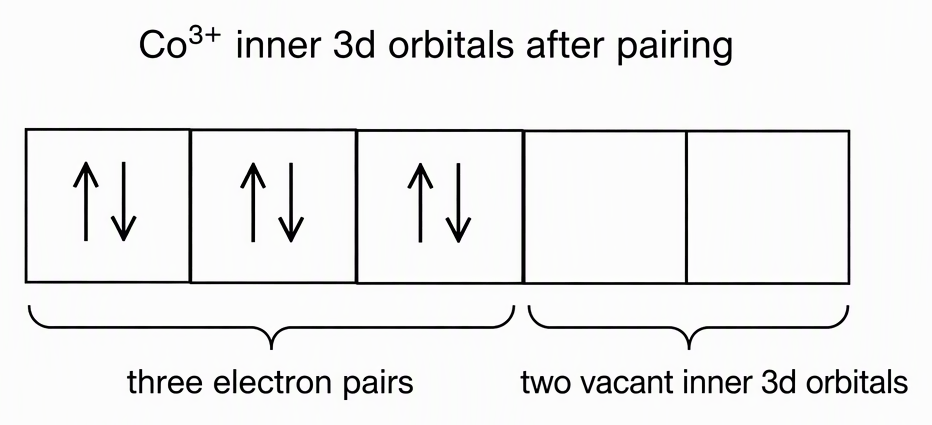
The paired occupancy is:
Count the pairs and remaining unpaired electrons:
Zero unpaired electrons means diamagnetic behaviour. This proves the magnetic condition, but the orbital count still needs checking.
The three pairs occupy only three of the five inner 3d orbitals:
Those two vacant orbitals join one 4s and three 4p orbitals in the VBT construction:
Using the inner 3d shell makes the complex inner orbital. Both conditions are now proved, confirming C without a crystal-field energy calculation.
Why do zinc, chromium and nickel fail?
Zinc fails the inner-orbital test, chromium fails the magnetic test, and nickel fails both. Keep orbital availability separate from unpaired-electron count: an inner-orbital complex need not be diamagnetic, and a diamagnetic complex need not be inner orbital.
- A, zinc: d count: ten; unpaired electrons: zero; inner-orbital status: no. All five inner 3d orbitals are filled. Verdict: diamagnetic, but rejected because no vacant inner d orbitals remain.
- B, chromium: d count: three; unpaired electrons: three; inner-orbital status: yes. Three singly occupied 3d orbitals leave two vacant. Verdict: inner orbital, but rejected because it is paramagnetic.
- C, cobalt: d count: six, paired; unpaired electrons: zero; inner-orbital status: yes. Three paired orbitals leave two vacant. Verdict: passes both conditions.
- D, nickel: d count: eight; unpaired electrons: two in the octahedral complex; inner-orbital status: no. It cannot provide two vacant inner 3d orbitals. Verdict: rejected on both conditions.
Chromium proves that two empty 3d orbitals can exist without complete electron pairing. Vacant orbitals decide inner-orbital availability, not magnetic behaviour.
Why does checking only magnetism lead to option A?
Selecting zinc because all its electrons are paired gives a correct magnetic conclusion but an incomplete answer. The question requires both properties. The faulty chain is:
The last step is wrong. Filled inner orbitals do not provide the two vacant inner d orbitals required for this VBT construction.
Use this checklist:
- Find the oxidation state.
- Derive the d-electron count.
- Determine pairing and count unpaired electrons.
- Check for two vacant inner d orbitals.
- Give the verdict only after both tests.
If electron removal or hybridisation still causes confusion, use Chemical bonding study order and practice before attempting the practice questions below.
Can you apply the same VBT sequence to three related questions?
Use oxidation state, d count, pairing and orbital availability in that order for each question. These are original practice questions based on the supplied complexes, not additional verified PYQs. Attempt each before reading its worked answer.
What are the oxidation state, d count and unpaired electrons in the chromium complex?
The answers are positive three, three d electrons and three unpaired electrons. Neutral ammonia leaves chromium in the positive-three state:
Removing one 4s and two 3d electrons gives:
The three electrons occupy separate d orbitals. Two inner orbitals remain vacant, so inner-orbital bonding is possible despite paramagnetism.
Can a fully occupied d shell supply two vacant inner d orbitals?
No: all five inner d orbitals are filled. The zinc complex demonstrates this:
It is diamagnetic because every electron is paired. However, it cannot supply two vacant inner d orbitals for:
How do the cobalt and nickel complexes differ in unpaired electrons?
Cobalt has zero; octahedral nickel has two. Neutral ammonia gives cobalt(III) and nickel(II), so electron removal produces:
\begin{aligned} [\mathrm{Co}(\mathrm{NH}_3)_6]^{3+}&:\ 3d^6 \ \longrightarrow\ 0\text{ unpaired}\\ [\mathrm{Ni}(\mathrm{NH}_3)_6]^{2+}&:\ 3d^8 \ \longrightarrow\ 2\text{ unpaired} \end{aligned}Cobalt’s six electrons form three pairs here. Nickel’s octahedral eight-electron arrangement has three pairs and two single electrons, so it remains paramagnetic.
Next step: photograph a doubt on NEET JEEnius AI and photograph any question you are stuck on and get a step-by-step solution across Physics, Chemistry and Biology (20 free a month).
Frequently asked questions
Which option is correct in the coordination compounds NEET 2005 question?
Option C, [Co(NH3)6]3+, is correct because it is both inner orbital and diamagnetic. Its cobalt(III) ion has six d electrons that form three pairs, leaving two vacant inner 3d orbitals.
What is the hybridisation of [Co(NH3)6]3+?
In the octahedral VBT treatment, [Co(NH3)6]3+ has d2sp3 hybridisation. Two vacant inner 3d orbitals combine with one 4s and three 4p orbitals. Ammonia produces pairing for cobalt(III) in this complex, so no unpaired electrons remain.
Why is [Zn(NH3)6]2+ not the correct answer?
[Zn(NH3)6]2+ is diamagnetic, but it fails the inner-orbital condition. The zinc(II) ion has a filled 3d10 shell and cannot supply two vacant inner 3d orbitals. The question requires both diamagnetism and inner-orbital bonding.
Can an inner-orbital complex be paramagnetic?
Yes; [Cr(NH3)6]3+ is an example in this question. Chromium(III) has three d electrons occupying separate orbitals, leaving two vacant inner 3d orbitals available for bonding. Its three unpaired electrons make it paramagnetic despite its inner-orbital character.