Chemical Bonding NEET 2025: which property orders are correct?
Option A, statements A and D only, is correct for this Chemical Bonding NEET 2025 question. It belongs to Chemical Bonding and Molecular Structure and is tagged hard on this question bank’s scale. The suggested solving time is 90 seconds, not a measured student average.
Check four proposed decreasing orders, using a separate rule for each property:
- Statement A, molecular dipole moment:
- Statement B, central-atom lone pairs:
- Statement C, bond length:
- Statement D, bond enthalpy:
The supplied choices are option A: statements A and D only, and option C: statements A and C only. The supplied record does not contain the text of options B and D.
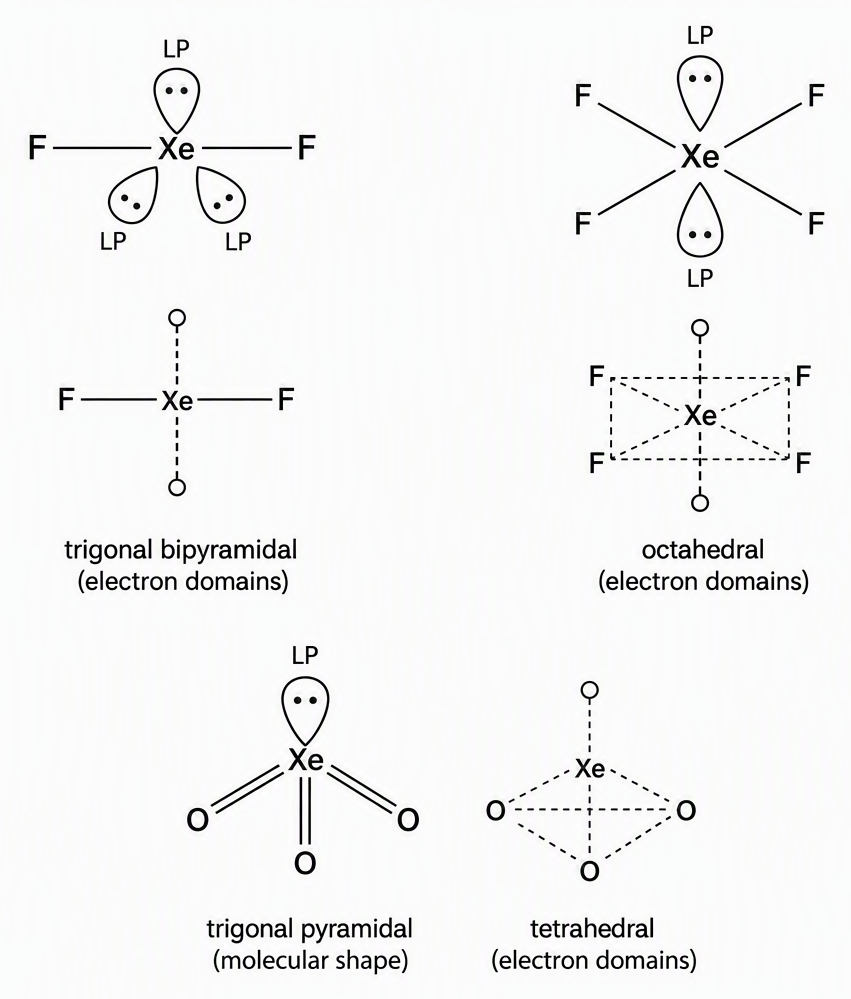
Use four independent checks, not one ranking shortcut. The xenon comparison concerns lone pairs on the central atom and requires distinguishing molecular shape from electron-domain arrangement.
Why is statement A correct for dipole moment?
A is true because the supplied molecular dipole moments decrease from water to ammonia to chloroform. Use these approximate values, rather than ranking different molecules by electronegativity alone.
D denotes debye, a unit of dipole moment. These are molecular values, reflecting the vector addition of bond dipoles, not the polarity of one selected bond.
Shape matters because dipoles have directions. But shape alone neither supplies these numerical values nor settles every comparison between different molecules.
How do you count xenon lone pairs in statement B?
B is false: XeF₂ has three central lone pairs, not the fewest. Start with xenon’s eight valence electrons and use the conventional Lewis structures rather than recalling shapes without counting.
For this bookkeeping, assign one xenon electron per single bond and two per double bond. Divide the remaining xenon electrons by two to obtain the lone-pair count.
- XeF₄: Four Xe–F single bonds use four xenon electrons. Its molecular shape is square planar.
- XeO₃: Three Xe=O double bonds use six xenon electrons. Its molecular shape is trigonal pyramidal.
- XeF₂: Two Xe–F single bonds use two xenon electrons. Its molecular shape is linear.
Electron counting and VSEPR domain counting are different. Each Xe=O double bond occupies one bonding domain, not two; therefore, XeO₃ has three bonding domains and one lone-pair domain.
Why is statement C’s bond-length order reversed?
C is false because the correct decreasing length order starts with N–O and ends with O–H. Read the property label first: a greater bond length means a larger internuclear separation, not a stronger or shorter bond.
For the bonds as written, the official solution uses a qualitative atomic-size and bonding comparison. O–H is shorter than C–H, while N–O is longer than either.
Statement C proposes the reverse. This comparison applies to the generic bonds in this question, not every molecular environment containing those atom pairs.
Why is statement D correct, and which option follows?
D is true, so the final answer is option A: statements A and D only. Bond enthalpy here compares the energy required to break the bond in each diatomic molecule.
The official solution compares bond orders:
- N₂: Bond order three.
- O₂: Bond order two.
- H₂: Bond order one.
For this particular set, the bond-enthalpy ranking follows that trend. Bond order is not a universal numerical predictor across arbitrary atom pairs; atom identity also matters.
The completed verdicts are:
- Statement A: true.
- Statement B: false.
- Statement C: false.
- Statement D: true.
Select answer option A, meaning statements A and D only. The answer-option label A is not the same thing as statement A.
Why does option C fail in this Chemical Bonding NEET 2025 question?
Option C includes false statement C and leaves out true statement D. It says “statements A and C only”, so both defects matter.
A concrete error is recognising O–H as the shortest bond, then mentally reading the greater-than sign as “shorter than”. That falsely validates statement C even though the property being ranked is length. Repair the reading by writing “longer than” above each sign:
This mistake can explain accepting statement C, but it does not explain rejecting statement D. Check enthalpy independently before selecting an option.
What related Chemical Bonding questions can I practise?
Try these three original related practice questions, not additional verified NEET PYQs. They test bond polarity versus molecular dipole, electrons versus domains, and increasing versus decreasing orders.
- If Xe–F bonds are polar, which of XeF₂ and XeF₄ has zero molecular dipole moment?
Answer: both. Opposite bond-dipole vectors cancel in linear XeF₂ and square-planar XeF₄, so polar bonds do not guarantee a polar molecule.
- In the conventional Lewis structure of XeO₃, do the three double bonds count as three or six VSEPR bonding domains, and how many lone pairs remain on Xe?
Answer: three bonding domains and one lone pair. Each double bond counts as one domain, giving four electron domains, a tetrahedral electron-domain arrangement and a trigonal-pyramidal molecular shape.
- Rewrite the main question’s bond-length and bond-enthalpy comparisons in increasing order.
Answer:
Increasing order runs from the smallest property value to the largest, so reverse each corrected decreasing order, not the original false statement.
Next step: photograph a doubt on NEET JEEnius AI and photograph any question you are stuck on and get a step-by-step solution across Physics, Chemistry and Biology (20 free a month).
For a worked example of the same idea, see Newton's Law of Cooling NEET 2014: Why the Answer Is 45 °C.
Frequently asked questions
Which option is correct in this Chemical Bonding NEET 2025 question?
Option A, meaning statements A and D only, is correct. The proposed dipole-moment and bond-enthalpy orders are true, while the central-atom lone-pair and bond-length orders are false.
What is the dipole moment order of H₂O, NH₃ and CHCl₃?
The decreasing order is H₂O > NH₃ > CHCl₃, with approximate dipole moments of 1.85 D, 1.47 D and 1.04 D, respectively. These are molecular dipole moments, determined by vector addition of bond dipoles rather than electronegativity alone.
How many lone pairs are on xenon in XeF₂, XeF₄ and XeO₃?
In their conventional Lewis structures, XeF₂ has three central lone pairs, XeF₄ has two and XeO₃ has one. The decreasing order is therefore XeF₂ > XeF₄ > XeO₃. Each Xe=O double bond in XeO₃ counts as one VSEPR bonding domain, not two.
What is the correct bond length order of O–H, C–H and N–O?
For the generic bonds in this question, the decreasing bond-length order is N–O > C–H > O–H. Read each greater-than sign as 'longer than', not 'stronger than'. This comparison should not be extended to every molecular environment containing these atom pairs.
Why is the bond enthalpy order N₂ > O₂ > H₂?
For these three diatomic molecules, the bond-enthalpy order follows their bond orders: three for N₂, two for O₂ and one for H₂. Thus, statement D is correct. Bond order alone is not a universal predictor of bond enthalpy across different atom pairs.