
Combination of Lenses NEET 2023: −100 cm Solution
The combination of lenses NEET 2023 question has an equivalent focal length of −100 cm. NEET 2023 asks for the equivalent focal length of three thin lens layers in contact. This single-correct Physics question has a hard question-bank difficulty tier and an expected solving time of 120 seconds.
The choices are:
From left to right, the refractive indices are 1.6, 1.5 and 1.6. The successive signed surface radii used in the official solution are infinity, +20 cm, −20 cm and infinity.
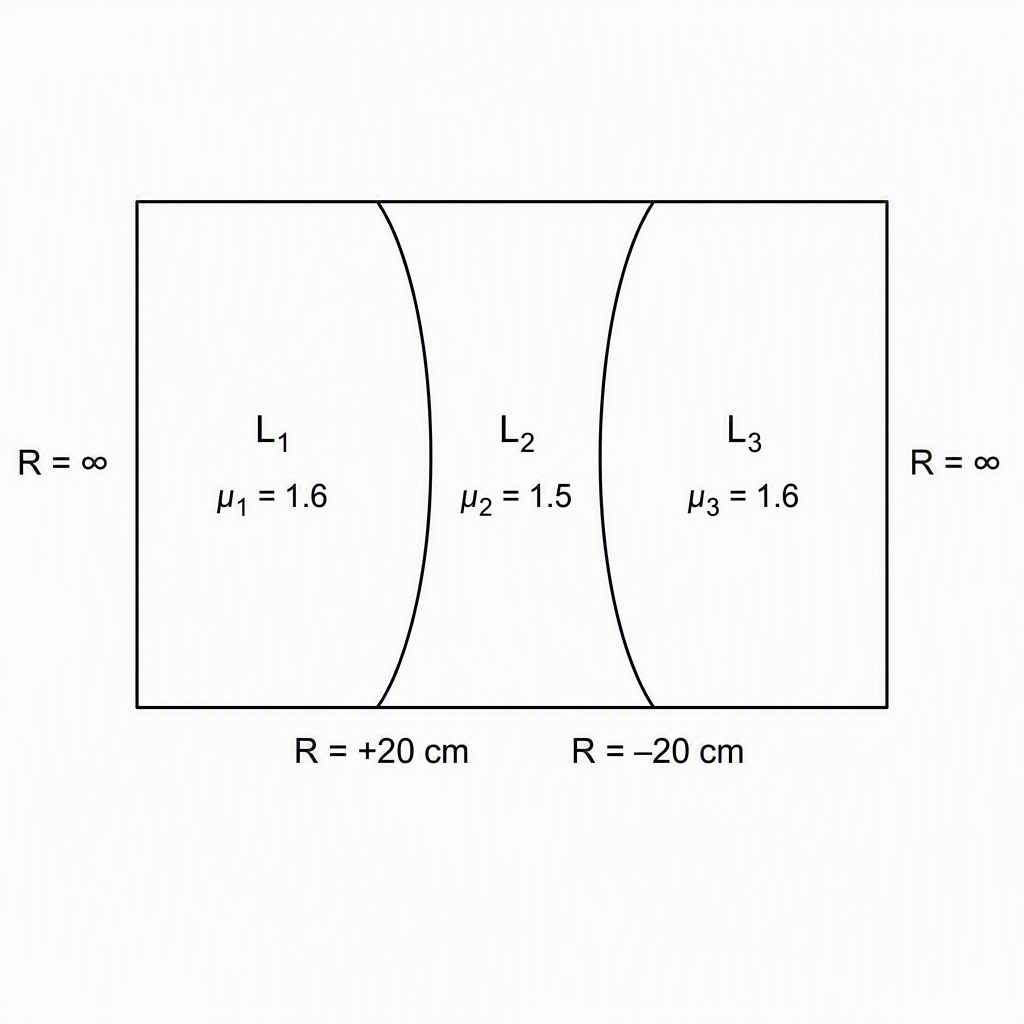
Treat the arrangement as three thin layers. Assign the refractive index and two signed radii to every layer before calculating any focal power.
How do you assign the radius signs to each lens layer?
Use the radii in the order encountered from left to right. The three required pairs are infinity and +20 cm, then +20 cm and −20 cm, then −20 cm and infinity. This signed-radius mapping is the main test in the combination of lenses NEET 2023 problem.
The lens-maker relation is:
Write a separate parameter row for each layer:
- Layer 1
- Layer 2
- Layer 3
The same curved boundary is the second surface of one layer and the first surface of the next. Carry its signed value exactly as specified in the official construction. Do not change the sign when moving to the next layer.
How do you calculate and add the three lens powers?
Calculate each layer separately, then add the three focal powers. The outer plane surfaces contribute zero because the reciprocal of an infinite radius is zero. The two outer layers give negative power, while the middle layer gives positive power.
For the first layer:
For the second layer:
For the third layer:
For thin lenses in contact, the effective power is the sum of the individual powers:
Substitute and add the three powers:
Take the reciprocal without losing the negative sign:
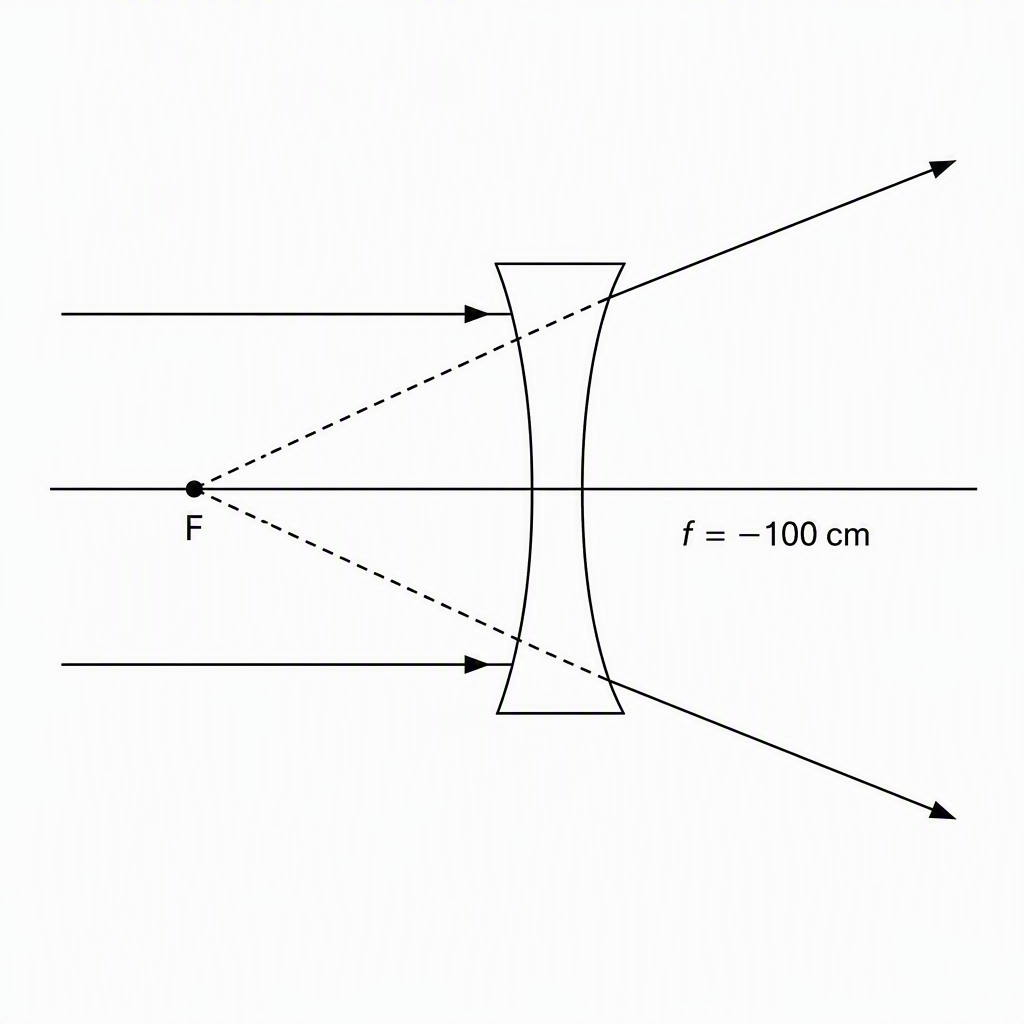
Option C is the official correct answer. The negative focal length means the net lens combination is diverging.
Why can the −50 cm option appear?
The −50 cm result comes from a specific parameter-handling mistake: entering the middle-layer refractive-index difference as 0.4 instead of calculating it from 1.5. The method failure is starting arithmetic without first making a separate refractive-index and radius row for every layer.
The correct subtraction is:
The incorrect entry is:
With that wrong value, the middle-layer power becomes:
The resulting total is:
Taking the reciprocal gives:
This is option D, but it follows from an incorrect middle-layer parameter. Calculate every refractive-index difference explicitly, then check the final power sum before taking the reciprocal. Here, the power pattern must be negative, positive, negative.
Which related combination-of-lenses questions should you practise?
Practise these three algebraic checks after solving the combination of lenses NEET 2023 question. They test focal-power addition, radius signs and unit conversion. Keep centimetres throughout the first two questions, and convert from dioptres only after adding the powers in the third.
What is the focal length of lenses with +20 cm and −30 cm focal lengths?
The equivalent focal length is +60 cm. Since the two thin lenses are in contact, add their reciprocal focal lengths with their signs intact. The positive result means that this combination is converging.
Therefore:
What is the focal length of a plano-concave lens with radius +25 cm?
The focal length is −50 cm. Use the given refractive index and signed radii directly in the lens-maker formula. The plane first surface has an infinite radius, so its reciprocal contributes zero.
Therefore:
What is the combined focal length for powers +2 D, −5 D and +1 D?
The total power is −2 D, giving a focal length of −0.5 m or −50 cm. Since the powers are already in dioptres, add them directly before converting the result to focal length.
For every layered-lens problem, write one separate row containing the refractive index, first radius and second radius for each layer before touching the calculator.
Next step: the past-paper archive on NEET JEEnius AI and search past NEET papers by year, subject or chapter, each with a worked solution (100 free searches a month).
Frequently asked questions
What is the answer to the combination of lenses NEET 2023 question?
The equivalent focal length is −100 cm, so Option C is correct. The net power is −0.01 cm⁻¹, and the negative sign shows that the combination is diverging.
How do I assign radius signs in the NEET 2023 lens combination?
From left to right, use the surface radii ∞, +20 cm, −20 cm and ∞. The layer pairs are (∞, +20 cm), (+20 cm, −20 cm) and (−20 cm, ∞); retain the same signed boundary value for adjacent layers.
How are the powers of the three lens layers added?
Using the lens-maker formula gives layer powers of −0.03, +0.05 and −0.03 cm⁻¹. Their sum is −0.01 cm⁻¹, whose reciprocal is −100 cm.
Why does −50 cm appear as an option?
It results from incorrectly using μ₂ − 1 = 0.4 for the middle layer instead of 1.5 − 1 = 0.5. That error changes the middle power to +0.04 cm⁻¹ and produces a total focal length of −50 cm.