What Was the 2018 NEET Question on Density Ratio of Iron When It Changes from BCC to FCC?
Iron exhibits BCC structure at room temperature and transforms to FCC above 900 °C. Molar mass and atomic radius remain constant. The task is to calculate the ratio of density at room temperature to density at 900 °C.
Options are:
How Do BCC and FCC Unit Cells Relate Edge Length a to Atomic Radius r?
For BCC, Z = 2 and a = 4r/√3. For FCC, Z = 4 and a = 2√2 r. BCC packs 2 atoms per cell with body diagonal 4r. FCC packs 4 atoms per cell with face diagonal 4r.
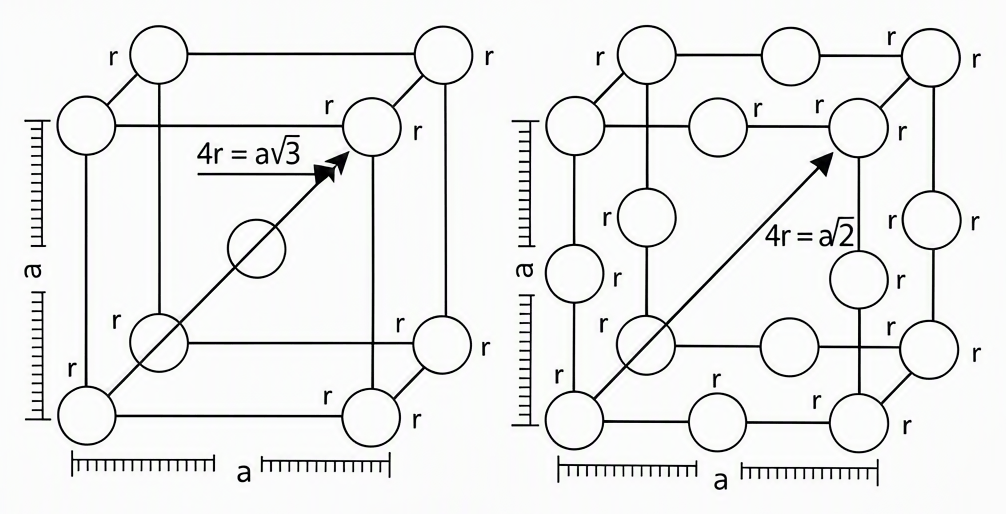
BCC uses a smaller cube edge for the same r yet only half the atoms that FCC fits into its larger cube. This difference in both Z and a³ drives the final density ratio.
What Is the Official Step-by-Step Solution for the Density of Crystal Lattice NEET 2018 Question?
The official NEET 2018 solution uses the density formula . Because M, N_A and r are constant, the ratio is:
The term inside the bracket simplifies to .
Cubing gives .
Overall: which equals .
The correct choice is therefore option D.
Why Does Treating the Density Ratio as Simply Z_BCC/Z_FCC Give the Wrong Answer?
Treating the density ratio as simply Z_BCC/Z_FCC = 2/4 = 1/2 without substituting or cubing the lattice-parameter terms produces option C. The mistake is forgetting that volume of the unit cell (a³) changes differently in the two lattices even when r is constant.
Correct method requires both the Z ratio and the inverse-cubed ratio of the two different a values derived from the same r. The official sequence converts 3√6/8 into 3√3/(4√2) only when the algebra is completed without shortcuts.
How Can You Apply These Steps to Related Solid-State Density Questions?
A metal has BCC structure with density 2.0 g cm⁻³ and edge length 300 pm; calculate its atomic mass (M).
Use . Here Z = 2, a = 300 pm = 3 × 10^{-8} cm, so a³ = 2.7 × 10^{-23} cm³. Then:
FCC iron would have higher packing efficiency than BCC because more atoms fit per unit volume when r is fixed. Yet the density ratio here is less than 1 when r is fixed because the increase in a³ for FCC outweighs the Z increase to make d_FCC > d_BCC.
An element crystallises in FCC with a = 400 pm and density 2.5 g cm⁻³; find the radius r and number of unit cells in 1 g sample.
First, molar mass:
Radius from a = 2√2 r:
Mass of one unit cell = density × a³ = 2.5 × 6.4 × 10^{-23} = 1.6 × 10^{-22} g. Number of unit cells in 1 g = 1 / (1.6 × 10^{-22}) = 6.25 × 10^{21}.
Search past NEET papers by chapter with the past-paper archive to find every similar worked solution (100 free searches a month).
What Formulae and Quick Revision Points Must You Memorise for Density of Crystal Lattice Questions?
BCC: body diagonal = √3 a = 4r → a = 4r/√3.
FCC: face diagonal = √2 a = 4r → a = 4r/(√2) = 2√2 r.
Ratio of densities always = (Z1/Z2) × (a2/a1)³ when M and NA are same.
When the final expression contains √6 in the numerator, multiply numerator and denominator by √2 to obtain separate √3 and √2 terms that match typical NEET options. Practise writing a expressions for both lattices the moment you read “BCC” or “FCC” so the ratio simplifies in under two minutes. If a similar problem still trips you, photograph a doubt for an immediate step-by-step solution.
Next step: photograph a doubt on NEET JEEnius AI and photograph any question you are stuck on and get a step-by-step solution across Physics, Chemistry and Biology (20 free a month).
If that step was the hard part, work through Diversity in Living World NEET 2013: Three Correct Statements.
Frequently asked questions
What was the NEET 2018 density of crystal lattice question?
The question asked for the ratio of density of iron at room temperature in BCC structure to its density above 900 °C in FCC structure. Molar mass and atomic radius remain the same. The correct answer is option D, 3√3/(4√2), obtained after accounting for both Z and unit cell volume changes.
How to calculate density ratio from BCC to FCC when r is constant?
Apply the density formula ratio d_BCC/d_FCC = (Z_BCC/Z_FCC) × (a_FCC/a_BCC)^3. Substitute a_BCC = 4r/√3 and a_FCC = 2√2 r. This simplifies to 3√3/(4√2) after algebraic steps including rationalising √6/2 cubed. Always write the a expressions immediately upon seeing BCC or FCC.
Why is the density ratio not simply 1/2 in NEET 2018 question?
Taking only Z_BCC/Z_FCC = 2/4 = 1/2 ignores that the unit cell edge length a differs for the same atomic radius in each lattice. FCC has a larger a for fixed r, so its a³ increase must be cubed and multiplied. The full calculation yields 3√3/(4√2) instead of 0.5, matching official option D.
What is the relation between a and r in BCC and FCC for density questions?
For BCC the body diagonal equals 4r, so a√3 = 4r and a = 4r/√3. For FCC the face diagonal equals 4r, so a√2 = 4r and a = 2√2 r. These two relations are essential to find the ratio of a³ values when radius is constant in NEET problems.