
What was the NEET 2025 electrostatics question on extra charge and energy when a dielectric fills a battery-connected capacitor?
Extra charge drawn is 4 mC and stored energy increases by 0.2 J. A 40 μF parallel-plate capacitor initially connected to a 100 V supply has a dielectric of K=2 inserted that completely fills the gap between plates. The task is to find the additional charge drawn from the supply and the change in stored electrostatic energy.
The battery keeps V fixed at 100 V. Capacitance rises from 40 μF to 80 μF, so the supply must provide extra charge and the stored energy increases.
What does the setup diagram look like for this electrostatics NEET 2025 capacitor problem?
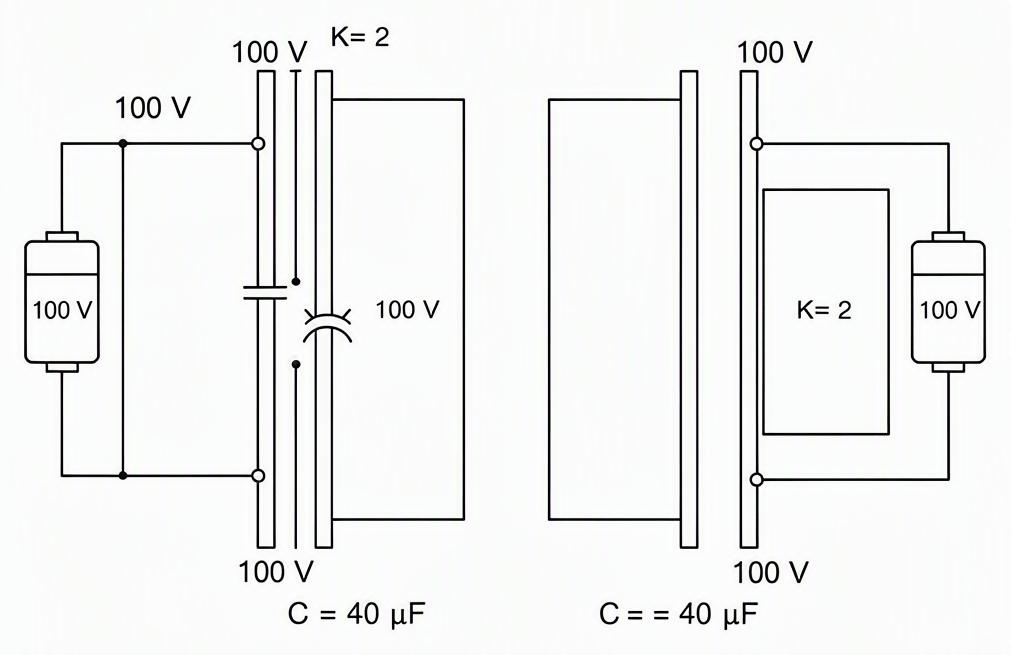
The battery maintains 100 V on the left. The K=2 slab fills the entire gap with zero air gap, so only the full-dielectric formulas apply.
What is the official step-by-step solution for the NEET 2025 electrostatics capacitor question?
Extra charge is 4 mC and energy change is 0.2 J. Use the connected-capacitor rules directly.
Given
,
,
.
Extra charge
Energy change
The pair 4 mC and 0.2 J is the correct option.
Which single method mistake produces the wrong 2 mC and 0.4 J option in this electrostatics NEET 2025 question?
Treating the energy change formula as (K-1)CV² instead of (1/2)(K-1)CV² while also incorrectly halving the charge increment produces 2 mC and 0.4 J.
The wrong steps are
Battery maintains constant V so charge rises from CV to KCV giving Δq = (K-1)CV. Stored energy rises from (1/2)CV² to (1/2)KCV² giving ΔU = (1/2)(K-1)CV². The factor 1/2 must be retained because energy is quadratic in charge or voltage.
What two practice questions on dielectric capacitors match the NEET 2025 connected-case method?
Isolated case (charge constant): The same 40 μF capacitor is charged to 100 V then disconnected. A K=2 dielectric completely fills the gap. Find the change in stored energy.
Q = 4 × 10^{-3} C stays fixed. New voltage is 50 V and final energy is 0.1 J, so ΔU = −0.1 J. This contrasts with the connected case where energy increases.
Ratio for connected case (K=3): A capacitor connected to a battery has dielectric K=3 inserted. Find the ratio of final stored energy to initial stored energy.
With battery connected, V is constant and energy scales with C, so ratio = 3. The connected case always uses the (K-1)CV and (1/2)(K-1)CV² expressions shown above.
What key rules for dielectric effect on capacitors must you revise before NEET 2025?
When connected to supply: V constant, C → KC, extra charge = (K-1)CV, ΔU = (1/2)(K-1)CV² (positive, energy increases).
For isolated capacitor, Q constant, V drops by factor K, and stored energy decreases to 1/K of initial value.
These rules cover every dielectric-capacitor MCQ that has appeared in recent papers. Integrate them into final revision with the NEET 30 Day Strategy: Best 10-Hour Revision Timetable.
How does this dielectric capacitor question fit the NEET 2025 physics paper pattern?
Physics had 45 compulsory MCQs. This 120-second calculation question tested precise formula recall under time pressure. The marking scheme (+4, -1) makes selecting the wrong energy factor costly.
Solve all past electrostatics questions from the archive during 250-day preparation. Search past NEET papers by year, subject or chapter, each with a worked solution (100 free searches a month). That habit removes doubt on connected versus isolated cases before the actual exam.
Next step: photograph a doubt on NEET JEEnius AI and photograph any question you are stuck on and get a step-by-step solution across Physics, Chemistry and Biology (20 free a month).
Frequently asked questions
What was the electrostatics NEET 2025 question on capacitor with dielectric?
The question involved a 40 μF capacitor connected to 100 V battery. When a K=2 dielectric is inserted filling the gap, find extra charge drawn and change in stored energy. The answers are 4 mC and +0.2 J respectively.
How to find extra charge in battery connected capacitor with dielectric NEET?
Use the formula Δq = (K-1)CV. With K=2, C=40×10^{-6} F and V=100 V, Δq = (2-1)×40×10^{-6}×100 = 4×10^{-3} C or 4 mC. The battery maintains constant potential difference.
Why does energy increase in connected capacitor with dielectric NEET 2025?
With battery connected, voltage is fixed. As capacitance becomes KC, energy which is (1/2)CV² becomes (1/2)KCV². Thus ΔU = (1/2)(K-1)CV² = 0.2 J. The battery supplies the additional energy.
What is the common mistake in NEET electrostatics capacitor energy question?
Students often use ΔU = (K-1)CV² instead of (1/2)(K-1)CV² or halve the Δq incorrectly. This gives the trap option of 2 mC and 0.4 J. Remember to keep the 1/2 factor as energy formula has 1/2.