
What does the equivalent capacitance NEET 2023 question ask?
The equivalent capacitance NEET 2023 circuit gives 3 μF under the stated balanced-bridge working, although the verified answer key marks 2 μF. This single-correct problem asks for the equivalent capacitance of the displayed capacitor network between its two terminals.
The choices are:
This is a hard Electrostatics question with an expected solving time of 120 seconds. The main test is recognising the balanced bridge before combining capacitors.
How should you solve the capacitor bridge step by step?
The network is interpreted as a balanced capacitor Wheatstone bridge. Each outer branch contains two 3 μF capacitors, while another capacitor joins the two branch midpoints. Test the bridge balance before combining any capacitors.
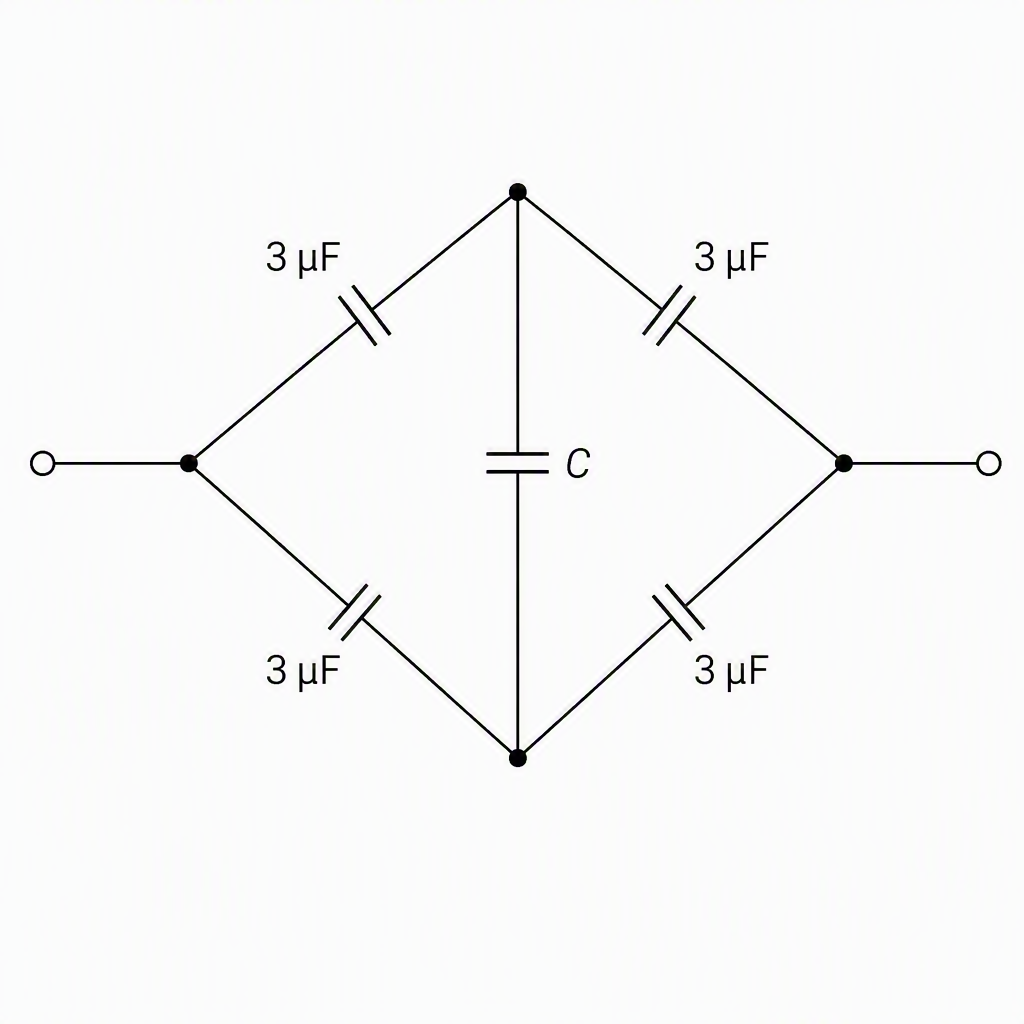
Why can you remove the middle capacitor?
The upper and lower branches are identical, so their corresponding capacitors divide the terminal potential equally. The two branch midpoints are therefore at the same potential. This makes the potential difference across the middle capacitor zero:
The charge stored by a capacitor is:
Hence:
The middle capacitor carries no charge, irrespective of its capacitance. Remove only this capacitor while calculating the terminal equivalent capacitance.
This is not a short circuit between the midpoints. A short circuit joins two points through a zero-resistance conducting path. Here, the capacitor branch has zero potential difference and does not affect the equivalent capacitance.
What is the equivalent capacitance of each outer branch?
Each outer branch contains two 3 μF capacitors in series, so its equivalent capacitance is 1.5 μF. For the upper branch:
The lower branch is identical:
The two reduced branches are connected in parallel between the same terminals. Parallel capacitances add:
The balanced-Wheatstone reduction shown in the supplied solution therefore gives:
Why does the answer key say 2 μF when the calculation gives 3 μF?
The supplied bridge reduction evaluates to 3 μF, not 2 μF. However, the verified answer key marks option A, 2 μF. That is the official final answer to report for this archived equivalent capacitance NEET 2023 item.
There is no valid step in the displayed working that converts 3 μF into 2 μF. With four outer capacitors of 3 μF each, each series branch reduces to 1.5 μF, and the two parallel branches total 3 μF.
The supplied official solution indicates a different interpretation or rendering of the original circuit. That is the only supported explanation for the mismatch. Do not invent another capacitor value, alter the circuit or manufacture algebra to reach the keyed option.
Calculated result from the stated interpretation: 3 μF. Keyed answer for the item: option A, 2 μF.
Which mistake produces the 6 μF option?
Option C results if two equal 3 μF capacitors in series are incorrectly treated as having an equivalent capacitance of 3 μF. That error assigns 3 μF to each outer branch and then adds the two branches in parallel:
The correct series calculation is:
Therefore:
Use this diagnostic rule:
- Equal capacitors in series give:
- Equal capacitors in parallel give:
Series capacitance must be smaller than either individual capacitor. If two 3 μF capacitors in series give 3 μF or more, the reduction is wrong.
Which related equivalent-capacitance questions should you practise?
Practise these three problems to test bridge balance, series reduction and parallel addition. In every bridge, prove that the midpoints are at equal potential before removing the central capacitor.
What is the equivalent capacitance when all four bridge capacitors are 4 μF?
The terminal equivalent is 4 μF. A balanced bridge has four outer capacitors of 4 μF each and an arbitrary central capacitor. The central capacitor carries no charge because the two midpoints are at equal potential.
Each outer branch gives:
The branches are parallel:
What is the equivalent capacitance when the bridge branches contain unequal capacitors?
The equivalent capacitance is 10/3 μF. The upper branch contains 2 μF and 4 μF, while the lower branch contains 3 μF and 6 μF. A capacitor joins their midpoints, so test the balance ratios first:
The bridge is balanced, so the central capacitor can be removed. The upper branch becomes:
The lower branch becomes:
Adding the parallel branches:
What is the equivalent of two 6 μF capacitors in series and parallel with 3 μF?
The equivalent capacitance is 6 μF. The two 6 μF capacitors first form one series branch, which is then placed in parallel with a 3 μF capacitor.
The series branch reduces to:
The two parallel capacitances then add:
What should you remember in the NEET exam?
Follow the same four-step order in a timed single-correct paper. First establish symmetry or bridge balance. Remove only a branch with zero potential difference, reduce all series groups, and then add the parallel groups.
- Inspect symmetry or test the bridge-balance ratio.
- Remove only a branch with zero potential difference.
- Reduce the series groups.
- Add the parallel groups.
A capacitor drawn at the centre of a bridge is not automatically removable. Balance must be established first.
NEET uses +4 for a correct answer and -1 for a wrong answer. If an archived item is internally inconsistent, record the valid calculation and the verified key separately. Never fabricate a calculation to make them agree.
Next step: the past-paper archive on NEET JEEnius AI and search past NEET papers by year, subject or chapter, each with a worked solution (100 free searches a month).
Frequently asked questions
What is the answer to the equivalent capacitance NEET 2023 question?
Under the displayed balanced-bridge interpretation, the equivalent capacitance is 3 μF. Each outer branch reduces to 1.5 μF, and the two branches add in parallel. However, the verified answer key marks option A, 2 μF.
Why can the middle capacitor be removed from a balanced bridge?
The two branch midpoints are at the same potential, so the potential difference across the middle capacitor is zero. Since Q = CΔV, it stores no charge and does not affect the terminal equivalent capacitance.
Why is 6 μF wrong for this capacitor network?
The 6 μF option comes from incorrectly treating two 3 μF capacitors in series as 3 μF. Their correct series equivalent is 1.5 μF, so two such branches in parallel give 3 μF.
How do I solve a balanced capacitor bridge in NEET?
First prove symmetry or verify the bridge-balance ratio. Remove only the capacitor across equal-potential points, reduce each series group, and then add the parallel branches. Never remove the central capacitor merely because it is drawn across the bridge.