
What is the correct answer to the Formal Charge NEET 2026 hard question?
The formal charge NEET 2026 question has answer B: 0, +1, −1. It belongs to Chemical Bonding and Molecular Structure, has a hard difficulty tag and has a listed expected solving time of 90 seconds. You must evaluate three labelled oxygen atoms independently, then report their charges specifically in the order O2, O1, O3.
The single-correct question gives a labelled Lewis structure. You must find the formal charges on oxygen atoms 2, 1 and 3 without changing the requested order.
The four choices are:
First calculate the charge attached to each oxygen label. Then arrange the results as O2, O1, O3.
Which formal charge formula and electron-counting rule should you use?
Use the official shared-electron method. Every oxygen atom contributes 6 valence electrons. Count shared and non-bonding electrons separately before substitution. Counting bonds instead of bonding electrons gives the wrong input.
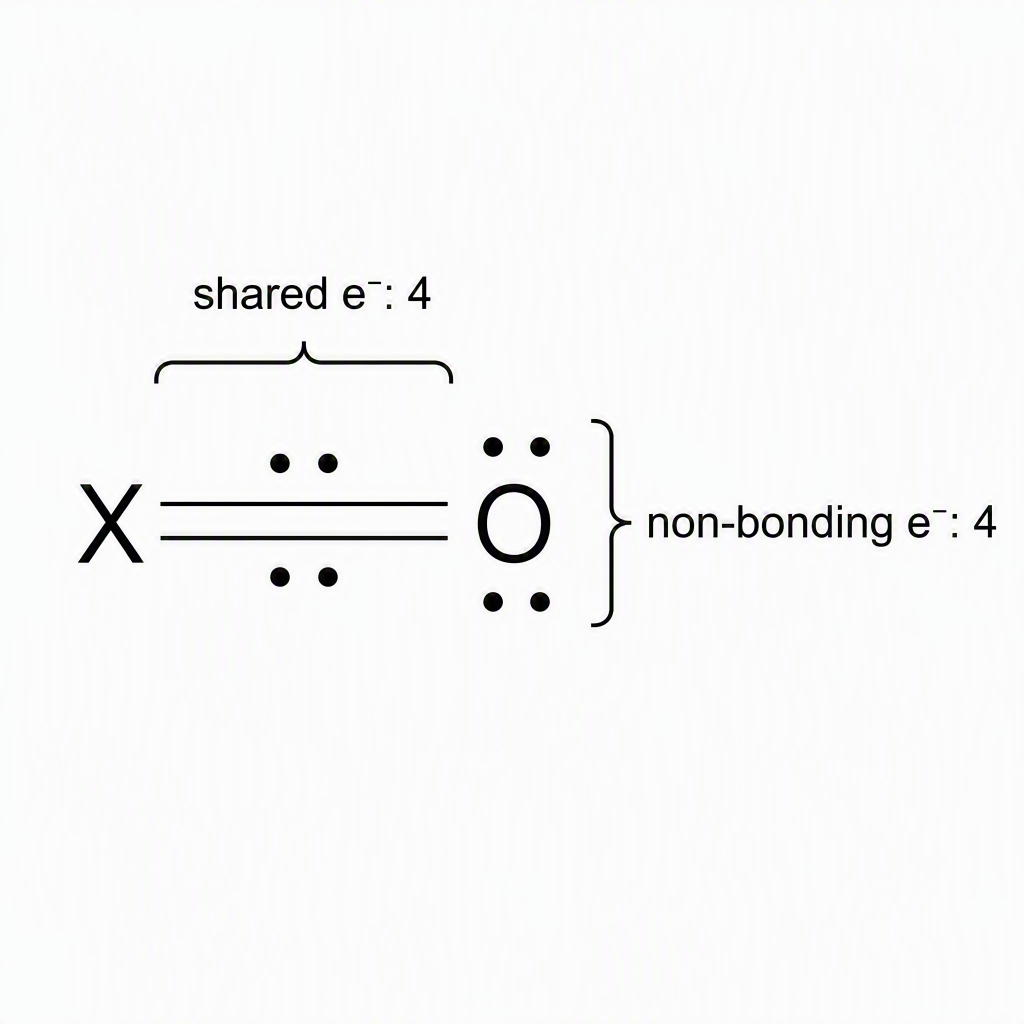
A single bond contains 2 shared electrons, a double bond contains 4, and a triple bond contains 6.
- Enter lone-pair electrons in full because they are non-bonding electrons.
- Halve shared electrons because they are divided equally between two bonded atoms.
- Do not enter the number of bonds where the formula asks for shared electrons.
An atom with one double bond has 4 shared electrons, not 1 bond or 2 bond lines.
How do you calculate the formal charges on O2, O1 and O3?
Calculate in the requested order. O2 has charge 0, O1 has charge +1, and O3 has charge −1. The required sequence is 0, +1, −1, so option B is correct.
How is the formal charge on O2 calculated?
O2 has 4 shared electrons and 4 non-bonding electrons. Substitution gives:
How is the formal charge on O1 calculated?
O1 has 6 shared electrons and 2 non-bonding electrons. Half of the 6 shared electrons is assigned to O1.
How is the formal charge on O3 calculated?
O3 has 2 shared electrons and 6 non-bonding electrons. Substitution gives:
The comparison is:
- Atom: O2, shared electrons: 4, non-bonding electrons: 4, formal charge: 0
- Atom: O1, shared electrons: 6, non-bonding electrons: 2, formal charge: +1
- Atom: O3, shared electrons: 2, non-bonding electrons: 6, formal charge: −1
The requested sequence is:
Therefore, option B is correct.
Verify the result by adding the formal charges:
The sum is zero, matching the overall charge of the neutral species. This verifies the charge total, but it does not detect a label-order error.
Why does option D appear after an answer-order error?
Option D appears when the charges are calculated correctly but written in ordinary numerical label order. The charges attached to the atoms are O1 = +1, O2 = 0 and O3 = −1. Writing them in the order 1, 2, 3 gives +1, 0, −1, which matches option D.
This is an answer-order error, not an electron-counting error. The question asks for O2, O1, O3 rather than O1, O2, O3.
Before calculating, write the requested order above your working:
Place each calculated charge below its matching label. This should prevent an order error because the answer slots are fixed before the arithmetic begins.
Which three related Chemical Bonding questions should you practise?
Practise formal charge on ammonium ion, one nitrate-ion resonance structure and hydronium ion. All three belong to Chemical Bonding and Molecular Structure and use the same shared-electron method.
What is the formal charge on nitrogen in NH4+?
In ammonium ion, nitrogen has 5 valence electrons, 8 shared electrons and 0 non-bonding electrons.
Answer: The formal charge on nitrogen is +1.
What are the formal charges in one nitrate-ion resonance structure?
In one nitrate-ion resonance structure, nitrogen has charge +1, the double-bonded oxygen has charge 0, and each single-bonded oxygen has charge −1.
For nitrogen:
For the double-bonded oxygen:
For a single-bonded oxygen:
Answer: Nitrogen is +1, the double-bonded oxygen is 0, and each single-bonded oxygen is −1.
What is the formal charge on oxygen in H3O+?
In hydronium ion, oxygen has 6 valence electrons, 6 shared electrons and 2 non-bonding electrons.
Answer: The formal charge on oxygen is +1.
How can you solve this formal charge question within 90 seconds?
Use this five-step routine. Based on the listed expected solving time, it is designed for a 90-second attempt and is safer than guessing charge signs from the number of bonds.
- Mark the requested label order. Write O2 → O1 → O3 before calculating.
- Write 6 for every oxygen. This is its valence-electron count.
- Count separately. Record shared electrons and lone-pair electrons in separate columns.
- Substitute directly. Do not use shortcut sign guesses.
- Check the total. Add all formal charges and compare the sum with the species’ overall charge.
For this formal charge NEET 2026 question, the final answer is:
Option B is correct.
Next step: the past-paper archive on NEET JEEnius AI and search past NEET papers by year, subject or chapter, each with a worked solution (100 free searches a month).
Frequently asked questions
What is the answer to the Formal Charge NEET 2026 question?
The correct sequence for O2, O1 and O3 is 0, +1, −1. Therefore, option B is correct.
What formula should I use to calculate formal charge?
Use formal charge = valence electrons − half of shared electrons − non-bonding electrons. Count bonding electrons rather than the number of bonds, and enter lone-pair electrons in full.
Why is option D wrong in this formal charge question?
Option D gives +1, 0, −1, which is correct only for the order O1, O2, O3. The question asks for O2, O1, O3, so the required sequence is 0, +1, −1.
How can I solve this formal charge question in 90 seconds?
Write the requested atom order first, then record shared and non-bonding electrons separately for each oxygen. Substitute directly into the formula and finally check that the formal charges add to the overall charge.