

What is the answer to the Hydrocarbons NEET 2026 re-examination question?
The verified answer to the Hydrocarbons NEET 2026 stereochemistry question is option D: Statement I is incorrect, but Statement II is correct. This Chemistry question appeared in the NEET 2026 Re-Examination held on 21 June 2026, after the 3 May sitting was cancelled. It belongs to Hydrocarbons, is tagged hard and has an expected solving time of 90 seconds.
The statement-based MCQ asks you to judge two depicted products:
- Statement I: Bromination of trans-but-2-ene using Br₂ in CCl₄. You must decide whether the depicted 2,3-dibromobutane has the correct stereochemical identity.
- Statement II: Treatment of cis-but-2-ene with cold alkaline KMnO₄. You must decide whether the depicted butane-2,3-diol has the correct stereochemical identity.
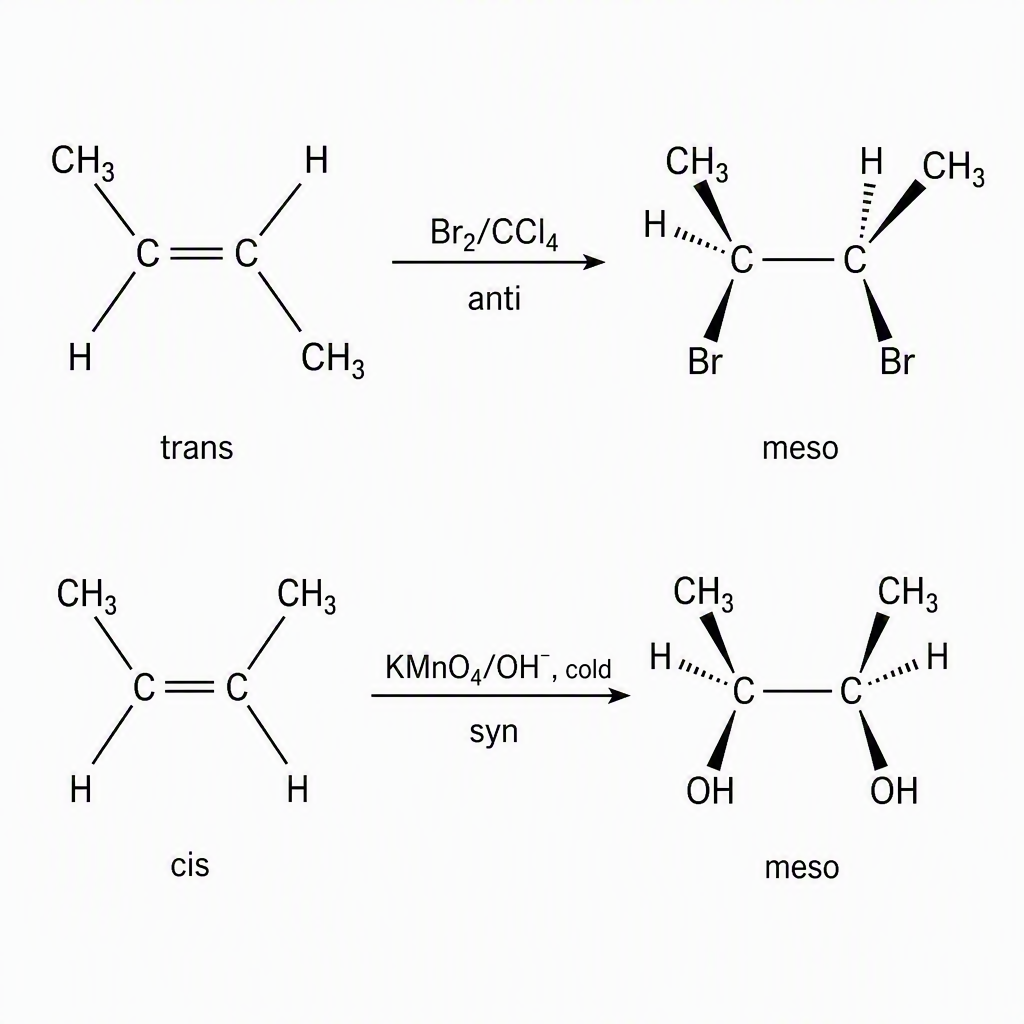
The four choices are:
Both reactions produce a 2,3-disubstituted butane framework. The test is whether each depicted product has the required meso or racemic identity, not merely the correct carbon skeleton.
How does the four-step stereochemistry test work?
Use one fixed chain: reagent, intermediate or pathway, syn or anti addition, then meso or racemic product. This is safer than recalling separate wedge-dash structures. In this Hydrocarbons NEET 2026 problem, apply the chain separately to each cis or trans alkene.
- Identify the reagent and reaction type. Decide whether the reaction is halogenation, hydroxylation or another addition.
- Identify the controlling intermediate or pathway. Bromination proceeds through a cyclic bromonium ion. Cold alkaline KMnO₄ causes vicinal dihydroxylation.
- Decide whether addition is syn or anti. Bromination is anti. KMnO₄ hydroxylation is syn.
- Combine the mode with alkene geometry. The starting cis or trans arrangement determines whether the product is meso or a racemic pair.
Use this reaction map:
- Br₂ in CCl₄ → bromonium ion → anti addition
- Cold alkaline KMnO₄ → vicinal dihydroxylation → syn addition
Correct connectivity is insufficient. Every candidate may appear to be a 2,3-disubstituted butane while having the wrong three-dimensional arrangement.
Why is Statement I about bromination of trans-but-2-ene incorrect?
Statement I is incorrect because anti bromination of trans-but-2-ene gives meso-2,3-dibromobutane. The product depicted in the statement does not represent this required meso stereoisomer. The result depends on both facts: bromination is anti, and the starting alkene is trans.
The alkene first reacts with Br₂ to form a bridged cyclic bromonium ion. A free carbocation is not formed, and the bridge blocks attack from the same face.
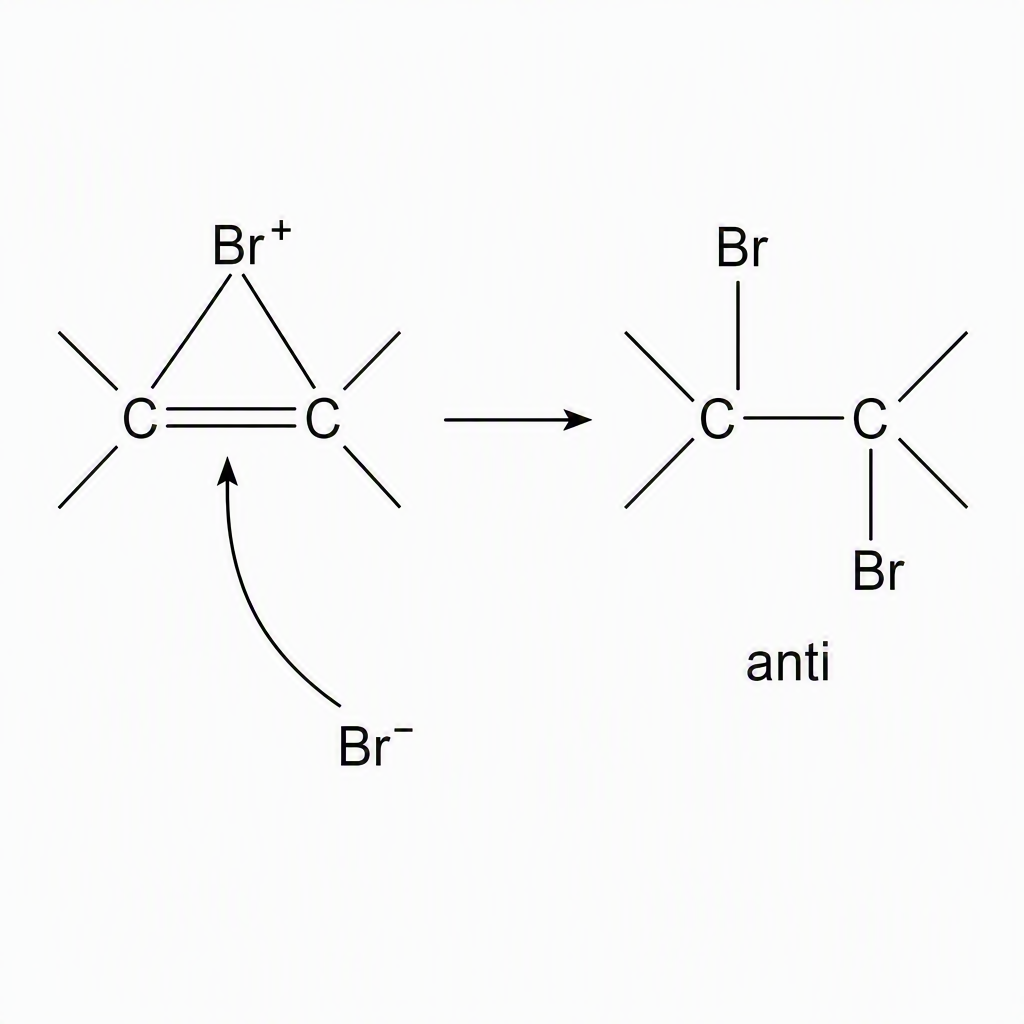
Br⁻ attacks a bromonium-ion carbon from the face opposite the bridge. The two bromine atoms are therefore introduced by anti addition.
Applying anti addition specifically to trans-but-2-ene gives opposite configurations at C-2 and C-3. The product has internal compensation, so its stereochemical identity is meso-2,3-dibromobutane, not a racemic pair.
The product shown in Statement I is not this required meso stereoisomer.
Verdict: Statement I is incorrect.
Why is Statement II correct, and what is the final answer?
Statement II is correct because cold alkaline KMnO₄ causes syn hydroxylation of cis-but-2-ene, producing meso-butane-2,3-diol. Both OH groups enter from the same face. Combined with the cis geometry of the alkene, this gives the internally compensated product represented in Statement II.
Under cold, dilute alkaline conditions, KMnO₄ adds two OH groups across the double bond without oxidative cleavage. Cleavage belongs to more vigorous oxidation conditions and does not apply here.
Both OH groups are delivered to the same face, so the process is syn hydroxylation. Applying syn addition to cis-but-2-ene gives meso-butane-2,3-diol.
- Statement I: incorrect
- Statement II: correct
- Official answer: option D
90-second memory line: trans alkene + anti bromination → meso dibromide; cis alkene + syn hydroxylation → meso diol.
How does checking only connectivity lead to option A?
Option A results from checking only the carbon skeleton in Statement I. A solver may note that trans-but-2-ene reacts with Br₂ to form 2,3-dibromobutane and stop. That check establishes the constitution, but not whether the depicted stereoisomer is correct.
Anti addition to trans-but-2-ene must produce the meso stereoisomer of 2,3-dibromobutane. If Statement I is accepted on connectivity alone while Statement II is correctly accepted, the answer becomes option A.
Check three levels separately:
- Carbon skeleton: Is the basic carbon framework correct?
- Position of new groups: Are the substituents attached to the correct carbon atoms?
- Three-dimensional stereochemistry: Does syn or anti addition to the stated cis or trans alkene give a meso compound or a racemic pair?
The third check changes the answer in this Hydrocarbons NEET 2026 MCQ.
Which related Hydrocarbons questions test the same rule?
These three questions use the same sequence: reagent → pathway → syn or anti → cis or trans substrate → meso or racemic result. For each one, identify the addition mode and starting geometry before deciding the stereochemical product. The reagent alone cannot determine whether the result is meso or racemic.
What forms when cis-but-2-ene reacts with Br₂ in CCl₄?
Anti addition to cis-but-2-ene gives a racemic pair of 2,3-dibromobutane enantiomers, (2R,3R) and (2S,3S). The cyclic bromonium ion fixes the anti pathway, while the cis geometry determines that the products are enantiomers rather than a meso compound.
- Reagent: Br₂ in CCl₄
- Pathway: Cyclic bromonium ion followed by Br⁻ attack
- Mode: Anti addition
- Substrate: Cis-but-2-ene
- Result: A racemic pair of 2,3-dibromobutane enantiomers, (2R,3R) and (2S,3S)
What forms when trans-but-2-ene reacts with cold dilute alkaline KMnO₄?
Syn hydroxylation of trans-but-2-ene gives a racemic pair of butane-2,3-diol enantiomers, not a meso product. Cold dilute alkaline KMnO₄ places both OH groups on the same face, while the trans geometry determines the racemic result.
- Reagent: Cold dilute alkaline KMnO₄
- Pathway: Vicinal dihydroxylation
- Mode: Syn addition
- Substrate: Trans-but-2-ene
- Result: A racemic pair of butane-2,3-diol enantiomers, not a meso product
Which intermediate causes anti addition of Br₂ to an alkene?
A cyclic bromonium ion causes the anti stereochemistry of Br₂ addition. The bridge blocks same-face attack, so Br⁻ attacks from the opposite side. The alkene’s cis or trans geometry must then be used to decide whether the final product is meso or racemic.
- Reagent: Br₂ in an inert solvent such as CCl₄
- Pathway: Cyclic bromonium ion followed by backside attack by Br⁻
- Mode: Anti addition
- Substrate check: Apply the rule to the given cis or trans alkene
- Result check: Use that geometry to decide between a meso product and a racemic pair
For the next practice problem, write the five-part sequence beside the question before checking any wedge-dash option.
Next step: the past-paper archive on NEET JEEnius AI and search past NEET papers by year, subject or chapter, each with a worked solution (100 free searches a month).
Frequently asked questions
What is the answer to the Hydrocarbons NEET 2026 re-exam question?
The verified answer is option D: Statement I is incorrect, while Statement II is correct. Trans-but-2-ene gives a meso dibromide by anti bromination, and cis-but-2-ene gives a meso diol by syn hydroxylation.
Why does trans-but-2-ene with Br2 give a meso product?
Br2 forms a cyclic bromonium ion, after which Br− attacks from the opposite face, making the addition anti. With trans-but-2-ene, this produces meso-2,3-dibromobutane through internal compensation.
What does cis-but-2-ene form with cold alkaline KMnO4?
Cold dilute alkaline KMnO4 causes syn hydroxylation of cis-but-2-ene. The product is meso-butane-2,3-diol because both OH groups add from the same face.
How do I decide between meso and racemic products in alkene addition?
First identify the reagent and pathway, then determine whether the addition is syn or anti. Combine that mode with the alkene's cis or trans geometry and check for internal symmetry; connectivity alone cannot distinguish a meso product from a racemic pair.