What was the induced emf and charge flow NEET 2017 question?
The total charge flowing through the coil is 32 μC. A long solenoid of diameter 0.1 m having 2×10^4 turns per meter contains at its center a 100-turn coil of radius 0.01 m placed with coinciding axes. The solenoid current falls linearly from 4 A to 0 A in 0.05 s. Coil resistance equals 10π² Ω.
The official method removes time completely and leaves 32 × 10^{-6} C after π² cancellation.
How do I visualize the physical arrangement of the solenoid and inner coil?
The magnetic field is uniform inside the long solenoid and zero outside, so flux linkage uses only the inner coil area. Coil radius 0.01 m determines the area πr² while solenoid radius never appears in the calculation.
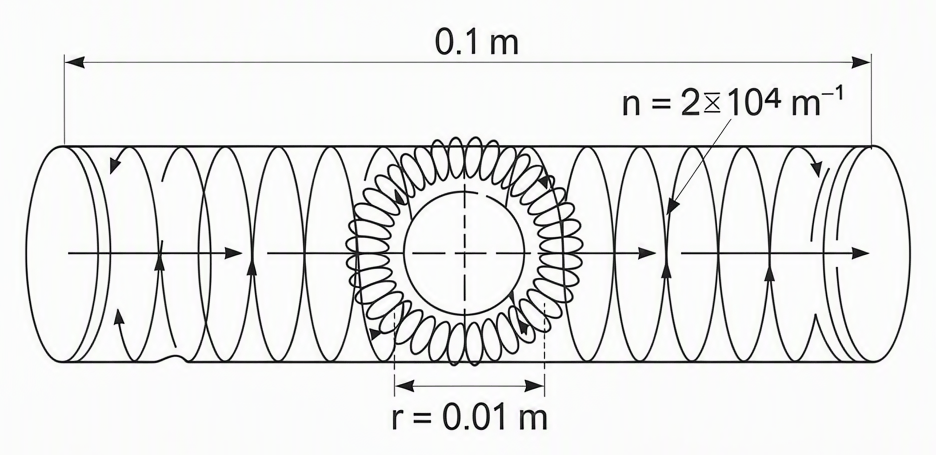
Solenoid is long so B = μ₀ n I is uniform across entire coil area and zero outside. Coil radius is used for area, not solenoid radius.
What is the official step-by-step solution for the induced emf and charge flow NEET 2017 question?
The total charge equals 32 μC. Induced emf is given by ε = –N dφ/dt. Magnitude of induced current is |I| = N/R × |dφ/dt|. Since dq = I dt, integration yields ΔQ = N(Δφ)/R with no time dependence left.
Magnetic field inside the solenoid is B = μ₀ n i. Flux per turn of the inner coil is φ = B × π r². Change in B equals μ₀ n Δi where Δi = 4 A. Therefore Δφ per turn = ΔB × π r².
Full expression for total charge becomes ΔQ = [μ₀ n (Δi) (π r²) N]/R. Substitute μ₀ = 4π×10^{-7}, n = 2×10^4, Δi = 4, r = 0.01, N = 100, R = 10π² exactly.
The π² terms cancel directly. Numerical factor simplifies to 32 × 10^{-6} C, or 32 μC.
The time interval 0.05 s indicates linear change but drops out between emf and charge integration.
Why does using average current give the wrong 16 μC answer in this problem?
Many students substitute average current I_avg = 2 A in place of the actual change Δi = 4 A while calculating total flux change Δφ. This halves ΔB and therefore halves ΔQ, producing 16 μC.
The correct approach uses net change in current from 4 A to 0 A because total charge equals net change in flux linkage divided by R, independent of rate.
What similar practice questions test the same charge flow concept?
A 50-turn coil of area 2 cm² lies in a uniform magnetic field that decreases from 0.4 T to 0 in 0.1 s. Coil resistance is 4 Ω. Total charge is 1 mC.
Δφ per turn = ΔB × A = 0.4 × 2 × 10^{-4} = 8 × 10^{-5} Wb.
Total flux linkage change = 50 × 8 × 10^{-5} = 4 × 10^{-3} Wb.
Q = 4 × 10^{-3} / 4 = 10^{-3} C = 1 mC.
Two coaxial solenoids: outer long solenoid has turn density 10^4 m^{-1}. Inner 80-turn coil of area 3 × 10^{-4} m² and resistance 6 Ω sits at the center. Current in outer solenoid drops from 2 A to 0. Charge through inner coil is 32π × 10^{-6} C.
ΔB = μ₀ n Δi = 4π × 10^{-7} × 10^4 × 2 = 8π × 10^{-3} T.
Δφ per turn = ΔB × A = 8π × 10^{-3} × 3 × 10^{-4} = 24π × 10^{-7} Wb.
Total flux linkage change = 80 × 24π × 10^{-7}.
Q = (80 × 24π × 10^{-7}) / 6 = 32π × 10^{-6} C.
Both follow identical ΔQ = N Δφ / R steps. Use the past-paper archive to search past NEET papers by chapter for more EMI numericals with worked solutions.
What must I remember when solving induced charge flow problems in NEET?
Total charge Q = N(μ₀ n ΔI π r²)/R for a coil inside a long solenoid. Time interval is given only to indicate linear change and cancels between emf and integration. Always use coil area for flux, never solenoid cross-section.
Emf depends on 1/Δt while charge has no Δt. Students who apply ΔQ = N(Δφ)/R directly can expect the π cancellations to finish inside two minutes because time drops out of the integrated equation. When a fresh doubt appears during practice, photograph a doubt for an immediate step-by-step solution.
Next step: photograph a doubt on NEET JEEnius AI and photograph any question you are stuck on and get a step-by-step solution across Physics, Chemistry and Biology (20 free a month).
Keep going with Anatomy of Flowering Plants Practice Questions for NEET.
Frequently asked questions
What is the total charge in induced emf and charge flow NEET 2017 question?
The total charge flowing through the coil is 32 μC. This is obtained by calculating the total change in flux linkage using the full ΔI = 4 A and dividing by the coil resistance of 10π² Ω.
Why does the time interval cancel in the NEET 2017 charge flow problem?
Induced emf depends on rate of change of flux but charge is the integral of current over time. This integration yields Q = N(Δφ)/R, removing all time dependence. The 0.05 s only indicates linear fall but is not required for the final answer.
Why do students get 16 μC in the NEET 2017 induced emf problem?
Students wrongly substitute average current I_avg = 2 A instead of the net change ΔI = 4 A while finding ΔB and Δφ. Total charge depends on net flux change from initial 4 A to final 0 A, so the correct value is 32 μC.
How to calculate induced charge flow for a coil inside solenoid in NEET?
Use Q = N(μ₀ n ΔI π r²)/R with the inner coil area and full current change. In the 2017 problem the given values cause exact π² cancellation in numerator and denominator, leaving 32 × 10^{-6} C after substitution.