Where should the object be placed so the final image coincides with the object in the NEET 2025 biconvex lens with one surface polished question?
The object must be placed at from the lens. This follows from treating the system as an equivalent mirror with focal length and locating the object at its centre of curvature.
The NEET 2025 question described a thin glass convex lens of refractive index μ having both surfaces with radius of curvature R. One surface is polished so that it reflects all incident light. An object is placed on the optic axis at a distance such that the final image after refraction, reflection and refraction again coincides with the object itself. The four options were A) , B) , C) , D) .
What does the physical arrangement look like when one surface of a biconvex lens is polished?
Light enters from the unsilvered side, passes through the lens material, reflects from the curved polished surface and passes back through the lens. The first refraction occurs at the left surface, the light travels inside the glass, reflects at the right surface, and refracts once more at the left surface on the way out.
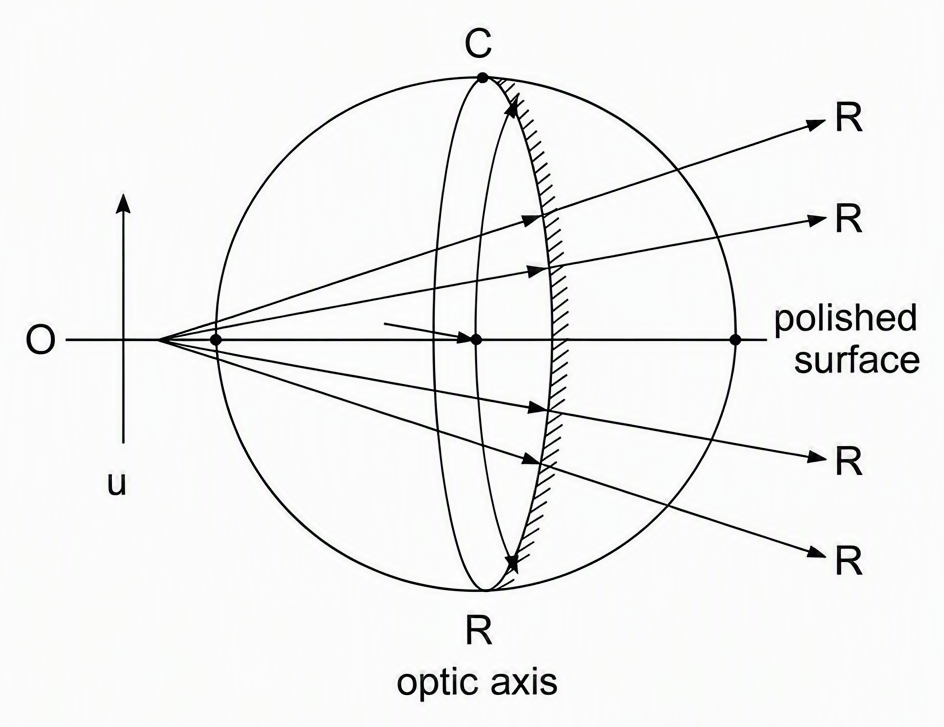
This double pass through the lens is the reason its power must be counted twice.
What is the official step-by-step solution for the NEET 2025 lens with one polished surface question?
The lens maker formula gives the power of the lens as
The polished spherical surface acts as a mirror with focal length , so its power is
Light traverses the lens twice before and after reflection, therefore the equivalent power of the system is
Substitution yields
The equivalent focal length is therefore
For the final image to coincide with the object the incident rays must strike the equivalent mirror normally, which means the object is placed at the centre of curvature of the equivalent mirror. Thus the object distance is
This matches option D.
What exact method mistake produces the wrong answer in the NEET 2025 silvered lens question?
Students who calculate instead of obtain
The equivalent focal length then becomes and twice that value is , which is option A. The error is a method mistake of counting lens power only once instead of recognising the double refraction that occurs on the return path.
This slip changes the entire result because the light physically crosses the refracting surface twice.
How do you solve related silvered-surface and separated lens-mirror questions from the Optics chapter?
For a plano-convex lens of refractive index μ with radius of curvature R for the curved surface and its plane face silvered, place the object on the curved side so the image after refraction, reflection and refraction coincides with the object. Here and because the silvered plane surface is a flat mirror. Then , , and object distance .
For a convex lens of focal length f placed at a distance d in front of a concave mirror of focal length f, find the object position from the lens so that the final image after passing through the lens, reflecting from the mirror, and passing through the lens again coincides with the object. First form the image by the lens, treat it as object for the mirror, form the mirror image, then treat that as object for the lens on return. Set the final image position equal to object position and solve for u. The condition usually simplifies when the first image formed by the lens lies at the centre of curvature of the mirror.
- Silvered lens (one surface polished): use single equivalent power formula and place object at
- Separate lens and mirror with fixed separation: apply lens formula, then mirror formula, then lens formula again and solve for the specific distance given
- Silvered lens problems hide the double pass inside one formula while separate systems require three distinct ray-transfer steps
What are the key takeaways for NEET 2025 Optics silvered lens questions?
Any time one surface of a lens is polished, treat the system as a mirror with power . Image coinciding with object implies object at centre of curvature of the equivalent mirror, i.e. . Sign convention must be maintained but final magnitude for this geometry is always for equiconvex case.
Expected solving time is 180 s. Practise until it drops under 90 s by repeating the power addition step from scratch each time.
Search past NEET papers by chapter in the past-paper archive to reinforce the double-pass rule on similar solved examples. If a fresh variant appears in a test and the algebra stalls, photograph the question for a step-by-step solution.
Next step: photograph a doubt on NEET JEEnius AI and photograph any question you are stuck on and get a step-by-step solution across Physics, Chemistry and Biology (20 free a month).
For a worked example of the same idea, see Biodiversity Practice Questions NEET: Free Mocks 2025.
Frequently asked questions
Where should the object be placed so final image coincides with object in NEET 2025 polished lens question?
The object must be placed at R/(2μ-1) from the lens. The system behaves as an equivalent mirror with feq = R/[2(2μ-1)]. For the final image to coincide with the object, it is placed at the centre of curvature, which is 2feq.
What is equivalent power for lens with one surface polished in NEET?
Equivalent power is 2Pl + Pm. For the given biconvex lens, Pl = 2(μ-1)/R and Pm = 2/R. This gives Peq = (4μ-2)/R so feq = R/[2(2μ-1)]. Light refracts twice through the lens, hence the factor of 2 for Pl.
Why do students get R/μ instead of R/(2μ-1) in silvered lens NEET question?
They incorrectly use Peq = Pl + Pm instead of 2Pl + Pm. This forgets the second refraction on the return path after reflection. The wrong feq = R/(2μ) leads to 2feq = R/μ, which is option A.
How to solve silvered plano-convex lens problem for NEET 2025?
For plano-convex lens with plane face silvered, Pl = (μ-1)/R and Pm = 0 for plane mirror. Then Peq = 2Pl, feq = R/[2(μ-1)], and object is placed at 2feq = R/(μ-1) for image to coincide with object.