
What is the bent-wire NEET 2023 question asking?
The magnetic effects of current NEET 2023 bent-wire question has option C as the correct answer. The semicircular arc produces a field out of the page, while both straight portions produce fields into the page. The net field is the signed vector sum of all three contributions.
A very long wire consists of two semi-infinite straight portions joined through a semicircular section of radius R. Point P is at the centre, and a steady current i flows through the complete wire. Find both the magnitude and direction of the net magnetic field at P.
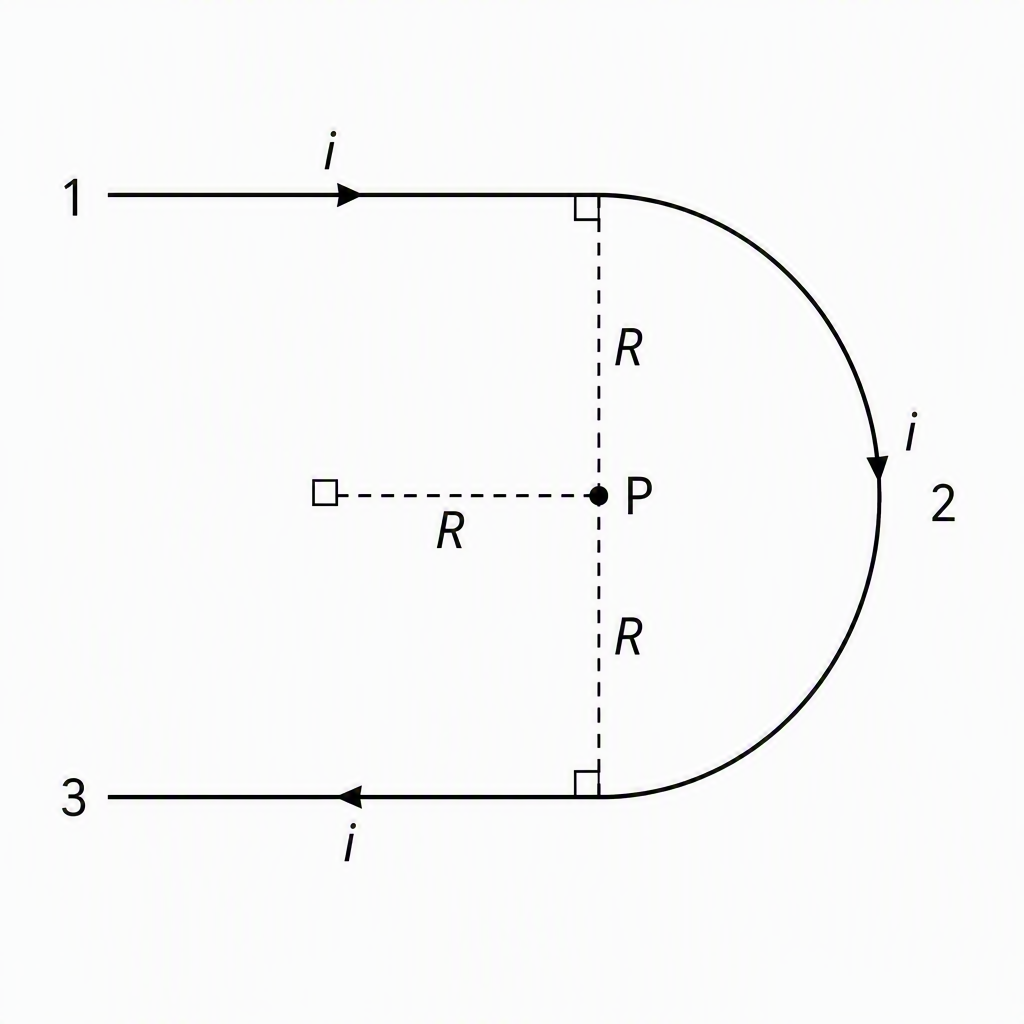
The question gives four choices. Both the magnitude and page direction must match.
- Option A, into the page:
- Option B, out of the page:
- Option C, out of the page:
- Option D, into the page:
This is a NEET 2023 single-correct Physics question from Magnetic Field due to Current Carrying Wire. Its hard-tier classification gives an expected solving time of 120 seconds.
How should the bent wire be split into three magnetic-field sources?
Treat the conductor as three sources: semi-infinite straight segment 1, semicircular segment 2 and semi-infinite straight segment 3. The right-hand thumb rule gives opposite directions for the arc and straight portions. Choose a sign convention before calculating any magnitude.
The official decomposition is:
Apply the right-hand thumb rule separately to each piece.
- Segment 1 produces a field into the page at P.
- Segment 2 produces a field out of the page at P.
- Segment 3 produces a field into the page at P.
Choose out of the page as positive and into the page as negative. This converts the final vector addition into a signed one-dimensional calculation.
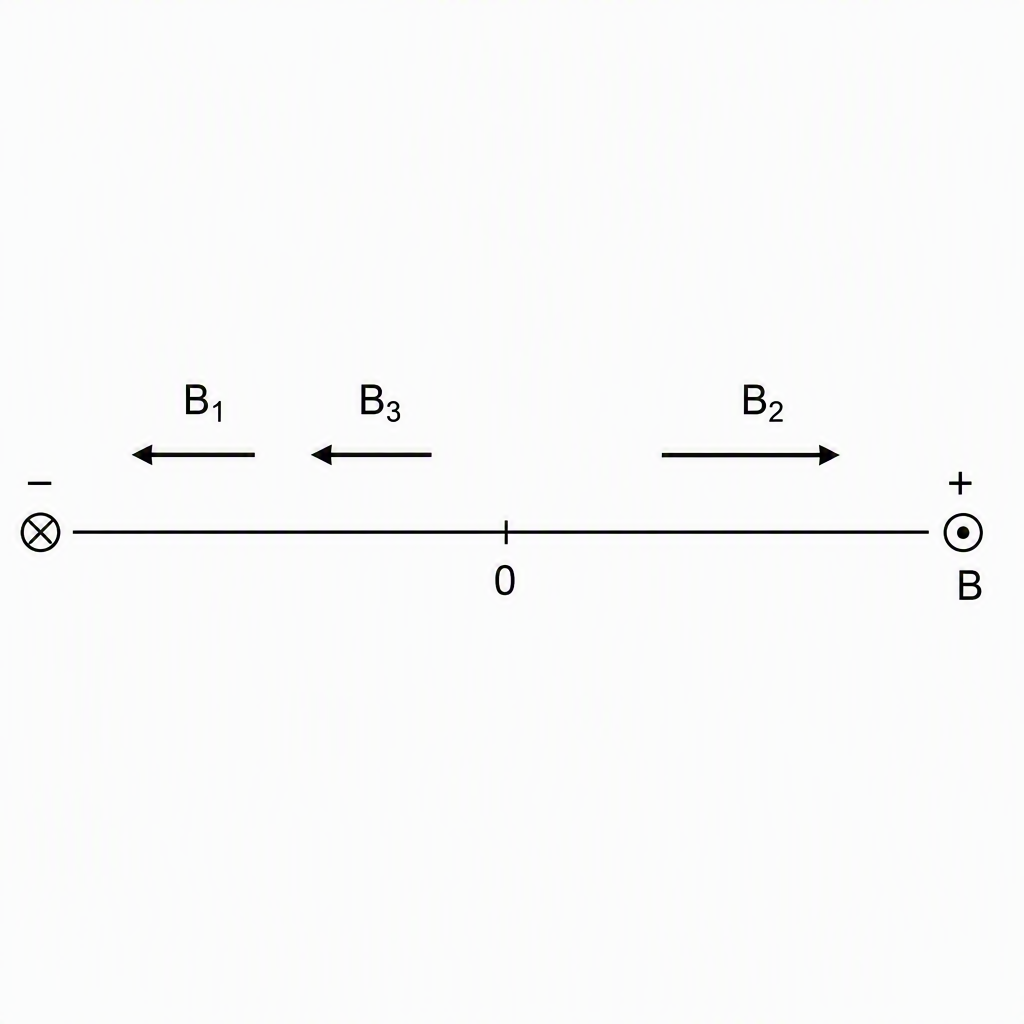
The straight portions cannot be discarded because P is at perpendicular distance R from each semi-infinite section. Each section therefore produces a finite magnetic field at P.
For the expected 120 seconds, use this order: split the wire, assign directions, choose signs, substitute the standard magnitudes and check the final sign numerically.
How is the magnetic field of each wire segment calculated?
Use the semi-infinite-wire result for segments 1 and 3, and the circular-arc result for segment 2. Both straight sections have equal magnitudes because their perpendicular distance from P is R. Keep magnitude and direction separate until the signed addition.
For segment 1, the semi-infinite-wire formula gives the following magnitude. Its direction is into the page.
For segment 3, the same formula gives an equal magnitude. Its direction is also into the page.
For a circular arc subtending angle theta at its centre, the field magnitude is:
The semicircular segment subtends the following angle. Substitute it into the arc formula.
The field from segment 2 is directed out of the page. The three magnitudes should now be combined using the directions fixed earlier.
How are the three magnetic fields added with the correct signs?
The arc field is positive because it points out of the page. The two straight-wire fields are negative because they point into the page. Therefore, subtract their combined magnitude from the arc field.
Substitute the three standard results, combine the equal straight-wire terms and factor out the common term. The complete algebra is:
Use a numerical check to fix the direction. The factor multiplying the field magnitude is positive.
Positive means out of the page under the chosen sign convention. This is also stated as away from the page.
Option C is correct.
Why does using only the semicircular arc give the wrong option?
Considering only the arc gives option B, but it omits two magnetic-field sources. A very long wire does not mean that its straight sections produce zero field. Each semi-infinite section remains at perpendicular distance R from P and contributes a finite field into the page.
The arc-only calculation gives the following result. Its direction is out of the page.
This corresponds to option B. The arc formula is correct, but the physical decomposition is incomplete.
Each straight section contributes:
Ignoring both sections removes the following total opposing field:
Use one correction rule for every composite conductor: divide it into all standard pieces, determine each field independently and only then perform vector addition.
Which related magnetic-field questions should I practise?
Practise a full circular loop, a circular arc and a pair of semi-infinite straight wires. These three cases test the same formulas and direction logic used in the NEET 2023 question. Identify every conductor piece and fix its direction before adding fields.
What is the field at the centre of a full circular loop?
A full circular loop of radius R carrying current i produces the following field at its centre. Its direction is fixed by the right-hand rule.
What is the field at the centre of a 60-degree arc?
For an arc of radius R carrying current i, first convert 60 degrees into radians. Then apply the circular-arc formula.
What is the combined field of two semi-infinite straight wires?
If two semi-infinite straight wires each produce a field opposite to that of a semicircular arc at P, their equal magnitudes add. Their combined magnitude is:
Subtract this combined field from the arc field during vector addition. Always insert arc angles in radians.
Next step: the past-paper archive on NEET JEEnius AI and search past NEET papers by year, subject or chapter, each with a worked solution (100 free searches a month).
Frequently asked questions
What is the correct answer to the NEET 2023 bent-wire question?
Option C is correct. The net field is μ₀i(1 − 2/π)/(4R), directed out of the page.
Why are the straight wire sections included in the magnetic field?
Each semi-infinite straight section is at perpendicular distance R from point P and therefore produces a finite field. Each contributes μ₀i/(4πR) into the page.
What is the magnetic field due to the semicircular arc?
For an arc, B = μ₀iθ/(4πR), with θ measured in radians. Substituting θ = π gives B = μ₀i/(4R), directed out of the page.
Why is option B wrong in the NEET 2023 question?
Option B includes only the field of the semicircular arc. It incorrectly ignores the two straight sections, whose combined field μ₀i/(2πR) opposes the arc field.
How do I determine the direction of the net magnetic field?
Apply the right-hand thumb rule separately to all three wire segments. The arc field is out of the page, while both straight-section fields are into the page; the positive final result is out of the page.