What is the hard NEET 2026 question on alkyne reduction and radical HBr addition?
Option A is correct: K and L are geometrical isomers while M and N are identical racemic compounds. An internal alkyne Ph–C≡C–CH₃ is reduced by two different reagent pairs to give alkenes labelled L and K. Both alkenes are then treated with HBr in the presence of benzoyl peroxide to produce compounds labelled N and M. The four options centre on whether K and L are geometrical isomers or enantiomers and whether M and N are geometrical isomers or stereoisomers. The question tests simultaneous recall of hydrocarbon reduction stereochemistry from Class 11 and haloalkane free-radical regiochemistry from Class 12.
How do you solve the step-by-step NEET 2026 question on Na/liq NH3 versus Lindlar reduction followed by peroxide HBr?
NCERT Class 11 Hydrocarbons states that Na in liquid NH₃ on an internal alkyne gives the trans-alkene, so L is trans-PhCH=CHCH₃. H₂ with Lindlar’s catalyst gives the cis-alkene, so K is cis-PhCH=CHCH₃. Thus K and L are geometrical (cis-trans) isomers.
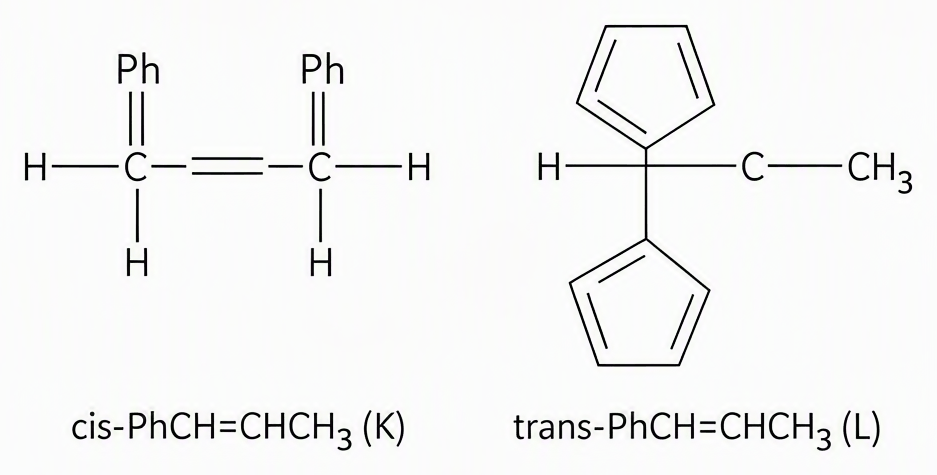
Both K and L undergo free-radical addition with HBr in the presence of benzoyl peroxide and follow anti-Markovnikov regiochemistry. Br• adds to the terminal carbon, generating the more stable benzylic radical Ph–CH•–CHBr–CH₃. The radical mechanism is non-stereospecific, so the planar benzylic radical produces the identical racemic mixture of PhCH₂CHBrCH₃ from either cis or trans alkene. Therefore M and N are the same compound. Option A is correct. Option B is wrong because geometrical isomers are diastereomers, not enantiomers.
What is the exact method mistake that leads to the wrong option in this radical addition question?
The method mistake is treating HBr addition as an ionic electrophilic process that is stereospecific instead of the peroxide-initiated free-radical pathway. This error leads to selection of option D (M and N are stereoisomers) because the student expects different diastereomeric bromides from cis versus trans alkene. The correct method recalls the peroxide effect from NCERT Class 12 first, then recognises that the planar benzylic radical loses all memory of original alkene geometry and produces one racemate from both K and L. Peroxide effect must be checked before assigning any addition stereochemistry.
Which precise NCERT lines unlock the question on cis-trans alkenes and anti-Markovnikov addition?
Partial reduction with Na in liquid NH₃ yields the trans-alkene while Lindlar’s catalyst yields the cis-alkene (Class 11, Hydrocarbons chapter). In the presence of peroxide, HBr adds anti-Markovnikov via a free-radical mechanism (Class 12, Haloalkanes and Haloarenes). The benzylic radical is more stable than a secondary alkyl radical and therefore controls regioselectivity. Free-radical additions are not stereospecific unlike ionic additions to alkenes. Quote these lines directly in the exam.
What practice questions test the same concepts from hydrocarbons and haloalkanes at NEET level?
Q1: What is the product stereochemistry when 2-butyne is reduced with (a) Na/liq. NH₃ and (b) Lindlar’s catalyst? Are the products geometrical isomers or enantiomers?
Q2: 1-Phenylpropene (cis and trans) is treated with HBr/peroxide; draw the product and state whether the two reactions give the same compound or different stereoisomers. Explain via radical stability.
Q3: Predict the major product when Ph–C≡C–H is first treated with NaNH₂ then CH₃I, followed by HBr/peroxide; is the final bromide chiral?
Work these on paper before checking solutions. To locate more solved examples from actual NEET papers by chapter, search the past-paper archive.
What quick revision checklist covers organic compounds containing halogens for NEET 2026?
- Memorise exact reagent pairs for cis versus trans alkene from internal alkynes: Na/liq. NH₃ for trans, Lindlar for cis.
- Always check for peroxide before deciding Markovnikov or anti-Markovnikov in HBr additions.
- Identify possible chiral centres in radical addition products and decide if the outcome is a racemic mixture or optically active.
- Combine concepts across Hydrocarbons and Haloalkanes chapters; such hybrid questions appear in hard tier.
- Link: read similar multi-concept organic MCQs for more practice.
Why does NEET 2026 tag this reduction and radical addition sequence as hard tier?
This question is tagged hard tier because it requires simultaneous application of stereoselective reduction from Class 11 and regioselective radical addition from Class 12. It tests recognition that the radical mechanism destroys the stereochemical information present in the starting alkene. Option D corresponds to the error of defaulting to ionic addition thinking when peroxide is mentioned only in passing. NEET 2026 pattern continues to test mechanism over memory, so 3-step sequences like this are expected. Drill the non-stereospecific nature of benzylic radicals until it becomes automatic.
If a similar mechanism doubt appears while revising, photograph a doubt for a step-by-step solution across Chemistry topics.
Next step: photograph a doubt on NEET JEEnius AI and photograph any question you are stuck on and get a step-by-step solution across Physics, Chemistry and Biology (20 free a month).
Frequently asked questions
What is the correct option for the NEET 2026 question on alkyne reduction and radical HBr addition?
Option A is correct. K and L are geometrical isomers while M and N are identical racemic compounds. The planar benzylic radical in the free-radical mechanism erases the original alkene geometry and produces one racemate from both.
How do Na/liq NH3 versus Lindlar’s catalyst affect alkyne reduction in the NEET question?
Na in liquid NH3 on internal alkyne Ph–C≡C–CH₃ gives the trans-alkene L. Lindlar’s catalyst gives the cis-alkene K. Thus K and L are geometrical isomers as stated in NCERT Class 11 Hydrocarbons.
Why do cis and trans alkenes give the same product with HBr and peroxide?
Both follow anti-Markovnikov free-radical addition forming the same stable benzylic radical Ph–CH•–CHBrCH₃. The planar radical loses stereochemical memory and yields the identical racemic PhCH₂CHBrCH₃ from either K or L.
What common mistake occurs in radical HBr addition NEET questions?
Students treat the addition as stereospecific ionic electrophilic addition instead of checking for peroxide first. Peroxide triggers the non-stereospecific free-radical path via planar benzylic radical, so M and N are identical racemates, not stereoisomers.
Which NCERT lines are key for organic compounds containing halogens NEET 2026?
Class 11 Hydrocarbons: Na/liq NH₃ gives trans-alkene, Lindlar gives cis-alkene. Class 12 Haloalkanes and Haloarenes: peroxide causes anti-Markovnikov free-radical addition of HBr. Free-radical additions are not stereospecific.