What Was the NEET 2025 MCQ on Malus' Law with Three Polaroids at 22.5°?
The transmitted intensity is I₀/8. The question asks for the intensity transmitted through a middle polaroid sheet oriented at 22.5° placed between two crossed polaroids, with I₀ defined as intensity after the first polaroid. The four options are I₀/2, I₀/4, I₀/8, I₀/16.
The calculation requires the second angle of 67.5° and the double-angle identity to simplify the product of squared terms without a calculator. This matches the official NEET 2025 solution exactly.
How Do You Visualise the Three-Polaroid Arrangement?
The first polaroid has vertical transmission axis labelled P1, the middle sheet is at 22.5° clockwise labelled P2, and the final analyser has horizontal axis labelled P3 so that P1 and P3 are crossed at 90°. Angle between P1 and P2 is 22.5°. Angle between P2 and P3 must be 67.5° because P3 is crossed with P1.
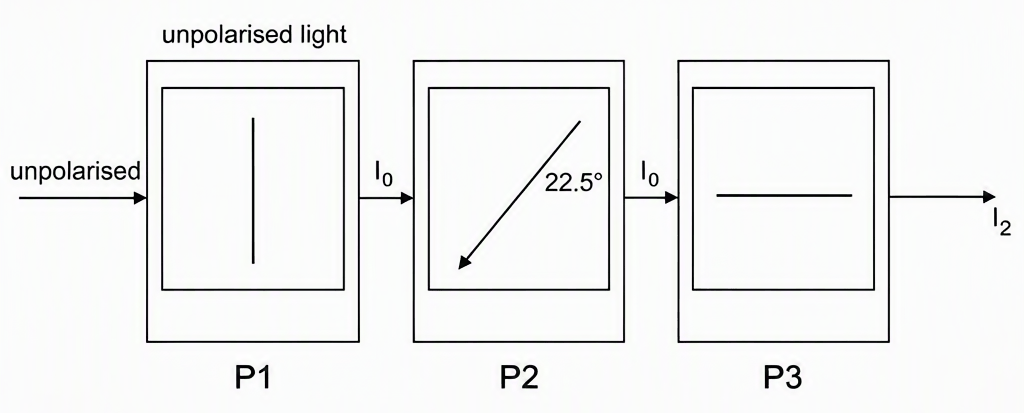
This geometry fixes the angles before any equation is written. Students who skip it assign 22.5° to both steps and reach a distractor.
What Is the Official Step-by-Step Solution for the NEET 2025 Three Polaroids Question?
The official solution applies Malus' law twice and reaches I₂ = I₀/8. After the middle sheet:
After the analyser:
Substitute cos(67.5°) = sin(22.5°):
Apply the identity cos²θ sin²θ = (1/4) sin²(2θ) with θ = 22.5°:
Since sin(45°) = 1/√2, sin²(45°) = 1/2. Therefore
What Mistake with the Angle Leads to the Wrong Option in This NEET Question?
Treating the angle between the middle polaroid and the analyser as 22.5° again instead of 90° - 22.5° = 67.5° produces a distractor. This leads to directly writing I₂ = I₀ cos⁴(22.5°) or I₀ cos²(45°) which evaluates near I₀/4.
Forgetting to apply the double-angle identity after I₂ = I₀ cos²(22.5°) sin²(22.5°) and stopping after the first cos² term yields the same error. The official route replaces the complement at once and uses the identity to reach I₀/8 cleanly.
How Do You Solve Related Wave Optics Questions That Test the Same Skills?
A middle polaroid at 15° between crossed polaroids transmits I₀/16. Angles are 15° and 75°. Then cos(75°) = sin(15°), so
sin(30°) = 1/2, sin²(30°) = 1/4, therefore I = I₀/16.
A middle polaroid at 30° between crossed polaroids transmits 3I₀/16. Angles are 30° and 60°. Then cos(60°) = sin(30°), so
sin(60°) = √3/2, sin²(60°) = 3/4, therefore I = 3I₀/16.
Both force the complementary angle and the identity. Repeat until you calculate successive angles and simplify to the result in under 90 seconds. You can search past NEET papers by year, subject or chapter in the past-paper archive, each with a worked solution (100 free searches a month), to locate every similar three-polaroid problem.
What Key Takeaways Help You Solve Malus' Law Questions in NEET 2025?
Always calculate the complementary angle when the final analyser is crossed with the first. Recognise cos(90° - α) = sin α immediately. Memorise that cos²θ sin²θ reduces to (1/4)sin²(2θ) to avoid calculator use. The two-polaroid case needs a single cos² factor while the three-polaroid crossed case needs the product of two cos² terms simplified by the identity.
These steps turn the 90-second MCQ into a routine calculation you will complete reliably in future mocks.
How Do You Revise Malus' Law in 60 Seconds?
Malus' law states I = I₀ cos²θ where θ is the angle between polariser and analyser. For unpolarised light after the first polaroid intensity is I₀ (given). Crossed polaroids (θ = 90°) give I = 0 when no middle sheet is present.
Drill the three-polaroid case above until the complementary angle and double-angle reduction are automatic. When a similar doubt appears in a mock test, photograph any question you are stuck on and get a step-by-step solution across Physics, Chemistry and Biology (20 free a month).
Next step: the past-paper archive on NEET JEEnius AI and search past NEET papers by year, subject or chapter, each with a worked solution (100 free searches a month).
Related on NEET JEEnius AI: Biotechnology Practice Questions for NEET 2025.
Frequently asked questions
What was the transmitted intensity in the NEET 2025 three polaroids Malus law question?
The transmitted intensity is I₀/8 where I₀ is the intensity after the first polaroid. The middle sheet is at 22.5° to the first vertical polaroid while the final analyser is at 90° to the first, requiring the second angle of 67.5°. The official solution applies Malus' law twice and simplifies with the double-angle identity.
Why is the angle for the third polaroid 67.5° not 22.5° in the NEET 2025 question?
The first and third polaroids are crossed, so their transmission axes are at 90°. With the middle polaroid at 22.5° to the first, the angle between middle and third must be 90° - 22.5° = 67.5°. Using 22.5° for both steps is the most common mistake and leads to the distractor option I₀/4.
How do you simplify cos²(22.5°)sin²(22.5°) without a calculator in Malus law problems?
Replace cos(67.5°) with sin(22.5°), then apply the identity cos²θ sin²θ = (1/4)sin²(2θ). For θ = 22.5°, 2θ = 45° and sin²(45°) = 1/2. Therefore I₂ = (I₀/4) × (1/2) = I₀/8. This exact method matches the official NEET 2025 solution.
What common mistake do students make in the three polaroids NEET 2025 question?
Students often treat both angles as 22.5° instead of recognising the complementary 67.5° for the analyser. This produces I₂ = I₀ cos⁴(22.5°) which is close to I₀/4, a distractor option. Forgetting the double-angle identity after writing cos²θ sin²θ also leads to the same error.