
Which graph is correct in the Rotational Motion NEET 2026 hard PYQ?
The Rotational Motion NEET 2026 graph question has option C, figure (3) as its correct answer. The system momentum starts at zero, reaches its maximum at the midpoint, and returns to zero when the particles meet. Its magnitude is
This is a hard-tier NEET 2026 Rotational Motion MCQ with an expected solving time of 90 seconds, based on the short vector calculation and three checkpoint values needed to identify the graph.
Two particles, each of mass 1, begin together at on a frictionless horizontal circular wire of radius 1. They move in opposite directions with equal constant angular speed
They meet at
The task is to choose, from four schematic options, the graph of the magnitude of total linear momentum against angular position.
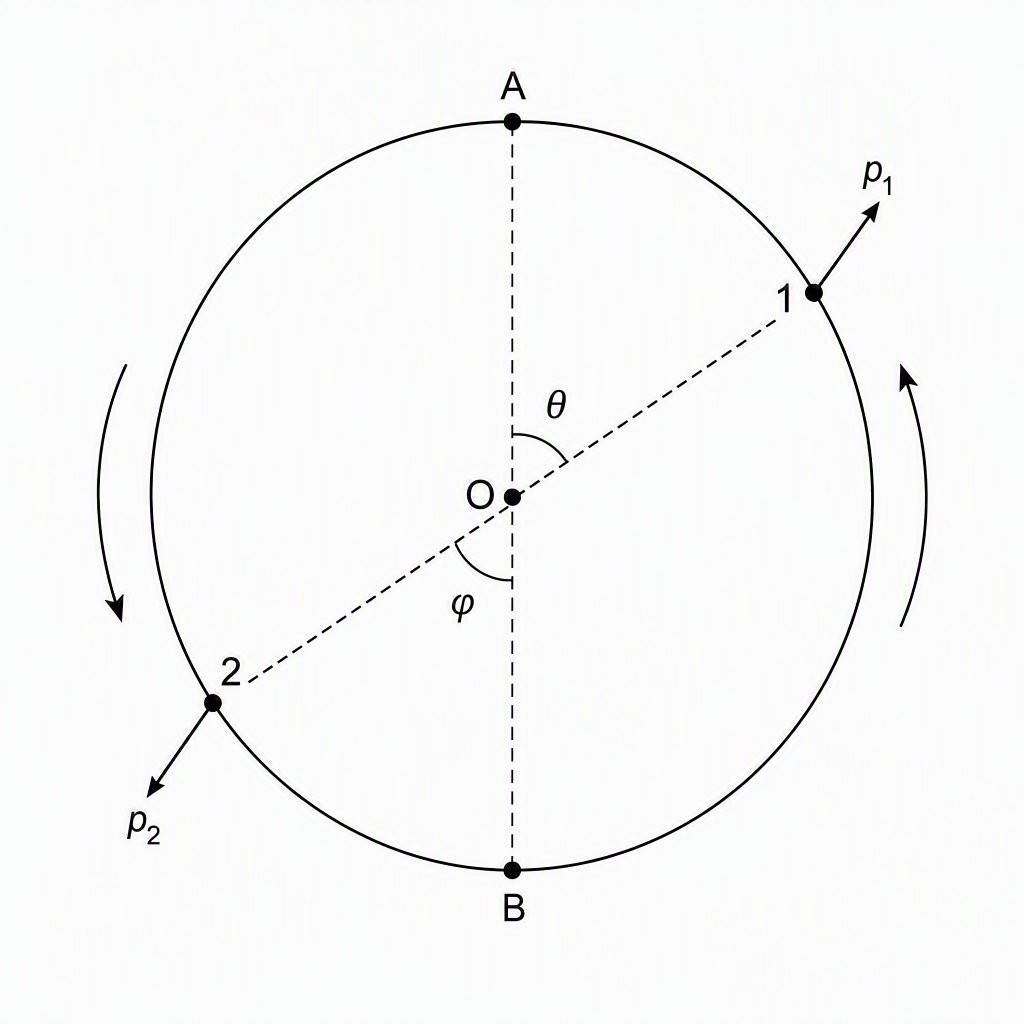
How do you fix the two angular positions correctly?
If the clockwise particle is at one angular position, the counterclockwise particle is at the supplementary angle. This relation puts both particles at the starting point and sends them through opposite semicircles until they meet at the bottom.
Because the mass and radius are both unity, each particle has speed
Its momentum magnitude is
Check the relation at the start:
Both particles are therefore at A initially. As the first particle moves from
the second moves along the opposite semicircle.
Equal momentum magnitudes do not imply a zero resultant. The resultant is zero only when the two vectors also point in opposite directions. Here, their relative directions change throughout the motion.
How do you add the tangential momentum components?
Resolve both tangential velocity vectors before taking the magnitude. In this Rotational Motion NEET 2026 question, the horizontal components cancel while the vertical components add. This component method gives both the momentum function and its direction.
For the clockwise particle, write
For the counterclockwise particle at write
Use the supplementary-angle identities:
Substitution gives
Since both masses are unity,
Therefore,
The horizontal components cancel:
The vertical components add:
Hence,
Over the given interval,
cosine is non-negative. The momentum magnitude is therefore
How do you identify the correct momentum graph in 90 seconds?
Check the start, midpoint and meeting point after fixing the vector directions. These three values force a single smooth cosine hump that is symmetric about the centre, zero at both ends, and maximum at the midpoint.
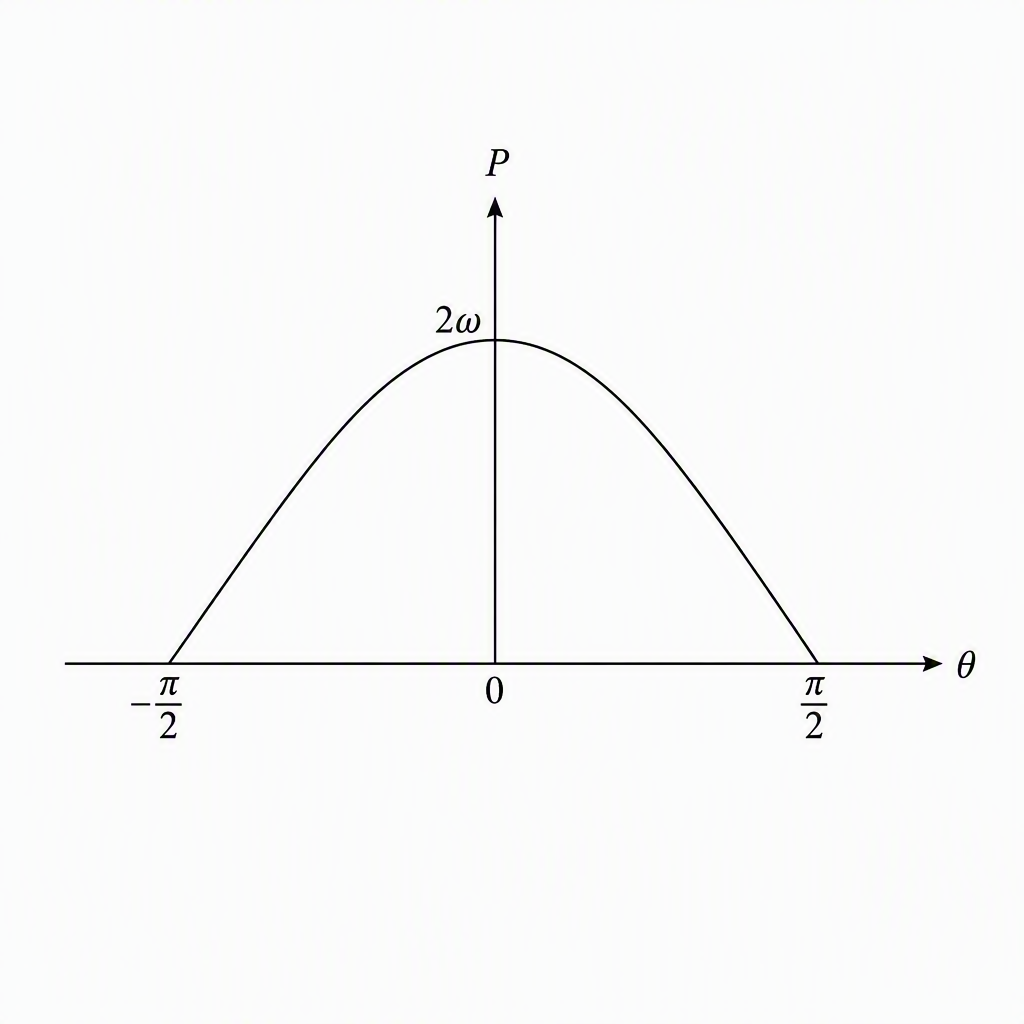
- At the start:
- At the midpoint:
- At the meeting point:
The correct answer to the Rotational Motion NEET 2026 MCQ is option C, figure (3).
A numerical check confirms the shape. Take the angular speed as
At the momentum magnitude is
At the centre, it rises to
For the 90-second check, establish the two tangential directions and test only the three checkpoint angles.
Which method error produces a constant momentum graph?
A constant graph comes from adding the two momentum magnitudes directly. This calculation ignores their changing directions and incorrectly gives the same total momentum throughout the motion.
The wrong calculation is
Total momentum is the magnitude of the vector sum:
It is not the sum of the two magnitudes.
At A and B, the particles have equal and opposite tangential velocities. The system momentum must be zero at both endpoints, so any graph that is non-zero at either endpoint fails immediately.
At the midpoint, both tangential momentum vectors point in the same vertical direction. Their magnitudes add only there. The wrong constant-shaped graph treats this midpoint condition as if it were true throughout the motion.
How do you solve the same question when mass or radius is not unity?
Replace the unit momentum magnitude with the general value. The horizontal components still cancel, the vertical components still add, and the same endpoint and midpoint checks identify the graph.
What is the momentum magnitude for particles of mass m on a wire of radius R?
Question 1: Each particle now has momentum magnitude
The system momentum magnitude is for
At the midpoint,
At either endpoint,
What is the direction of total momentum in the general setup?
Question 2: The horizontal components cancel, so the total momentum points in the same negative vertical direction throughout the motion, except at the endpoints where its magnitude is zero.
At either endpoint,
The zero vector has no direction at those points.
What is the centre-of-mass speed of the two particles?
Question 3: Divide the total momentum magnitude by the combined mass of the two particles.
Therefore,
At the midpoint,
At both endpoints,
For any variation of this setup, write both tangent vectors first. Then test the start, midpoint and meeting point before choosing the graph.
Next step: the past-paper archive on NEET JEEnius AI and search past NEET papers by year, subject or chapter, each with a worked solution (100 free searches a month).
Frequently asked questions
Which graph is correct in the Rotational Motion NEET 2026 PYQ?
Option C, figure (3), is correct. The total momentum magnitude follows P = 2ω cos θ, so it is zero at both endpoints and reaches 2ω at the midpoint.
Why is the total momentum not constant at 2ω?
The two momentum magnitudes cannot be added directly because their directions change continuously. Total momentum is the magnitude of the vector sum, not the sum of the individual magnitudes.
What is the momentum formula if mass and radius are not unity?
For particles of mass m moving on a circular wire of radius R, the total momentum magnitude is P = 2mωR cos θ. It is zero at θ = ±π/2 and maximum at θ = 0.
What is the centre-of-mass speed of the two particles?
The centre-of-mass speed is VCM = ωR cos θ. It reaches ωR at the midpoint and becomes zero at the two endpoints.