What was the hard thermodynamics NEET 2025 question on two spheres radiating blackbody energy?
The larger sphere radiates exactly E. Two spheres of identical material and emissivity, radii 0.2 m at 800 K and 0.8 m at 400 K, are placed in the same surroundings whose effect can be neglected. The smaller sphere radiates energy E. Find the energy radiated by the larger sphere.
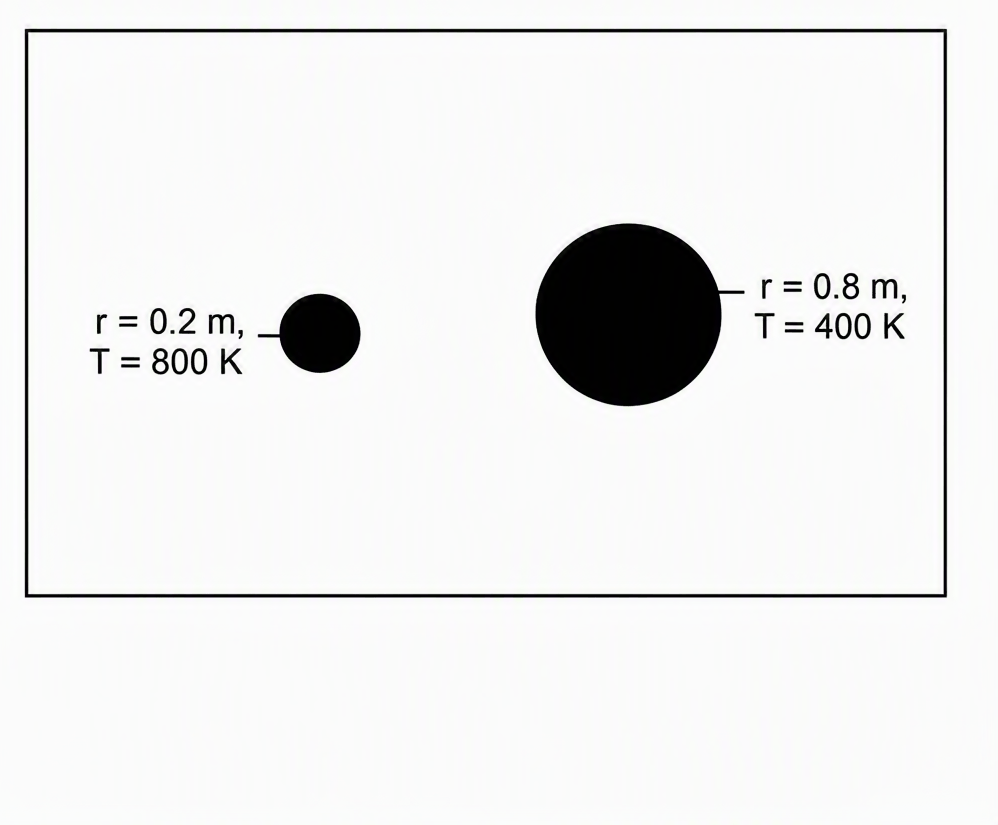
How do you solve the official step-by-step solution for this thermodynamics NEET 2025 blackbody question?
The energy radiated by the bigger body equals E. Stefan-Boltzmann law states radiated power P ∝ A T^4 where A = 4πr² for a sphere.
This equals
Note 800 = 2 × 400 so 800^4 = 16 × 400^4. Substitute to obtain
Therefore P_larger = P_smaller = E. The area ratio of 1/16 is exactly offset by the temperature ratio of 16.
What method mistake produces the wrong option 256E in this thermodynamics NEET 2025 question?
Swapping the temperature assignment while forming the ratio for the larger body produces 256E. Students pair the 800 K with the larger radius by mistake and use (0.8/0.2)^2 × (800/400)^4 instead of matching each radius to its own temperature.
This produces 16 × 16 = 256, leading to option 256E. The mistake occurs when the student loses track of which temperature belongs to which radius during proportion setup. Label each radius with its correct temperature at the start to block this.
What core principles of Stefan-Boltzmann law does this thermodynamics NEET 2025 question test?
This question tests that total power radiated depends on surface area (∝ r^2) and absolute temperature to the fourth power. Same material implies identical emissivity that cancels in ratio.
The question explicitly states surrounding effect negligible, so only emitted radiation σ A T^4 is considered, not net loss. The fourth power makes temperature changes far more influential than modest radius changes.
What related practice questions on blackbody radiation build mastery after the thermodynamics NEET 2025 PYQ?
- Two blackbodies of same radius but temperatures 300 K and 600 K; ratio of rates of energy radiated.
Power depends only on T^4.
- A sphere of radius r at T radiates E; new power if radius doubled and temperature halved.
Area becomes 4 times. Temperature factor is
Overall ratio 4 × 1/16 = 1/4, so new power is E/4.
- Compare radiated power of two bodies of equal mass and material, one sphere and one cube, at identical temperature.
Equal mass and material mean equal volume. The cube has larger surface area than the sphere for the same volume, therefore the cube radiates more power.
Search the past-paper archive by chapter to locate every similar blackbody numerical from recent years and repeat the ratio method on each.
How can you finish similar thermodynamics NEET 2025 questions in under 90 seconds?
You can finish them in under 90 seconds by writing the labelled ratio first, expressing one temperature as a multiple of the other, and cancelling terms without computing full powers.
- Write the ratio P1/P2 = (r1/r2)^2 (T1/T2)^4 before plugging numbers.
- Label each radius with its correct temperature at the start of the solution.
- Express larger temperature as integer multiple of smaller (800 = 2×400) and raise the factor immediately.
- Cancel identical 400^4 and π terms at once; never compute absolute fourth powers.
With this sequence the entire calculation fits on three lines and the answer is obvious before options are read. Use the same template on every radius-temperature pair you meet.
If you get stuck on any variant, photograph the doubt for a step-by-step solution.
Next step: photograph a doubt on NEET JEEnius AI and photograph any question you are stuck on and get a step-by-step solution across Physics, Chemistry and Biology (20 free a month).
Read next: Human Evolution NEET 2026: Assertion Reason on Homo Sapiens Origin.
Frequently asked questions
What was the hard thermodynamics NEET 2025 question on two spheres?
Two spheres of identical material with radii 0.2 m at 800 K and 0.8 m at 400 K are given. The smaller sphere radiates energy E and the task is to find the energy radiated by the larger sphere, which equals E.
Why does the larger sphere radiate E in the thermodynamics NEET 2025 question?
Stefan-Boltzmann law gives power proportional to surface area times T^4. The area ratio (0.2/0.8)^2 equals 1/16 while the temperature ratio (800/400)^4 equals 16. These factors cancel exactly, so both spheres radiate the same power E.
How do students arrive at 256E in the NEET 2025 thermodynamics question?
The error occurs when students swap the temperatures while setting up the ratio for the larger body. They compute (0.8/0.2)^2 × (800/400)^4 = 16 × 16 = 256 instead of using the correct pairing of each radius with its given temperature.
How can I solve thermodynamics blackbody questions faster for NEET 2025?
Write the ratio P1/P2 = (r1/r2)^2 × (T1/T2)^4 first and label each radius with its temperature. Express the higher temperature as a multiple of the lower one, raise to the fourth power immediately, and cancel common terms. This keeps the calculation to three lines and finishes in under 90 seconds.