

What did the hard Thermodynamics NEET 2026 re-examination MCQ ask?
The Thermodynamics NEET 2026 MCQ tested one skill: apply the correct work relation to each path before combining quantities. It was a hard Physics MCQ from the re-examination held on 21 June 2026, not the cancelled 3 May sitting. The expected solving time was 120 seconds because only the two isothermal paths need calculation.
One mole of an ideal gas follows four reversible paths shown in the supplied diagram. Processes 1 and 3 are isothermal at the following respective temperatures, while processes 2 and 4 are adiabatic:
The task is to identify the correct relation among:
The given gas constant is:
The four choices, written in equivalent form, are:
- Option A: The combined work of the two isothermal paths is
- Option B: The combined work of the adiabatic paths is claimed to be
- Option C: The work from processes 1 and 2 is claimed to satisfy
- Option D: The total work over all four paths is claimed to vanish:
How do you solve this Thermodynamics NEET 2026 question step by step?
Classify the paths before calculating. Processes 1 and 3 are reversible isothermal processes, so apply the logarithmic work formula separately to them. Processes 2 and 4 are adiabatic and do not belong in that formula. This process-by-process audit gives option A directly.
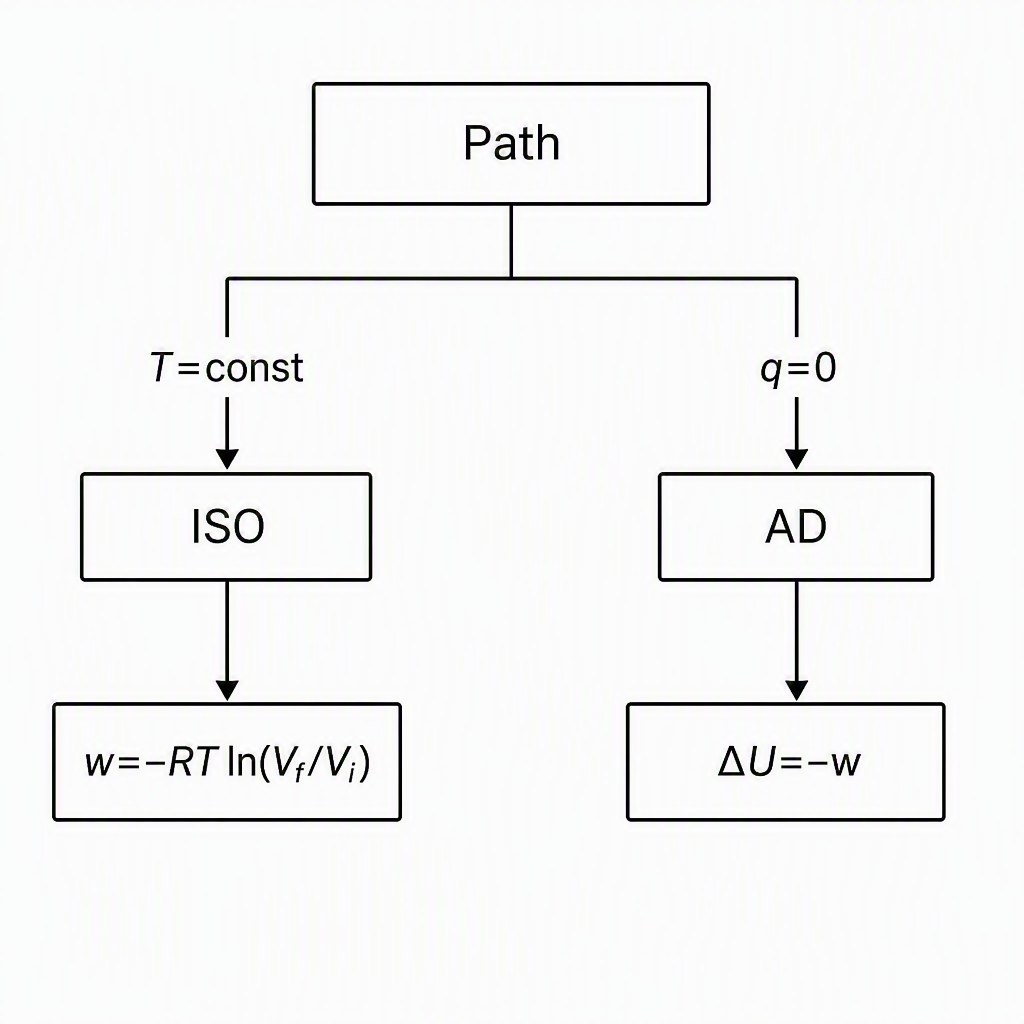
For one mole of an ideal gas undergoing a reversible isothermal process, the official solution uses:
How is the work for process 1 calculated?
Process 1 is isothermal at the first temperature. Its initial and final volumes are the first two labelled volumes. Substituting these values into the reversible isothermal expression gives:
Using the given gas constant:
Therefore:
How is the work for process 3 calculated?
Process 3 is reversible and isothermal at the second temperature. It moves from the first state below to the second while the temperature remains constant:
Apply the reversible isothermal work formula:
Substituting the given gas constant gives:
Add the two isothermal work expressions line by line:
This matches option A exactly.
How can you solve this MCQ within 120 seconds?
Use this four-step method. It fits the expected 120 seconds because it calculates only the quantities needed to identify option A.
- Mark processes 1 and 3 as isothermal.
- Write the reversible isothermal formula twice:
- Substitute the given value:
- Add the two expressions and compare the result directly with the options.
Do not calculate the adiabatic quantities unless you need to reject another option. The two isothermal paths are enough to confirm option A.
Why are the other three options wrong?
The remaining options apply a relation to the wrong process or confuse a state function with a path function. Option B combines internal-energy changes incorrectly. Option C mixes isothermal and adiabatic work. Option D treats zero cyclic change in internal energy as zero cyclic work.
Why is option B incorrect for the adiabatic paths?
For an adiabatic process, heat transfer is zero. Under the convention followed in the official solution, this gives:
Therefore, for process 2:
For process 4:
Adding the equations gives:
It does not give:
This rejects option B.
Why is option C a process-mixing error?
Option C combines work from process 1 with work from process 2. Process 1 is isothermal, but process 2 is adiabatic. Their sum cannot be replaced by an isothermal expression that belongs only to process 1.
Option C also mishandles the sign. For process 1, the valid expression is:
The option ignores the separate adiabatic contribution and reverses the sign of the isothermal work.
Why does zero cyclic internal-energy change not make option D correct?
Internal energy is a state function. After a complete thermodynamic cycle, the gas returns to its initial state, so:
Work is a path function. The net work over a closed cycle need not be zero:
Option D confuses zero net internal-energy change with zero net work.
Which related Thermodynamics questions should you practise?
Practise the three rules tested in this MCQ: logarithmic isothermal work, the adiabatic work relation under the stated convention, and the difference between state and path functions. Each question below targets one rule directly.
What is the work when one mole expands isothermally from one volume to twice that volume?
One mole of an ideal gas expands reversibly and isothermally under these conditions:
One-line solution:
What is the work in an adiabatic path when the internal energy increases by a given amount?
For an adiabatic path, suppose the internal-energy change is:
One-line solution: Using the convention followed in this solution,
Therefore:
Do work, heat and internal-energy change all vanish over a cycle?
Only the net internal-energy change must vanish because the system returns to its starting state. Net heat and net work need not separately be zero.
What should you recall during the NEET exam?
For a Thermodynamics NEET 2026 process question, classify each path before checking the options. Use the logarithmic formula only for a reversible isothermal path. For an adiabatic path, set heat transfer to zero and follow the work convention specified in the solution.
- Reversible isothermal path: Look for
- Adiabatic path: Set
and use:
- Complete cycle: Remember that
does not imply:
Final answer: option A.
Next step: the past-paper archive on NEET JEEnius AI and search past NEET papers by year, subject or chapter, each with a worked solution (100 free searches a month).
Frequently asked questions
What is the correct answer to the Thermodynamics NEET 2026 re-exam MCQ?
The correct answer is option A. Applying reversible isothermal work separately to processes 1 and 3 gives the stated expression for their combined work.
Which formula is used for reversible isothermal work?
For one mole of an ideal gas, the convention used here gives w = -RT ln(Vf/Vi). Apply it separately to each reversible isothermal path using that path's temperature and volume ratio.
Why is the net work over a thermodynamic cycle not necessarily zero?
Internal energy is a state function, so its net change over a complete cycle is zero. Work is a path function and can have a non-zero net value over the same cycle.
What is the work relation for an adiabatic process in this question?
For an adiabatic process, q = 0. Under the sign convention followed in the official solution, the first law therefore gives ΔU = -w, or w = -ΔU.