Which flightless swimmer is the answer to the Aves (Birds) NEET 2026 question?
C) Aptenodytes (penguin) is correct because it is flightless and uses modified forelimbs for swimming. This Aves (Birds) NEET 2026 item is a single-correct Biology question under the supplied chapter label Diversity in Living World.
The question asks: “Which of these birds cannot fly and uses paddle-shaped forelimbs to swim?” Both clues must match.
The bird must be flightless, and its forelimbs must function as swimming paddles. “Medium” is the question bank’s difficulty classification. The question bank gives an expected solving time of 30 seconds, not an official time limit.
Which scientific names identify flying birds that we can eliminate first?
Neophron is a vulture and Psittacula is a parrot; both can fly. Following the official solution’s first stage, eliminate B and D because neither meets the flightless condition. Translate the scientific names before testing the adaptations.
The four-option check is:
Both ostriches and penguins are flightless, so A and C remain. This first elimination step narrows the choice but does not establish the answer. Selecting either survivor now would leave the question’s forelimb clue unchecked.
Why does the swimming clue select Aptenodytes rather than Struthio?
Penguin forelimbs are modified into flippers, the paddle-like structures described in the question. Those flippers are used for swimming, so Aptenodytes satisfies both requirements. Ostrich forelimbs are small and help with balance while running, not as swimming paddles.
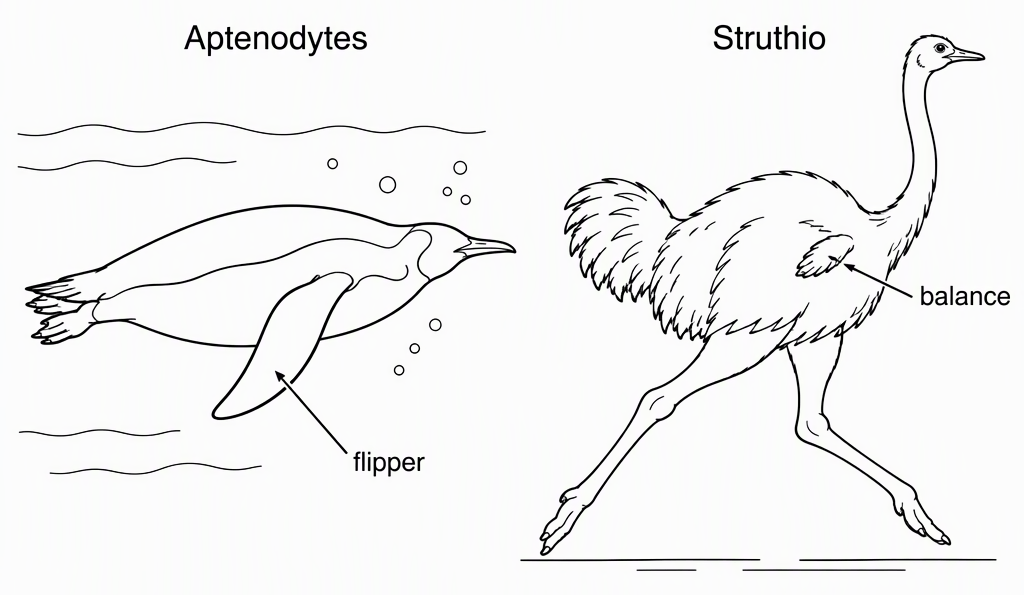
The decisive clue is what the forelimbs do, not simply the absence of flight. Struthio passes the flightless test but fails the swimming-forelimb test. Aptenodytes passes both.
Correct answer: C) Aptenodytes (penguin).
Treat “flightless” as the first filter and “swimming paddles” as the deciding filter. A correct option must match the whole description, not just one condition.
The complete reasoning chain is: eliminate Neophron and Psittacula because they fly; then distinguish Struthio from Aptenodytes by forelimb function, balance during running versus swimming.
Why is choosing A) Struthio a condition-checking error?
Choosing Struthio stops at a partial match instead of checking all stated conditions. The incomplete reasoning is: “Struthio is an ostrich; ostriches cannot fly; therefore A is correct.” Its biological starting fact is right, but its conclusion ignores the swimming requirement.
This is different from a naming error. A student can know that Struthio means ostrich and still answer incorrectly by failing to test its forelimb function.
Before marking, state how the option satisfies both clues:
- Flightless: Does this bird lack the ability to fly?
- Forelimbs used for swimming: Are its forelimbs the swimming paddles described?
If the marking scheme awards four marks for a correct answer and minus one for an incorrect answer, the score difference between selecting C and selecting A is:
That is a five-mark difference between outcomes, not five marks awarded for a correct response.
How can I practise the same Aves distinctions in three questions?
Check the scientific name first, then test every condition in the stem. These are original practice questions from the same chapter, not additional NEET PYQs.
Which pair contains two birds capable of flight?
Answer: B. Neophron is a vulture and Psittacula is a parrot; both can fly. A contains two flightless birds, while C contains the flightless penguin and D contains the flightless ostrich. Every rejected pair has at least one bird that fails the requirement.
Which description correctly matches Struthio?
Answer: C. Struthio means ostrich, and its small forelimbs help with balance during running. A describes Aptenodytes, B describes Psittacula and D describes Neophron. The correct choice must match both the name and the forelimb function.
A bird is described only as flightless. Which conclusion is justified among these options?
Answer: C. Both ostriches and penguins are flightless, so that clue alone cannot distinguish them. It also cannot establish a swimming adaptation: you need the forelimb clue before selecting penguin specifically.
Recall check: Cover the explanations and recall each link aloud: Aptenodytes, penguin, swimming flippers; Struthio, ostrich, balance while running.
Next step: photograph a doubt on NEET JEEnius AI and photograph any question you are stuck on and get a step-by-step solution across Physics, Chemistry and Biology (20 free a month).
Keep going with D- and F-Block Elements NEET 2005: Third Ionization Enthalpy.
Frequently asked questions
Which flightless bird uses paddle-shaped forelimbs to swim?
Aptenodytes (penguin) is the correct answer. Its forelimbs are modified into swimming flippers, so it satisfies both clues: flightlessness and forelimbs used as swimming paddles.
Why is Struthio not the answer to the swimming-forelimb question?
Struthio is an ostrich, so it satisfies the flightless condition. Its small forelimbs help with balance while running rather than functioning as swimming paddles. Choosing it ignores the second condition in the question.
What are the common names of Neophron and Psittacula?
Neophron is a vulture, and Psittacula is a parrot. Both can fly, so neither matches a question asking for a flightless bird.
Is flightlessness enough to distinguish Struthio from Aptenodytes?
No. Both Struthio (ostrich) and Aptenodytes (penguin) are flightless. The swimming-forelimb clue distinguishes Aptenodytes because penguin forelimbs are modified into flippers.