How do you solve the Simple Harmonic Motion NEET 2026 graph question?
Energy conservation gives the graph equation directly in this Simple Harmonic Motion NEET 2026 question. Compare the coefficients of the squared graph coordinates; a displacement-time equation is unnecessary.
Consider an ideal one-dimensional spring–mass oscillator on a frictionless horizontal guide. Use SI units: kilograms for particle mass, newtons per metre for spring constant, metres for extension from equilibrium and metres per second for instantaneous speed.
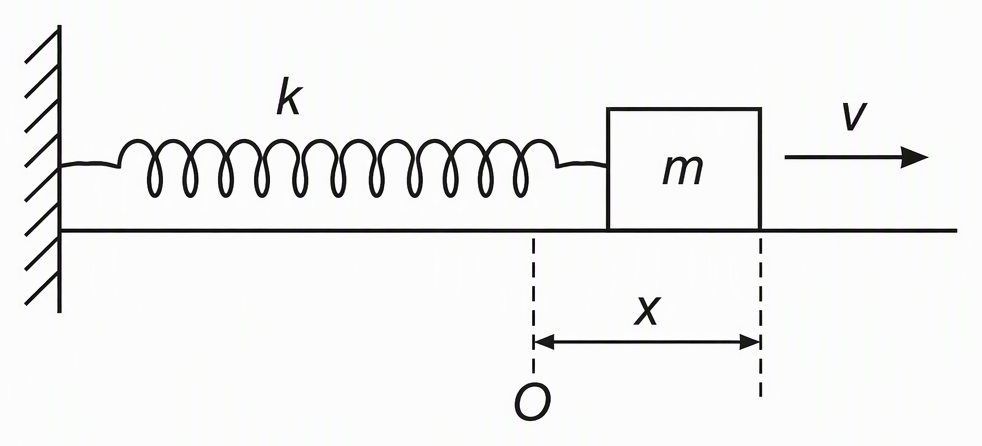
Which relation between spring constant and mass makes the stated speed-versus-displacement graph circular?
This is the supplied NEET 2026 question, tagged medium on this question bank’s scale. Try it in 75 seconds before reading further: that is a suggested practice time, not an official question-level exam limit.
How does conserved energy give the graph equation?
Equate kinetic energy plus spring potential energy to the energy at a turning point. Amplitude enters because it fixes the oscillator’s total energy, even though the question gives no numerical value for it.
Define amplitude as the maximum displacement from equilibrium:
At either turning point, speed is zero. All mechanical energy is spring potential energy:
At the stated instant, kinetic energy and spring potential energy are:
Conservation of energy gives:
Multiply every term by 2, not just the kinetic-energy term:
Now divide every term by the mass:
This is the official energy-conservation method. It relates displacement and speed directly, so solving for displacement as a function of time or differentiating a sinusoid adds unnecessary work.
Why is option B correct, and what does “circle” mean here?
Option B is correct: the intended circle requires equal numerical coefficients of the squared coordinates under the question’s SI plotting convention. The quadratic relation describes an ellipse in general, with coefficients:
For the intended circle:
Amplitude changes the intercepts, not this coefficient condition. Check the displacement intercepts:
At equilibrium, the speed is:
For signed velocity, both signs occur:
The boxed relation means equality of the numerical values of spring constant and mass in the stated SI plotting convention, not equality of their physical dimensions. The ratio has units:
The coefficient comparison assumes those numerical plotting coordinates. Changing the relative scales of the displacement and speed axes changes the apparent shape.
Speed cannot be negative, so it traces only the upper half of the locus. Signed velocity produces the complete closed ellipse or circle. This qualifies the question’s wording, but the coefficient condition and option B remain unchanged.
How can a wrong frequency formula produce option A?
The energy equation identifies angular frequency squared as spring constant divided by mass, not their product:
Using the wrong frequency formula, then imposing the intended numerical frequency condition, gives this erroneous chain:
That is option A. The mistake is the mass dependence: mass belongs in the denominator.
Increasing mass at fixed spring constant must reduce angular frequency. The incorrect square-root-of-product formula predicts an increase instead.
Use the energy coefficient rather than recall a frequency formula separately. Divide every term of the energy equation by mass and read the coefficient directly; this also prevents dropping the mass from only one term.
How do you solve three related SHM energy questions?
Use the same conserved-energy equation for speed, equal energy sharing and amplitude changes. These are author-created practice questions from Oscillations and Waves, not additional NEET past-paper questions.
What is the speed at half the amplitude?
Substitute half the amplitude into the energy equation, then take the positive square root because speed is non-negative:
For a numerical check, use these author-created values:
This is below the maximum speed, as required:
Where are kinetic and potential energies equal?
Each energy must be half the total. Set spring potential energy equal to that half:
The two positions are equally far from equilibrium on opposite sides.
What changes when amplitude doubles?
With mass and spring constant fixed, total energy becomes four times its original value and maximum speed doubles. The graph keeps its shape classification under unchanged axis scales:
Both intercept magnitudes double, but the coefficient ratio remains unchanged:
A circle stays a circle and a non-circular ellipse stays non-circular. Cover the solutions and reproduce the coefficient comparison, then these three substitutions, without using a time equation.
Next step: photograph a doubt on NEET JEEnius AI and photograph any question you are stuck on and get a step-by-step solution across Physics, Chemistry and Biology (20 free a month).
If that step was the hard part, work through How to Study Current Electricity NEET: NCERT to Circuits.
Frequently asked questions
How do you solve the Simple Harmonic Motion NEET 2026 graph question?
Conservation of energy gives v² + (k/m)x² = (k/m)A². Equal numerical coefficients of the squared plotting coordinates give k = m, so option B is correct under the question’s SI plotting convention. This means equal numerical values, not equal physical dimensions; the apparent shape also depends on the relative axis scales.
Is the speed–displacement graph in SHM a full circle?
No: speed is non-negative, so the speed–displacement graph traces only the upper half of the locus. Signed velocity produces the full ellipse, or a circle under the appropriate coefficient and plotting-scale condition.
What is the correct angular frequency formula for a spring–mass oscillator?
The angular frequency is ω = √(k/m), not √(km). Increasing mass at fixed spring constant reduces angular frequency, which provides a quick check against the incorrect formula.
What happens to SHM energy and maximum speed when amplitude doubles?
With mass and spring constant fixed, doubling amplitude makes total energy four times larger and doubles maximum speed. Both graph intercept magnitudes double, but the circle or ellipse classification stays unchanged if the axis scales remain fixed.