
What should I study first in Current Electricity for NEET?
In Current Electricity for NEET, remembering Ohm’s law is not enough: you must identify which voltage and which current belong in it. Choose the physical model before choosing a formula.
Step 1: Read NCERT in this order, including the relevant worked examples and graphs:
- Current and drift velocity.
- Resistance and resistivity.
- Resistor combinations.
- Emf and internal resistance.
- Kirchhoff’s rules and bridge balance.
For each relationship, identify what it connects and the conditions under which it applies.
Step 2: Build a formula sheet with three columns: relationship, conditions of use, quantity that stays fixed. Do not collect equations without assumptions.
Here, n is carrier number density, e is the magnitude of electronic charge, A is cross-sectional area, and the final factor is drift speed. The equation relates magnitudes: in electron conduction, electron drift is opposite to conventional current.
This applies to a uniform conductor with uniform resistivity. Before comparing resistances, identify whether length, area, volume or resistivity stays fixed.
This is an approximate linear temperature model over an appropriate range, not a universal rule. Alpha is the temperature coefficient of resistivity at the reference temperature.
Step 3: Read the axes before interpreting a graph. For an ohmic conductor under unchanged physical conditions:
For power comparisons, identify what stays fixed:
How do I choose the right equation for a circuit?
Choose from the connections, not the shape of the drawing. Label nodes, reduce genuine combinations, then use Kirchhoff’s laws where reduction fails. Do not put the source emf across a resistor without checking the voltage between its endpoints.
Step 4: Redraw and label. Mark nodes, the requested quantity, assumed current directions and source polarities. Points joined by an ideal uninterrupted wire belong to the same node.
- Series: the shared junction has no other current branch.
- Parallel: both ends connect to the same two nodes.
Step 5: Reduce, test balance, then write equations. Reduce genuine series–parallel groups and test a bridge for balance. Otherwise, use Kirchhoff’s junction and loop equations rather than forcing a reduction.
For loop signs:
A negative solved current means the actual direction is opposite to your assumption.
For a cell delivering current into an external resistance, distinguish emf from terminal voltage:
During charging, current enters the positive terminal:
For N identical, equally oriented cells:
Do not extend these shortcuts to unequal cells.
Step 6: Check before selecting an option. Verify units, junction current balance, loop voltage balance and sensible limits. Use the same four labels in every solution: identify the model, write the equation, calculate, check.
How does stretching a wire change its resistance?
Doubling the length makes the resistance four times its original value only when volume and resistivity stay unchanged. Stretching also reduces cross-sectional area. This is a material-and-geometry problem, not a circuit-reduction problem.
Constructed practice question 1: A uniform wire has resistance 3 ohms and is stretched to twice its length. Assume unchanged resistivity and constant volume. Find its new resistance.
Identify the model: Volume stays fixed, so the longer wire must become thinner.
Write the equation:
Calculate:
Check: The tempting answer of 6 ohms changes length but incorrectly keeps area fixed. Both increased length and reduced area increase resistance.
The reusable stretching rule is:
Cutting a wire changes the assumptions. For pieces with unchanged cross-section and resistivity:
These examples are constructed practice questions, not previous-year NEET questions or evidence of weightage. For focused follow-up, NEET JEEnius AI’s daily practice problems provide a fresh set on a topic every day, with 20 free attempts a month.
How do I find branch currents when a cell has internal resistance?
Find the external equivalent resistance, calculate total current, then find terminal voltage. Use terminal voltage across the parallel branches, not emf. Internal resistance carries the total current and is in series with the entire external parallel combination.
Constructed practice question 2: A 6-volt cell with internal resistance 1 ohm supplies 3-ohm and 6-ohm resistors connected in parallel across its terminals. Find terminal voltage and current through each external resistor.
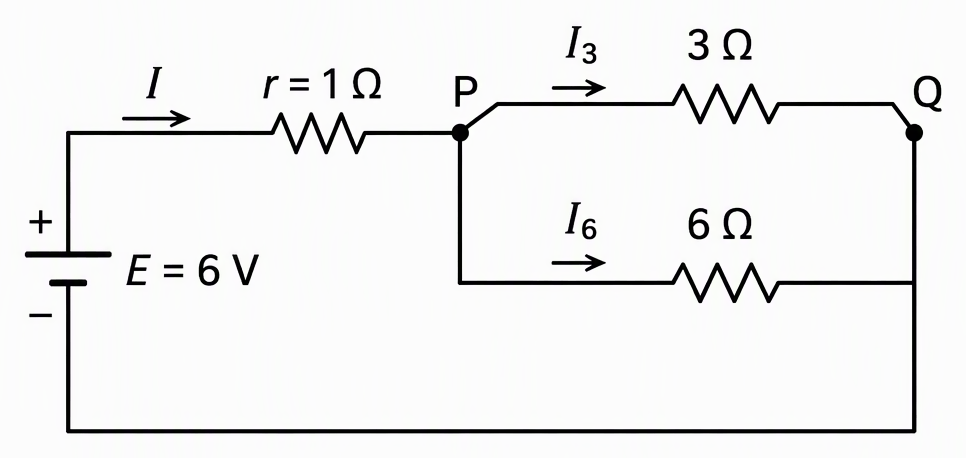
Identify the model: A real cell feeds a parallel load. Both external resistors have the same terminal voltage.
Write the equation:
Calculate:
Check: The branch currents must add to the total current, and the external and internal voltage drops must add to the emf.
Using 6 volts directly across each branch ignores the 2-volt internal drop. With emf and external resistances unchanged, reducing internal resistance increases terminal voltage and both branch currents:
When can I ignore the middle resistor in a bridge?
Ignore the middle branch only after proving its endpoints have equal potential. A balanced bridge carries zero current through that branch, whatever its finite resistance. Test the arm ratios, not the bridge’s familiar shape.
Constructed practice question 3: The resistances are A–B: 2 ohms, B–C: 4 ohms, A–D: 3 ohms, D–C: 6 ohms and B–D: 5 ohms. An ideal 6-volt source connects across A and C, with A positive. Find current through B–D and equivalent resistance.
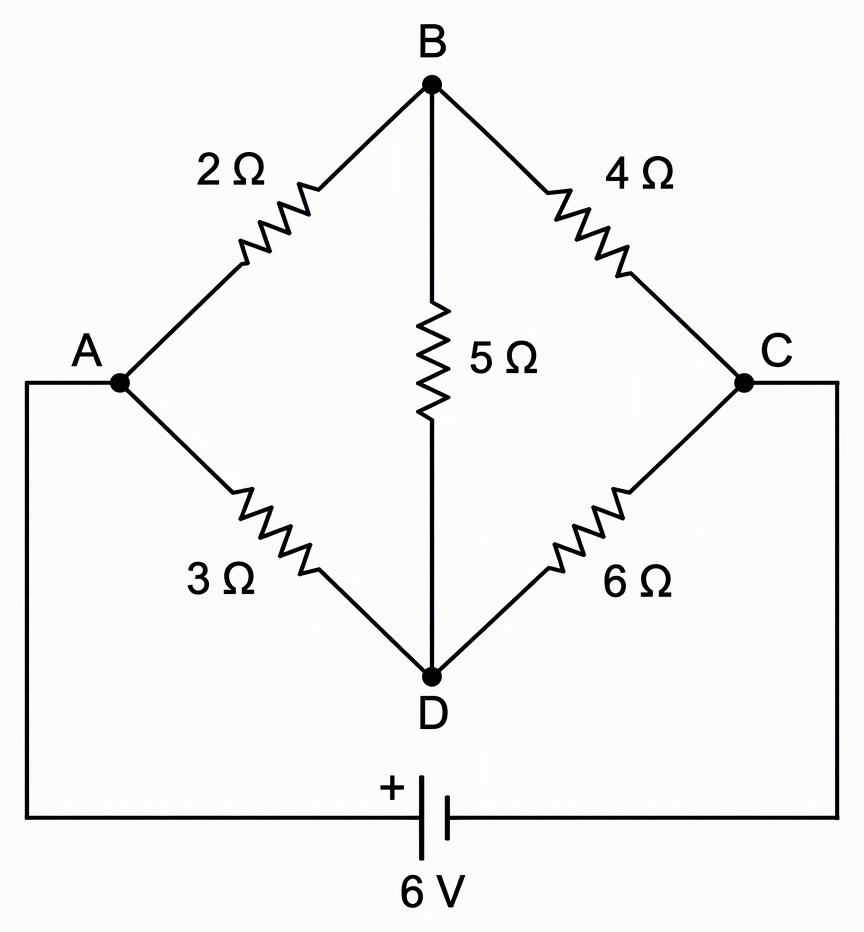
Identify the model: Test bridge balance before attempting series reduction.
Write the equation:
Calculate:
Only now can the outer paths be treated as 6-ohm and 9-ohm branches in parallel:
Check: Calculate the outer-path currents and compare the voltage drops from A to each midpoint.
The 5-ohm resistor is not short-circuited. It carries no current because its endpoints are equipotential. If the arm ratios differ, removing it and making these series reductions is invalid: return to Kirchhoff’s equations.
What should I practise after getting a Current Electricity question wrong?
Choose a small follow-up set based on your first wrong decision, then return to mixed questions. I would choose targeted practice over another full chapter test when the weakness is specific. If you used emf instead of terminal voltage, practise real-cell circuits first.
Use this suggested practice order:
- Drift velocity and material relations.
- Stretching and temperature change.
- Graphs and power.
- Resistor networks.
- Cells and internal resistance.
- Kirchhoff and bridge problems.
For each block, read the relevant NCERT material, reproduce one worked solution with the book closed, then attempt unseen single-correct MCQs. Classify errors by the decision that failed:
- Wrong physical assumption: treated stretching as fixed-area length change.
- Wrong nodes: mistook nearby resistors for parallel resistors.
- Wrong voltage: used emf across an external branch.
- Sign error: reversed a cell’s contribution in a loop.
- Unit error: failed to convert cross-sectional area correctly.
- Arithmetic error: formed the right equation but evaluated it incorrectly.
Record the first wrong decision, not the entire solution. Attempt a small targeted set, follow it with mixed questions, and reattempt the original question closed-book later. This is a suggested routine, not a universal schedule.
Readiness means you can justify the law, state its assumptions and solve an unfamiliar arrangement without your formula sheet. For the next targeted set, NEET JEEnius AI’s practice mode offers topic sets that skip questions already seen, with 60 free sets a month.
Next step: daily practice problems on NEET JEEnius AI and get a fresh set on a topic every day (20 free attempts a month).
Read next: Laws of Motion Practice Questions NEET: 6 Worked MCQs.
Frequently asked questions
What should I study first in Current Electricity for NEET?
Start with NCERT on current and drift velocity, then resistance and resistivity, resistor combinations, emf and internal resistance, and finally Kirchhoff’s rules and bridge balance. Include the worked examples and graphs. Build a formula sheet that records each relationship, its conditions of use and the quantity held fixed.
How do I find branch currents when a cell has internal resistance?
Calculate the external equivalent resistance, then find total current using I = E/(R_ext + r). For a cell delivering current, calculate terminal voltage using V = E − Ir and divide this voltage by each parallel branch resistance. Do not use the emf directly across the external branches unless the internal voltage drop is zero.
When can I ignore the middle resistor in a bridge circuit?
You can ignore the middle branch after proving that its endpoints have equal potential. In a balanced bridge, the corresponding arm ratios are equal, so the middle branch carries zero current despite having finite resistance. If the ratios differ, retain the branch and use Kirchhoff’s equations rather than forcing a series–parallel reduction.
How should I practise after getting a Current Electricity question wrong?
Record the first wrong decision, such as choosing the wrong physical assumption, misidentifying nodes or using emf instead of terminal voltage. Attempt a small targeted set on that weakness, then return to mixed questions. Reattempt the original question closed-book later.