
How should I study Coordination Compounds for NEET and solve its MCQs?
For Coordination Compounds for NEET, decode the coordination sphere before naming, counting isomers or predicting magnetism. Use a worksheet for charge, oxidation state, donor count and, when needed, d-electron count. Then choose the correct solution branch instead of forcing every question through a hybridisation shortcut.
- Repair only the prerequisites you need. Revise ionic charges, transition-metal electronic configurations and orbital filling. Transition-metal cations lose outer s electrons before inner d electrons:
Practise forming metal ions from neutral-atom configurations before starting magnetic-property questions. Do not restart the whole Chemical Bonding chapter.
- Read NCERT in dependency order. Start with terminology and Werner’s theory, distinguishing primary valency from secondary valency. Continue through formula writing and nomenclature, then isomerism, then bonding, crystal-field splitting and properties. Finish with stability and applications wherever included in your applicable syllabus.
- Build a compact ligand reference. Record both charge and denticity, not just the ligand’s name:
- Ammonia and water: neutral, monodentate.
- Chloride and cyanide: anionic, monodentate.
- Ethane-1,2-diamine, abbreviated en: neutral, bidentate.
- Oxalate: anionic, bidentate.
Bidentate means two donor atoms bind the same metal together. Ambidentate means alternative donor atoms are available, but only one binds in a given linkage.
- Decode before answering. Separate the bracketed coordination sphere from counterions. Find the sphere’s charge, then write:
Count coordinated donor atoms, not ligand molecules. Calculate d-electron count only when the question needs it. Oxidation state is not coordination number: one describes formal charge assignment, the other counts donor atoms attached to the metal.
- Choose the branch. For naming, apply ligand names, alphabetical order, metal oxidation state and the anionic-complex “-ate” rule. Ignore multiplicative prefixes when alphabetising. For isomerism, establish connectivity and geometry before counting arrangements. For magnetism, establish d count and relevant ligand-field behaviour before counting unpaired electrons.
Coordination number 4 alone cannot distinguish tetrahedral from square-planar geometry. Colour cannot be predicted merely by counting unpaired electrons.
- Close NCERT and reproduce the worksheet. Solve a question, then label the first mistake: charge, donor count, naming, geometry, pairing or isomer counting. Recall ligand identities, naming conventions, spectrochemical ordering and NCERT examples. Derive oxidation state, d count and spin-only magnetic moment.
Keep colour, stability, chelation and applications on the revision checklist. The worked examples below teach the calculation routes, not the entire chapter’s content.
How do I name a complex without counting counterions as ligands?
Locate the brackets first: only species inside them contribute coordinated donor atoms. This original illustrative MCQ, not a previous-year NEET question, tests that distinction.
Which is the correct name?
- A: pentaamminechloridocobalt(III) chloride
- B: pentaamminechloridocobalt(II) chloride
- C: pentaamminechloridocobaltate(III) chloride
- D: pentaamminetrichloridocobalt(III)
The two outer chloride ions require a doubly positive coordination sphere. Ammonia is neutral; the coordinated chloride contributes one negative charge.
Five ammonia donor atoms and one coordinated chloride donor atom bind cobalt:
Answer: A, pentaamminechloridocobalt(III) chloride. “Ammine” has a double m and denotes coordinated ammonia. Ammine precedes chlorido alphabetically; the prefix penta does not control that order. Cobaltate is wrong because this complex is cationic, not anionic.
Idealised dissociation is:
This gives three ions per formula unit. Under the standard textbook treatment, the two outer chloride ions are initially available for silver chloride precipitation. The coordinated chloride is not already a free ion.
The decisive first step: locate the square brackets before counting anything.
Why do the two four-coordinate nickel complexes have different magnetic properties?
The chloride complex is tetrahedral and paramagnetic; the cyanide complex is square-planar and diamagnetic. Identical oxidation state and coordination number do not guarantee identical geometry or electron pairing.
Original single-correct MCQ: Which comparison is correct for the chloride complex followed by the cyanide complex?
- A: Tetrahedral, paramagnetic; square-planar, diamagnetic.
- B: Square-planar, diamagnetic; tetrahedral, paramagnetic.
- C: Both tetrahedral and paramagnetic.
- D: Both square-planar and diamagnetic.
Each has four monodentate ligands carrying one negative charge each:
Both therefore have coordination number 4 and eight d electrons. In the standard NEET-level assignments, the chloride complex has two unpaired electrons; the cyanide complex has none.
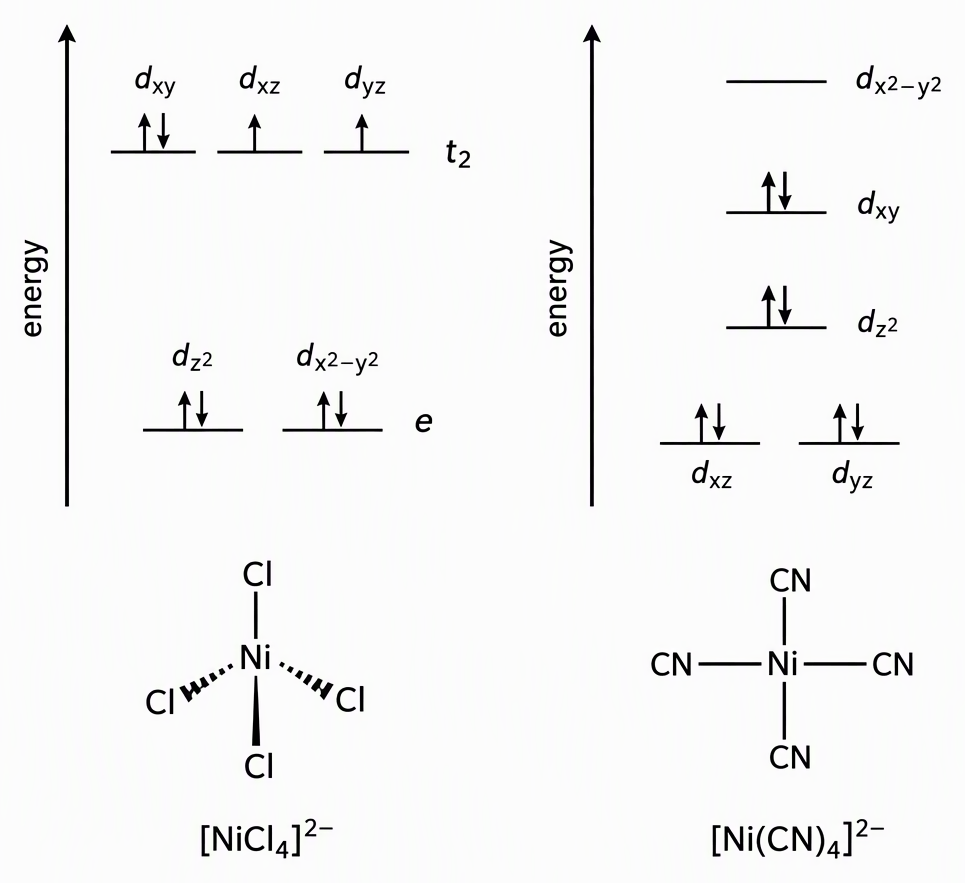
Their standard VBT descriptions, respectively, are:
The spin-only formula uses the number of unpaired electrons:
Answer: A. These are standard nickel(II) examples, not proof that every strong-field four-coordinate complex is square-planar. The familiar comparison below belongs to the octahedral high-spin/low-spin framework:
Do not apply it blindly to every geometry. Charge and d count narrow the problem, but geometry and electron pairing still need justification.
How do I count geometrical and optical isomers without double-counting?
Establish the geometry, preserve each chelate’s linked donor sites, then check each geometrical form for optical isomerism. For the octahedral complex below, this gives two geometrical forms but three stereoisomers when mirror-image forms are counted separately.
Original MCQ: What is the total number of stereoisomers, counting optical isomers separately?
- A: 1
- B: 2
- C: 3
- D: 4
En is ethane-1,2-diamine, a neutral bidentate ligand. Two en ligands supply four donor atoms; two chlorido ligands supply two.
Use an octahedral framework. Each en ligand occupies two linked donor sites; separating those sites into unrelated nitrogen donors creates false arrangements.
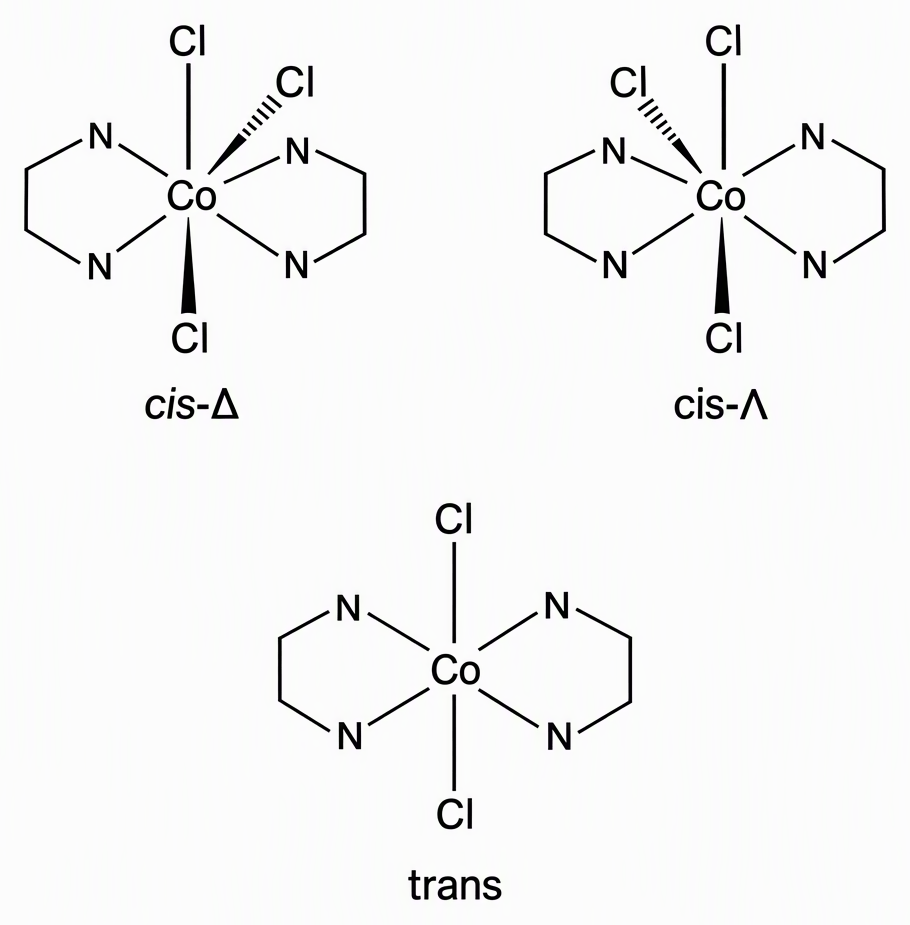
The cis form has adjacent chlorido ligands and two non-superimposable mirror-image forms. The trans form has opposite chlorido ligands and is optically inactive.
Answer: C. “Number of geometrical isomers” asks for 2; “total stereoisomers, counting optical isomers separately” asks for 3.
Rotating an entire structure does not create another isomer. Nor is every cis complex optically active: that conclusion must follow from the actual arrangement.
What should I practise after these worked examples?
Start with a diagnostic set, repair the first wrong step, then move to mixed MCQs. I recommend 12 diagnostic questions, as a faculty practice target, not an official requirement or a score guarantee:
- 3: Charge, coordination number and naming.
- 3: Isomerism.
- 3: Bonding and magnetism.
- 3: Werner’s theory, colour, stability or applications.
If a category exposes a misconception, return to that NCERT passage. Solve a fresh question testing the corrected rule before starting a mixed set.
Use this four-field error log:
- Question type: Naming a cationic complex.
- First wrong step: Counted counterions as coordinated ligands.
- Corrected rule: Only donors inside the coordination sphere determine coordination number.
- Fresh question testing the same rule: Decode a different complex containing both coordinated and outer-sphere chloride.
Reattempt missed questions with the solution hidden. Then attempt unseen questions, because remembering an option is not the same as understanding its rule.
Your minimum one-page revision sheet should contain:
- Ligand charge and denticity reference.
- Naming checklist.
- Standard geometry examples.
- Common isomer sketches with chelate links preserved.
- Spin-only magnetic-moment formula.
- Brief reminders on colour, stability, chelation and applications.
NCERT is the content anchor, not a rereading-only strategy. Test it through exercises, relevant verified PYQs and fresh MCQs.
For unseen follow-up questions, NEET JEEnius AI’s practice mode offers topic sets that skip questions already seen, with 60 free sets a month. Choose the topic matching your first wrong step.
Next step: practice mode on NEET JEEnius AI and practise a topic in sets that skip questions you have already seen (60 free sets a month).
Read next: Kinetic Theory Practice Questions NEET: 6 MCQs With Solutions.
Frequently asked questions
In what order should I study Coordination Compounds for NEET?
Revise ionic charges, transition-metal electronic configurations and orbital filling first. Then study NCERT terminology and Werner’s theory, formula writing and nomenclature, isomerism, bonding, crystal-field splitting and properties. Finish with stability and applications wherever included in your applicable syllabus.
How do I calculate oxidation state and coordination number?
Separate the bracketed coordination sphere from its counterions and determine the sphere’s charge. The metal oxidation state plus the sum of ligand charges equals the complex charge. For coordination number, count donor atoms attached to the metal, not ligand molecules or counterions.
Why is [NiCl4]2− paramagnetic but [Ni(CN)4]2− diamagnetic?
Both complexes contain Ni(II), have eight d electrons and have coordination number 4. In the standard NEET-level assignments, [NiCl4]2− is tetrahedral with two unpaired electrons, whereas [Ni(CN)4]2− is square-planar with none. Coordination number alone therefore cannot determine geometry or magnetic behaviour.
How many stereoisomers does [Co(en)2Cl2]+ have?
The octahedral complex [Co(en)2Cl2]+ has two geometrical forms: cis and trans. The cis form has two non-superimposable mirror-image forms, while the trans form is optically inactive. It therefore has three stereoisomers when optical isomers are counted separately.