
Should I start Kinetic Theory practice with chapter questions or a full mock?
Start with worked chapter MCQs if your concepts are uncertain. These free Kinetic Theory practice questions for NEET include an original six-question set with solutions after the short comparison. Use answer-key-only worksheets once you can justify answers independently, and full mocks to test performance across the syllabus. No format is universally best: a mock can expose a problem, but it does not replace the chapter work needed to repair it.
How do worked MCQs, answer-key worksheets and full mocks compare?
Worked MCQs check reasoning, worksheets test retrieval, and full mocks test mixed-syllabus performance. Choose by the learning job, not the largest question count.
- Chapter focus: Worked chapter MCQs on this page: Kinetic Theory only. Answer-key-only chapter worksheets: the selected chapter. NEET JEEnius AI full-length mocks: the full syllabus, with no guaranteed number of Kinetic Theory questions.
- Explanation support: Worked MCQs: relations, substitutions and distractor checks. Worksheets: correctness only; a key does not explain why a distractor is wrong. Mocks: a scored per-subject breakdown, not a worked chapter solution.
- What the result reveals: Worked MCQs: reasoning gaps in the sampled concepts. Worksheets: independent retrieval and accuracy. Mocks: subject-level outcomes within a mixed paper.
- Best preparation stage: Worked MCQs: concept repair. Worksheets: after concepts are secure. Mocks: broader performance checks.
- Main limitation: Worked MCQs: a short set cannot establish complete chapter mastery. Worksheets: quality depends on the source. Mocks: subject scores are not chapter diagnoses.
For the broader check, NEET JEEnius AI provides 30 free mocks a month, each with 180 questions, 720 marks and 180 minutes: 45 Physics, 45 Chemistry and 90 Biology questions.
Which practice format should I choose right now?
Choose from your errors, not your class year. A Class 12 student may need concept repair, while a Class 11 student may already be ready for independent retrieval. Change formats when your reasoning supports the move, not just because you finished a set.
- Class 11, just studied the chapter: Attempt worked MCQs without opening the solutions. Afterwards, explain the assumptions aloud: same gas, constant density, fixed temperature or inactive vibration. Recognising a formula is not enough if you cannot say when it applies.
- Class 12, formulas known but rms speed and kinetic energy confused: Use worked solutions to separate their temperature and mass dependences before attempting another worksheet. More questions are not the first step when the same distinction remains unclear.
- Any student who can justify answers without notes: Choose an answer-key-only worksheet. Return to explanations for uncertain answers, including answers that happen to be correct.
- Dropper with reliable chapter work but weaker mixed-paper Physics: Use full-length mocks to examine subject-level outcomes. Then review individual errors manually to separate forgotten concepts, reading errors and time allocation.
For parents, check what the student misunderstood. The size of a question bank tells you little about whether it addresses that problem.
Can I attempt six free Kinetic Theory practice questions for NEET now?
Attempt all six questions before checking the key below. These are original, single-correct practice questions, not previous-year NEET questions or predictions. Each has four options. Record the relation and the quantity held constant beside your choice so that a correct guess does not pass as understanding.
Question 1: Pressure and molecular speed
An ideal gas has constant mass density. Its rms molecular speed becomes twice its initial value. What happens to its pressure?
- A. It becomes twice the initial pressure.
- B. It becomes four times the initial pressure.
- C. It becomes half the initial pressure.
- D. It remains unchanged.
Question 2: Temperature and rms speed
A sample of the same ideal gas is heated from 27°C to 927°C. Use Kelvin for the temperature ratio, taking the Celsius-to-Kelvin offset as 273 for this exercise. What is the final rms speed compared with the initial speed?
- A. Four times
- B. Half
- C. Twice
- D. About 34 times
Question 3: Different gases at one temperature
Two ideal gases, A and B, are at the same temperature. Their molar masses are 4 and 36 grams per mole, respectively. What is the ratio of the rms speed of A to that of B?
- A. Three to one
- B. Nine to one
- C. One to three
- D. One to nine
Question 4: Molecular energy versus speed
Two ideal gases are at the same temperature. A molecule of the heavier gas has four times the mass of a molecule of the lighter gas. Which statement is correct?
- A. Their rms speeds and mean translational kinetic energies are both equal.
- B. The lighter gas has twice the rms speed and twice the mean translational kinetic energy.
- C. The heavier gas has twice the rms speed; their mean translational kinetic energies are equal.
- D. Their mean translational kinetic energies are equal; the lighter gas has twice the rms speed.
Question 5: Degrees of freedom
An ideal diatomic gas has three active translational and two active rotational degrees of freedom. Vibrational modes are inactive. What is its ratio of heat capacities, gamma?
- A. Five-thirds
- B. Nine-sevenths
- C. Seven-fifths
- D. Five-sevenths
Question 6: Mean free path
An ideal gas is compressed until its pressure becomes three times its initial value. Temperature and molecular collision diameter remain fixed. What happens to its mean free path?
- A. It becomes three times as large.
- B. It becomes one-third as large.
- C. It becomes one-ninth as large.
- D. It remains unchanged.
What are the answers and worked solutions?
The answer key is 1-B, 2-C, 3-A, 4-D, 5-C and 6-B. Check your written reasoning against each solution, not just the option letter.
1. Correct option: B
Pressure depends on the square of rms speed. Constant density removes the density ratio:
Option A treats a squared dependence as a linear one. Dimensionally, density multiplied by speed squared gives pressure.
2. Correct option: C
For the same gas, rms speed follows the square root of absolute temperature. Convert both temperatures to Kelvin before taking their ratio:
Option A forgets the square root. Option D incorrectly uses a Celsius ratio and also misses the square root.
3. Correct option: A
At equal temperature, rms speed varies inversely with the square root of molar mass. The matching mass units cancel in this ratio:
Option B uses the inverse mass ratio without taking its square root. Option C reverses which gas is faster.
4. Correct option: D
Mean translational kinetic energy depends only on temperature. RMS speed also depends on molecular mass, so equal energy does not require equal speed.
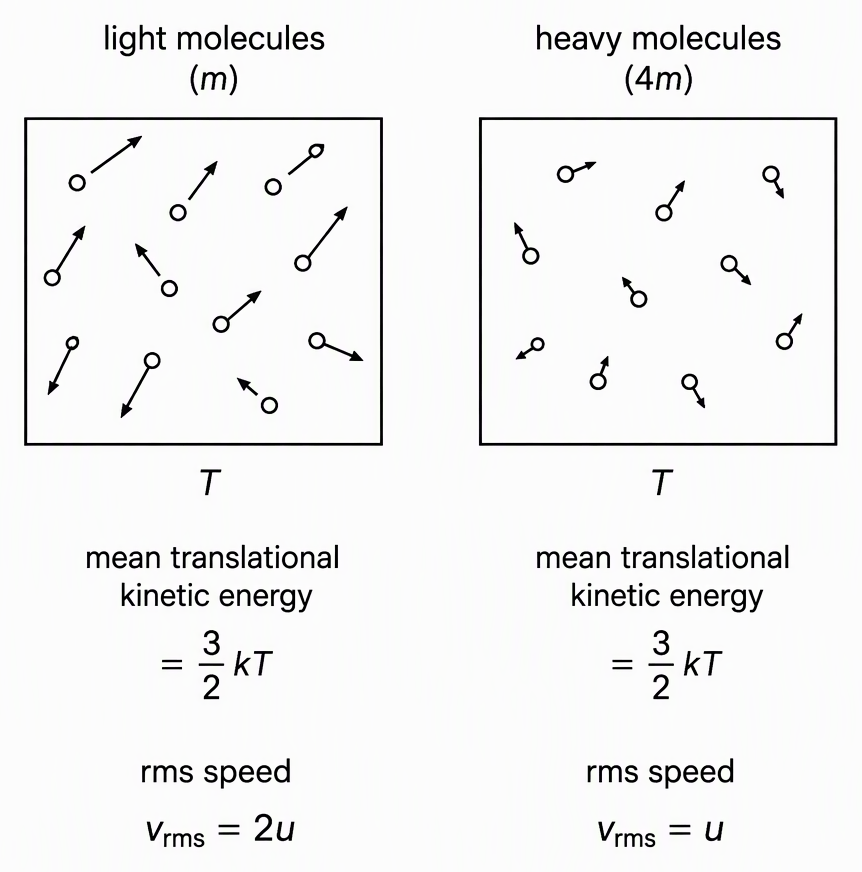
Option B assumes faster molecules must have greater mean energy. It overlooks their smaller mass.
5. Correct option: C
Use only the stated active degrees of freedom. With vibration inactive, count translation and rotation:
Option A uses the monatomic value. Option B counts an active vibrational contribution despite the question explicitly excluding vibration.
6. Correct option: B
At fixed temperature and molecular collision diameter, mean free path varies inversely with pressure. Both fixed quantities cancel in the ratio:
Higher pressure means greater number density under these conditions, shortening the mean free path. Option A reverses the dependence; option C invents an inverse-square dependence.
How should I use my mistakes to choose the next practice format?
Separate correct reasoning from correct guesses before choosing more questions. Both earn marks, but they are not equal evidence of understanding. Mark each response as justified, guessed, wrong or unattempted, then calculate the practice score using NEET marking:
Unattempted answers contribute zero. Do not convert this six-question result into an expected rank, percentile, Physics score or declaration of chapter mastery.
- Temperature-scale or square-root error: Rewrite the governing relation, convert temperatures to Kelvin, and reattempt the worked question without notes. State why the ratio needs a square root.
- Speed confused with kinetic energy: Write their mass dependences separately. At fixed temperature, mean translational kinetic energy per molecule is independent of mass; rms speed is inversely proportional to the square root of mass.
- Degrees-of-freedom error: Check which modes are active before selecting gamma. “Diatomic” alone is not a substitute for reading the stated assumptions.
- Repeated careless reading: On your next answer-key-only worksheet, underline what is held constant before solving. Check whether the question asks for molecular energy, rms speed or a ratio in a particular order.
- Correct answer with uncertain reasoning: Return to the explanation, then solve again without copying its steps.
Stay with chapter practice while these errors remain unresolved. Choose a full mock when you want to check whether repaired concepts remain accessible within a mixed-syllabus paper.
Where do free full mocks fit after chapter practice?
Use full mocks to assess broader execution, not to diagnose Kinetic Theory from a Physics total alone. NEET JEEnius AI provides 30 free full-length mocks a month with a scored per-subject breakdown. That breakdown can flag weak overall Physics performance, but it is not a verified Kinetic Theory diagnostic.
The current paper has 180 compulsory questions in 180 minutes, with no optional Section B. The paper-wide average is one minute per question, not a mandatory allowance for every Kinetic Theory question. Allocate time according to the working needed.
For another chapter-level check, use Kinematics Practice Questions NEET: 6 MCQs With Solutions. Repair uncertain concepts with worked chapter questions, test secure recall with worksheets, and assess mixed-syllabus execution with full mocks.
Start by reattempting the first question you could not justify without notes. Write the governing relation and what is held constant before choosing an option.
Frequently asked questions
Should I practise Kinetic Theory chapter questions or take a full NEET mock?
Start with worked chapter MCQs if your concepts are uncertain. Move to answer-key-only worksheets when you can justify answers independently, and use full mocks to check mixed-syllabus performance. A Physics total alone cannot diagnose your Kinetic Theory weaknesses.
Do gases at the same temperature have the same rms speed?
Not if their molecular masses differ: rms speed is inversely proportional to the square root of molecular mass at fixed temperature. Their mean translational kinetic energy per molecule is equal because it depends only on temperature. If one gas has molecules four times heavier, the lighter gas has twice the rms speed.
What is gamma for a diatomic gas when vibration is inactive?
With three active translational and two active rotational degrees of freedom, the total is f = 5. The heat-capacity ratio is gamma = (f + 2)/f = 7/5. Count only the modes stated to be active.
How should I score these six Kinetic Theory practice questions?
Use NEET marking: add 4 marks for each correct answer, subtract 1 for each wrong answer, and give zero for unattempted questions. Separately label answers as justified, guessed, wrong or unattempted to identify reasoning gaps. Do not use this short-set score to predict rank, percentile or complete chapter mastery.