
Should you start Laws of Motion practice with chapter questions or a full mock?
Start with worked chapter MCQs, not a full mock, when choosing Laws of Motion practice questions for NEET to repair force errors. Six free original MCQs with explanations follow below, not previous-year questions.
Use worked MCQs to learn the setup, verified chapter PYQs to check actual exam application, and full-length mocks to test complete-paper performance. If you already solve unfamiliar chapter questions reliably, skip easy repetitions and move to PYQs and mixed-paper practice.
How do worked MCQs, chapter PYQs and full-length mocks compare?
Choose by the mistake you need to expose. Worked questions expose setup errors; PYQs test your response to actual exam wording; mocks reveal problems with topic switching and time allocation.
- Best use: Worked chapter MCQs: isolate force-diagram and equation-setup errors. Verified chapter PYQs: check application against actual exam framing. Full-length mocks: test mixed-topic decisions, endurance and time allocation.
- Question scope: Worked chapter MCQs: one chapter, often one concept at a time. Verified chapter PYQs: chapter questions traceable to an actual paper and year. Full-length mocks: Physics, Chemistry and Biology together.
- Feedback needed: Worked chapter MCQs: force selection, equations and rejected options. Verified chapter PYQs: a checked answer and explanation. Full-length mocks: scored subject breakdown plus review of individual errors.
- Main limitation: Worked chapter MCQs: repetition can make recognition look like mastery. Verified chapter PYQs: remembered answers can hide weak reasoning. Full-length mocks: inefficient as the only way to repair one chapter.
- When to progress: Worked chapter MCQs: when you can set up unfamiliar questions independently. Verified chapter PYQs: when reasoning survives changed wording. Full-length mocks: continue simulation, returning to chapter work for recurring errors.
These categories overlap: a PYQ can have a worked solution, and a mock can contain Laws of Motion without a guaranteed chapter count. Historical frequency does not establish what the next paper will contain.
Which practice format should you pick right now?
Pick the format that addresses your current error, not your class label. A dropper may need force-diagram repair, while a Class 11 student may be ready for PYQs. Use these situations to choose your next practice session.
- Class 11, unsure which forces belong on a block: choose worked chapter MCQs. Make the free-body diagram before reading the options, including only forces acting on that block.
- Class 12, formulas remembered but friction confused: work on actual versus limiting static friction first. Then use verified chapter PYQs to check whether the distinction survives exam wording.
- Dropper, PYQ answers remembered: use unfamiliar original questions. State the governing equation and its physical meaning before selecting an option.
- Chapter sets go well, mixed papers go badly: prioritise full-length mocks. Inspect the Physics breakdown, then separate setup mistakes from rushed reading and poor time allocation.
The readiness check is observable: explain the correct option and reject the distractors without recalling the answer key. Getting the letter right is not enough if you cannot explain what changes when one condition changes.
For parents, collecting more PDFs is not evidence of improvement. Independent setup and correction of recurring errors are.
Which free Laws of Motion practice questions for NEET should you try first?
Attempt these six original, single-correct MCQs before reading the explanations. They test force reasoning before calculation and are practice questions, not official NEET questions or PYQs. Write the relevant forces and one reason for each choice; mark uncertain answers so you can distinguish reasoning from guesses during review.
1. Which force is the reaction partner?
A book rests on a horizontal table fixed to the ground. The table exerts an upward normal force on the book. Which force is its Newton’s third-law partner?
- A. Earth’s downward gravitational force on the book.
- B. The book’s downward contact force on the table.
- C. The book’s gravitational force on Earth.
- D. The floor’s upward contact force on the table.
2. How much static friction acts?
A nonzero horizontal force pushes a block on a rough horizontal floor. The block remains at rest, and no other horizontal force acts except friction. Which statement is necessarily correct?
- A. Friction equals its limiting value, regardless of the applied force.
- B. Friction is smaller than the applied force because the block is stationary.
- C. Friction matches the applied force in magnitude and does not exceed its limiting value.
- D. Friction is zero because there is no sliding.
3. What does the lift scale read?
A person stands on a horizontal weighing scale in a lift moving upward while its speed decreases. Contact with the scale is maintained, and the lift is not in free fall. How does the normal force compare with the person’s weight?
- A. It is greater than the weight.
- B. It equals the weight.
- C. It is zero.
- D. It is less than the weight.
4. What must be true for connected blocks?
Two unequal-mass blocks lie on a smooth horizontal surface, joined by a taut, light, inextensible string. A horizontal external force pulls the front block away from the rear block along their line of centres. Which statement is correct?
- A. Their accelerations are equal; tension cancels for the combined system.
- B. The lighter block accelerates faster; tension is internal.
- C. Their accelerations are equal; tension must be added as an external force.
- D. The rear block has zero net force because only the front block is pulled.
5. Which way does friction act on an incline?
A block remains at rest on a rough plane inclined at an angle strictly between zero and 90 degrees. Gravity and contact with the plane are its only interactions. Static friction acts:
- A. Down the plane.
- B. Up the plane.
- C. Perpendicular to the plane.
- D. In no direction because its magnitude is zero.
6. What turns the car?
A car travels at constant speed around a level, unbanked circular track. Its tyres roll without slipping. Ignore air resistance and rolling resistance. Which real force supplies its horizontal centripetal acceleration?
- A. The road’s normal force.
- B. The car’s weight.
- C. Static friction exerted by the road.
- D. An additional centripetal force, separate from contact forces.
What are the correct answers, and why do the distractors fail?
Answer key: 1 B; 2 C; 3 D; 4 A; 5 B; 6 C. Identify the body and its real forces before choosing an equation. For every error, check whether you selected the wrong force or used the right force incorrectly.
1. B: the book pushes on the table.
The book experiences upward normal force and downward weight. The reaction to the normal force acts on the table, not the book; A confuses balanced forces on the same body with a third-law pair.
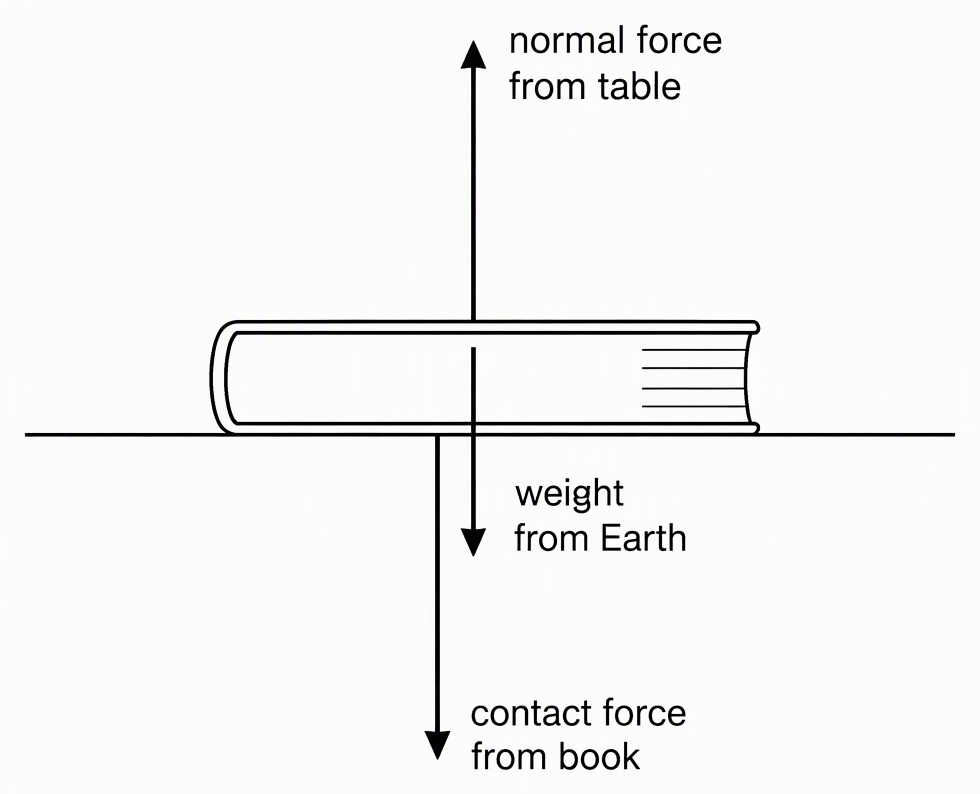
C is the reaction partner of the book’s weight. D belongs to another contact interaction.
2. C: static friction adjusts to the applied force.
The block experiences weight downward, normal force upward, the push horizontally and friction oppositely. Horizontal equilibrium and the static-friction limit give:
A assumes friction is always limiting. B leaves a net horizontal force; D wrongly treats friction as requiring sliding.
3. D: upward velocity does not mean upward acceleration.
The person experiences normal force upward and weight downward. Slowing during upward motion means downward acceleration; taking its magnitude as positive gives:
A confuses velocity with acceleration. B requires zero acceleration; C requires free fall in this setup.
4. A: tension cancels only for the combined system.
Each block has balanced vertical forces. Horizontally, tension pulls the rear block forward and the front block backward; the external force pulls the front block forward.
B ignores the taut, inextensible string’s constraint. C counts internal tension as external; D overlooks the rear block’s tension.
5. B: friction opposes the tendency to slide down.
Weight acts vertically downward, normal force perpendicular to the plane, and static friction uphill. Resolving along the slope gives:
A mistakes friction for a force that must point downhill. C confuses friction with normal force; D misses gravity’s downhill component. Equilibrium does not require limiting friction.
6. C: static friction supplies the inward force.
Weight and normal force balance vertically; static friction acts horizontally toward the centre. “Centripetal” describes the net inward force’s role, not an extra interaction.
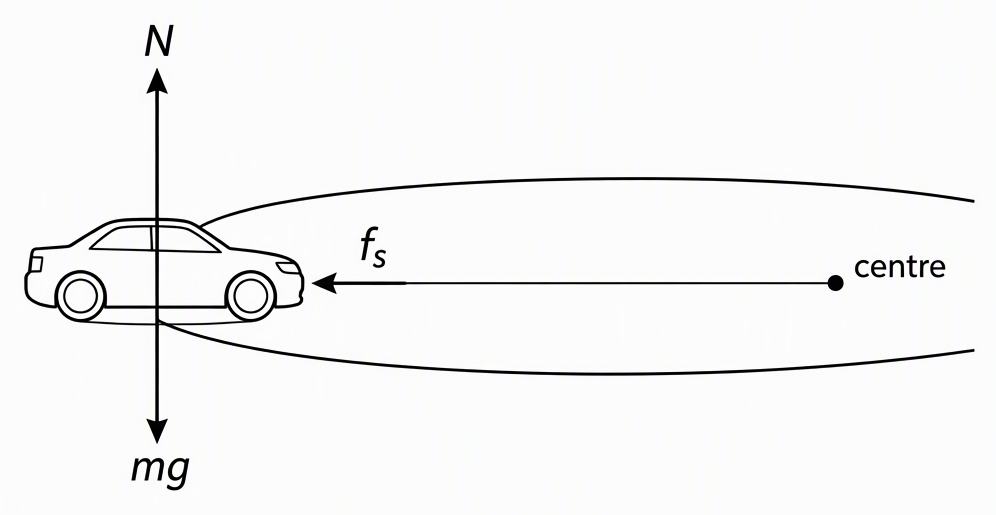
D double-counts the inward force. A and B are vertical, so neither supplies horizontal acceleration.
How should your mistakes decide the next practice format?
Wrong force selection needs diagram repair; correct forces with faulty equations need fresh setup practice. A correct guess or remembered answer remains unresolved reasoning. Do not count it as mastery when deciding whether to move on.
- Wrong force or friction direction: return to worked chapter MCQs. Identify the body, its interactions and its tendency to move before writing equations.
- Correct forces, faulty equations: solve fresh chapter questions without options first. Then attempt verified PYQs with traceable paper years and checked answers.
- Correct independent reasoning, weak mixed-paper execution: move to full-length mocks and review where Physics decisions break down.
Keep an error log with three entries: the missed force or assumption, the corrected equation, and the cue that should trigger it next time. For example, “upward but slowing” should trigger downward acceleration, not upward acceleration.
You may use NEET marking as an optional practice score:
Do not convert this small set into a predicted Physics score or rank. The full-paper average of one minute per question is not a compulsory limit for every Physics problem.
When does a free full-length mock become the better choice?
Take a full mock once you can independently set up unfamiliar chapter questions, or when mixed-paper performance is your main problem. Chapter work repairs a specific weakness; a mock tests whether that repair holds while you switch subjects and manage the whole paper.
A full mock is paper simulation, not a chapter bank, and does not guarantee a Laws of Motion question count. The current paper has 180 compulsory questions with no optional Section B.
NEET JEEnius AI offers 30 free full-length mock tests a month. Each has 180 questions, 720 marks and 180 minutes, comprising 45 Physics, 45 Chemistry and 90 Biology questions, with a scored per-subject breakdown.
Choose your next task: repair the specific chapter error you identified, or take a full mock to test mixed-paper execution.
Next step: full-length mock tests on NEET JEEnius AI and sit a full 180-question, 720-mark, 180-minute paper, 45 Physics, 45 Chemistry and 90 Biology, and get a scored per-subject breakdown (30 free a month).
Related on NEET JEEnius AI: Cell Organelles NEET 2026: Matching Question Explained.
Frequently asked questions
Should I start Laws of Motion practice with chapter questions or a full mock?
Start with worked chapter MCQs if you struggle to identify forces or set up equations. Use verified chapter PYQs once you can solve unfamiliar questions independently, and prioritise full mocks when topic switching or time allocation is the main problem.
Are these Laws of Motion questions official NEET PYQs?
No, these are six original, single-correct practice MCQs, not official NEET questions or previous-year questions. Each includes a worked explanation of the correct answer and why the other options fail.
Is static friction always equal to its limiting value?
No, static friction adjusts to prevent relative slipping, up to its limiting value of μsN. For a stationary block on a horizontal floor with only an applied horizontal push and friction acting horizontally, friction equals the push in magnitude.
How should I review mistakes in Laws of Motion MCQs?
First separate wrong force selection from errors in equation setup. Keep an error log recording the missed force or assumption, the corrected equation and the cue that should trigger it next time. Treat correct guesses and remembered answers as unresolved reasoning, not mastery.