
What is the answer to the d- and f-block elements NEET 2005 question?
D) Manganese is the answer to the d- and f-block elements NEET 2005 question: its dipositive ion has a stable, half-filled 3d subshell containing five electrons. The third removal disrupts this configuration.
Among the following first-row transition elements, which requires the greatest energy to remove an electron from its gaseous dipositive ion?
This is the 2005 Chemistry PYQ. “Hard” is the question bank’s difficulty classification, not evidence of student performance.
Which electron-removal step gives the third ionization enthalpy?
Start with the dipositive ion, not the neutral atom. Third ionization enthalpy measures the energy needed to remove one electron from that gaseous ion. It is not the total energy needed to remove three electrons from a neutral atom.
The three successive processes are:
Only the final process represents the third ionization enthalpy. When these transition-metal cations form, 4s electrons are removed before 3d electrons, even though 4s is filled first in the usual filling sequence.
Write the dipositive configuration first, then check what changes when it becomes tripositive. Judge stability at these two stages, not in the neutral atom.
Why does manganese require so much energy for the third removal?
Manganese’s third removal destroys an especially stable half-filled 3d subshell. Its first two removals take away the two 4s electrons, so the third electron must come from the 3d subshell.
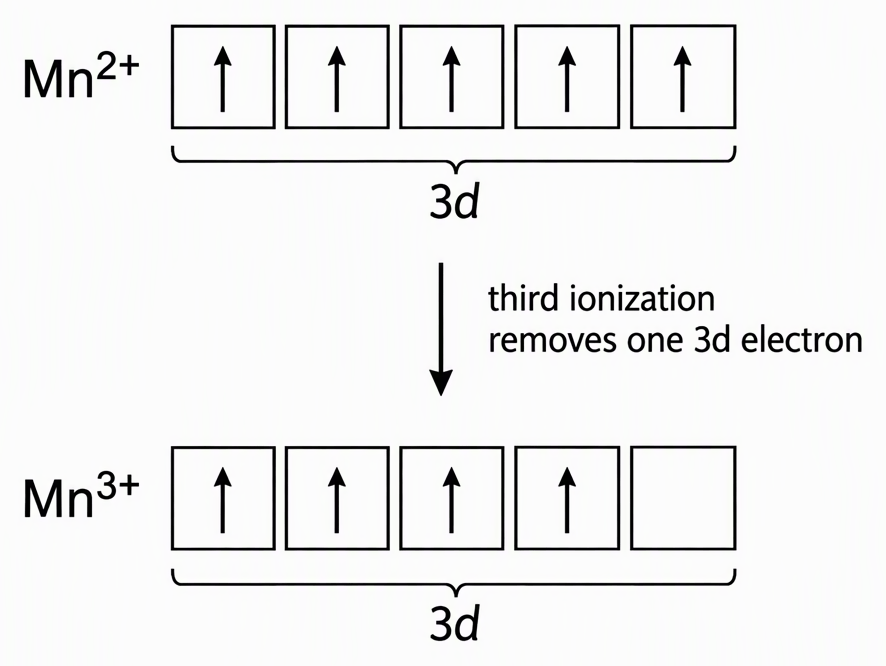
The intermediate configurations are:
Check the dipositive configuration by counting electrons. Manganese has atomic number 25; removing two electrons leaves 23, including the 18-electron argon core:
The third step is:
Five electrons half-fill the five d orbitals, with one electron in each. Removing one disrupts this especially stable configuration, which explains the high energy required for manganese’s third removal. The relevant stability belongs to the dipositive starting ion, not simply to “manganese” in any charge state.
Why is iron lower, and what happens in all four options?
Iron’s third removal creates a stable half-filled configuration, while manganese’s destroys one. This contrast explains why iron has a comparatively lower third ionization enthalpy than manganese in the supplied solution.
Iron loses its two 4s electrons before the third removal takes a 3d electron:
Compare the dipositive and tripositive configurations for every option:
- A) Vanadium: neither ion has a half-filled d subshell.
- B) Chromium: the dipositive ion has already lost its half-filled configuration.
- C) Iron: removal creates a half-filled d subshell.
- D) Manganese: removal destroys a half-filled d subshell.
D) Manganese has the highest third ionization enthalpy among these four elements. A stable product does not mean a higher removal energy: for iron, forming the stable product helps explain why removal is comparatively easier.
This configuration argument identifies the answer without assigning numerical enthalpies or claiming a complete ranking of all four. Half-filled stability alone does not predict every ionization-enthalpy comparison; other factors also affect the energy required.
How does looking at neutral chromium lead to option B?
The error is using the neutral atom’s configuration for a process that starts from a dipositive ion. The faulty argument says neutral chromium has a half-filled d subshell, so its third electron must be hardest to remove:
Follow the removals instead:
Chromium loses its half-filled d configuration during the second removal, not the third. The third removal starts with four 3d electrons, so the neutral atom’s half-filled configuration cannot justify option B.
Use the supplied 60-second expected solve time as a practice target, not a measured student result. Write the starting ion before inspecting stability.
Checkpoint: for the nth ionization enthalpy, inspect this step:
Can you apply the starting-ion method to three related questions?
Track the charge before each removal rather than memorising manganese as the answer. These are original chapter practice questions, not additional verified PYQs. Cover each worked answer before attempting its question.
What is the configuration of dipositive chromium, starting from the neutral atom?
Answer: the argon core followed by four 3d electrons. Starting from the neutral configuration below, remove the single 4s electron first, then one 3d electron:
Do not subtract both electrons from 3d. The first removal leaves the half-filled d subshell intact; the second breaks it.
Which ions have a half-filled 3d subshell: V²⁺, Cr²⁺, Mn²⁺ or Fe³⁺ (select all that apply)?
Answer: dipositive manganese and tripositive iron. The respective d-electron counts are:
- Dipositive vanadium: 3
- Dipositive chromium: 4
- Dipositive manganese: 5
- Tripositive iron: 5
Both correct ions contain five 3d electrons, but reach that configuration through different removals:
Count the electrons in the stated ion. The element’s neutral configuration is only the starting information.
Between chromium and manganese, which is expected to have the higher second ionization enthalpy?
Answer: chromium is expected to have the higher value, based on the configuration changes during the second removal. This time, start from the singly charged ions:
Chromium loses a 3d electron and breaks its half-filled configuration. Manganese loses its remaining 4s electron, retaining the half-filled d subshell.
Changing the ionization number changes the starting ion and can change the answer. Before selecting an option, write the starting charge and its configuration.
Next step: the past-paper archive on NEET JEEnius AI and search past NEET papers by year, subject or chapter, each with a worked solution (100 free searches a month).
For a worked example of the same idea, see Simple Harmonic Motion NEET 2026: Energy Graph Solution.
Frequently asked questions
What is the answer to the d- and f-block elements NEET 2005 question?
The answer is D) Manganese, which has the highest third ionization enthalpy among vanadium, chromium, iron and manganese. Mn²⁺ has the stable half-filled configuration [Ar] 3d⁵. Removing its next electron breaks that configuration, producing Mn³⁺ with [Ar] 3d⁴.
What is third ionization enthalpy?
Third ionization enthalpy is the energy required to remove an electron from a gaseous dipositive ion, forming a gaseous tripositive ion. The process is M²⁺(g) → M³⁺(g) + e⁻. It is not the total energy required to remove three electrons from a neutral atom.
Why is manganese's third ionization enthalpy higher than iron's?
Manganese's third electron removal changes Mn²⁺ from [Ar] 3d⁵ to [Ar] 3d⁴, destroying a stable half-filled subshell. Iron's third removal changes Fe²⁺ from [Ar] 3d⁶ to [Ar] 3d⁵, creating a half-filled subshell. This contrast explains why the third removal requires more energy for manganese than for iron.
Why is chromium not the answer despite its half-filled 3d subshell?
Neutral chromium has the configuration [Ar] 3d⁵ 4s¹, but third ionization starts from Cr²⁺, not the neutral atom. Chromium loses its 4s electron first and a 3d electron second, leaving Cr²⁺ with [Ar] 3d⁴. Its half-filled configuration is therefore broken during the second removal, not the third.