
What does the Electrostatics NEET 2026 hard capacitor PYQ ask?
The Electrostatics NEET 2026: Hard Capacitor PYQ asks for the network’s equivalent capacitance and the charge on each capacitor. The decisive step is identifying the complete four-capacitor series branch before using any formula. The question bank classifies this Capacitors in Series and Parallel question as hard and gives an expected solving time of 120 seconds.
This is a single-correct Physics question from the NEET 2026 re-held examination on 21 June 2026. The given capacitor values are:
The network is connected across:
The four answer combinations are:
No option should be identified as correct until the two complete branches have been read correctly.
How should you read the capacitor circuit before using formulas?
C1, C2, C3 and C4 form one complete series path between the battery terminals. C5 forms a separate branch across the same two terminals. The four-capacitor chain and C5 are therefore parallel branches, not five individual capacitors in parallel.
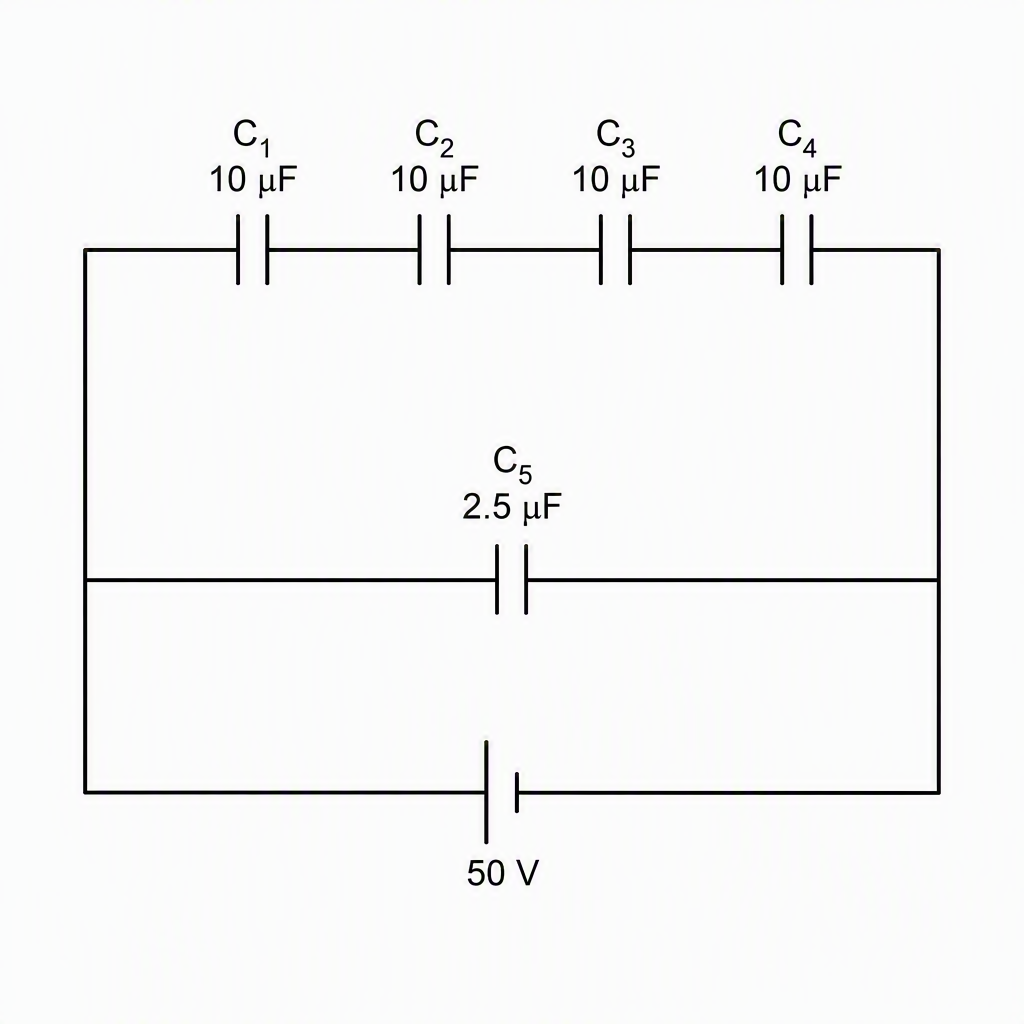
Both complete branches have the same potential difference because they connect across the battery:
The capacitors within the C1 to C4 series chain carry equal charge. Equal voltage applies to the two complete parallel branches, while equal charge applies within the series chain.
How do you solve this hard capacitor question step by step?
The equivalent capacitance is 5 μF, and every capacitor carries 125 μC. First reduce the four-capacitor series branch, then combine it in parallel with C5. Calculate the charge in each complete branch only after finding its voltage.
For the four identical 10 μF capacitors in series:
Therefore:
This 2.5 μF series branch is parallel to C5, which is also 2.5 μF. Parallel capacitances add:
The total charge supplied by the battery is:
The charge in the four-capacitor branch is:
Charge is equal on capacitors connected in series. Hence:
C5 is directly across the 50 V battery, so its charge is:
The official result is:
Option B is correct.
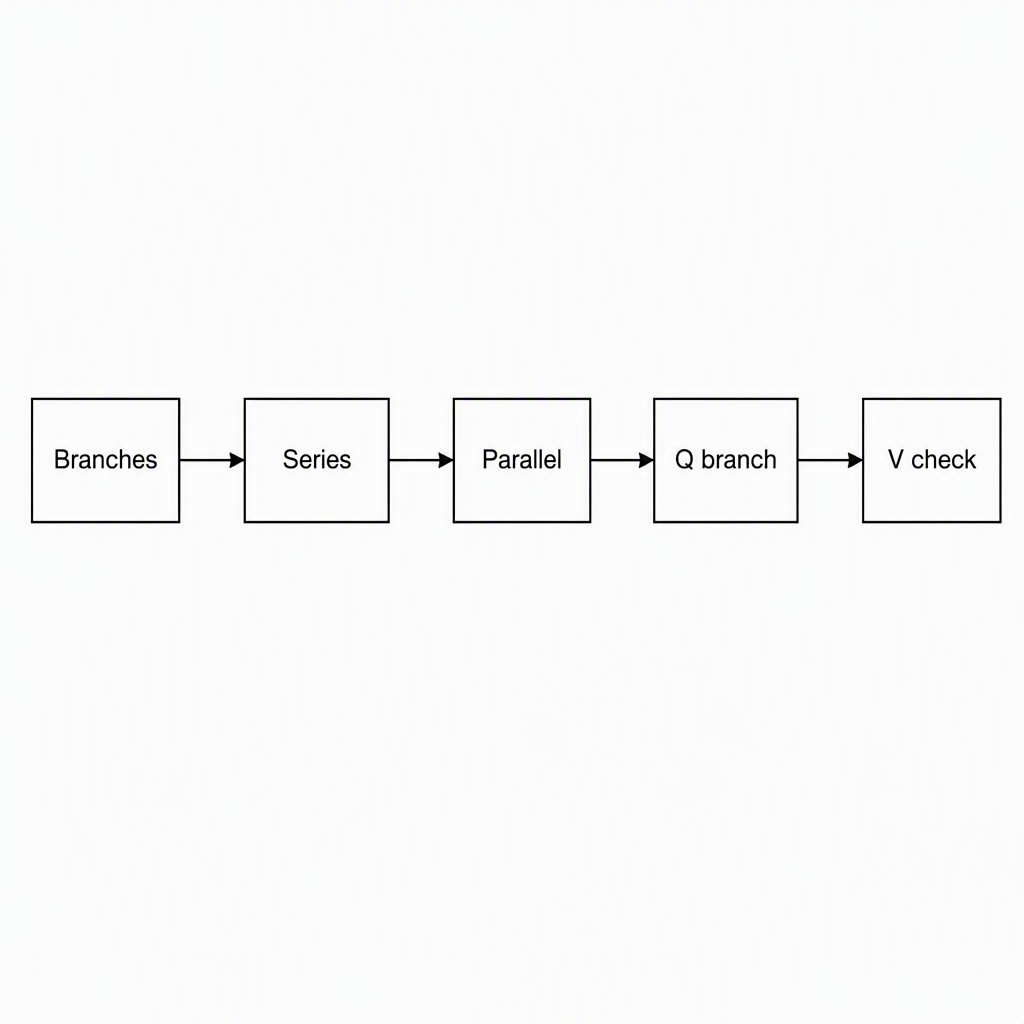
For the question bank’s expected solving time of 120 seconds, use this order: identify the complete branches, reduce the series chain, add the parallel capacitances, calculate each branch charge, then run the voltage check.
Which two checks confirm that option B is correct?
Check the voltage division inside the series chain, then check the total charge supplied by the source. These tests reproduce the given 50 V and 250 μC totals, so the result does not depend on trusting a memorised rule alone.
Does the voltage across the four series capacitors add to 50 V?
Each identical capacitor in the chain carries 125 μC, so each has a potential difference of 12.5 V:
The four capacitor voltages add to:
This matches the battery voltage.
Does the branch charge match the charge supplied by the battery?
The two parallel branches draw 125 μC each. Their combined charge is:
This agrees with:
Equal charge on all five capacitors is a numerical result of this particular network. It is not a universal rule for parallel capacitors. Parallel capacitors have equal voltage, while their charges depend on capacitance.
Why does option A fail?
Option A correctly assigns 125 μC to C1 through C4 but incorrectly assigns only 25 μC to C5. The mistake is scaling charge from capacitance alone while ignoring that C5 is connected directly across the full 50 V.
If C5 carried 25 μC, its voltage would be:
That contradicts its connection across the battery:
The correct decision rule is to determine the voltage across a branch first, then apply:
Never infer charge merely from the ratio of capacitor values.
Which related electrostatics questions should you practise?
These three questions train the same topology-first method. Identify each complete branch before calculating capacitance or charge. The first repeats the solved circuit pattern, while the next two test a pure series circuit and a branch containing unequal capacitors.
What happens when four 8 μF capacitors are parallel to one 2 μF capacitor?
Four 8 μF capacitors are connected in series in one branch. That branch is parallel to a single 2 μF capacitor across 24 V. Find the equivalent capacitance and all capacitor charges.
Answer: The equivalent capacitance is 4 μF, and every capacitor carries 48 μC.
What are the charge and voltage for three 6 μF capacitors in series?
Three 6 μF capacitors are connected in series across 12 V. Find the equivalent capacitance, charge and voltage on each capacitor.
Answer: The equivalent capacitance is 2 μF, each capacitor carries 24 μC, and each has 4 V across it.
What happens when 3 μF and 6 μF in series are parallel to 2 μF?
A series combination of 3 μF and 6 μF is placed parallel to a 2 μF capacitor across 18 V. Find the total capacitance and all capacitor charges.
Answer: The series equivalent is 2 μF, the total equivalent is 4 μF, and every capacitor carries 36 μC.
For another hard Physics question that depends on reading the setup before calculating, practise Rotational Motion NEET 2026: Hard Momentum Graph PYQ.
Frequently asked questions
What is the correct answer to the Electrostatics NEET 2026 capacitor PYQ?
Option B is correct. The equivalent capacitance is 5 μF, and each of the five capacitors carries 125 μC.
Why do all five capacitors carry 125 μC?
The four 10 μF capacitors form a series branch equivalent to 2.5 μF, which is parallel to the 2.5 μF capacitor. Each branch is across 50 V, so each draws 125 μC; charge is also equal within the series chain.
How do you identify series and parallel branches in this circuit?
C1, C2, C3 and C4 make one uninterrupted series path between the battery terminals. C5 forms a separate path across the same terminals, so it is parallel to the complete four-capacitor branch.
Why is option A wrong in the capacitor PYQ?
Option A assigns only 25 μC to C5, even though C5 is directly across the 50 V battery. Using Q = CV gives 2.5 μF × 50 V = 125 μC, not 25 μC.