What was the hard NEET 2025 numerical on equilibrium constant Kp?
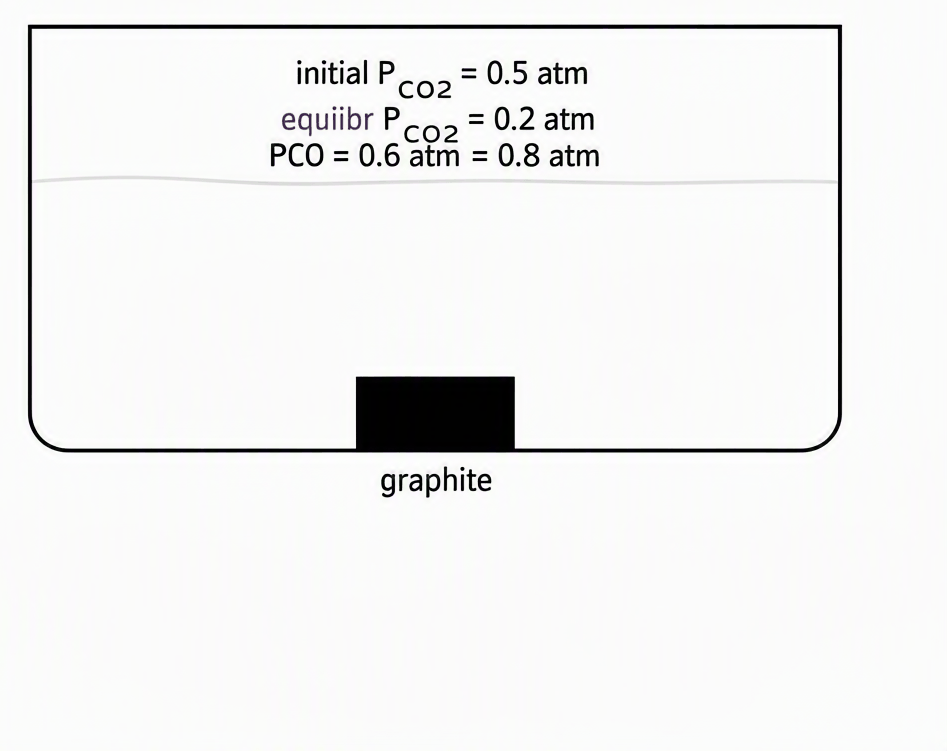
Kp equals 1.8 atm. A vessel maintained at 1000 K initially holds CO2 gas exerting 0.5 atm pressure. Addition of graphite converts some CO2 into carbon monoxide. The system reaches equilibrium with a total pressure of 0.8 atm. The task is to calculate the value of Kp for this process.
The official method sets x as the pressure of CO2 converted and solves for it from the net gaseous mole increase before substituting into Kp.
What is the official step-by-step solution for this equilibrium constant Kp numerical?
The balanced reaction is .
Initial pressure of CO2 is 0.5 atm. Let x atm be the pressure of CO2 that gets converted.
At equilibrium the partial pressures are CO2 = 0.5 − x atm and CO = 2x atm. The solid carbon does not contribute to pressure.
atm.
Solving gives x = 0.3 atm.
Final partial pressures are CO2 = 0.2 atm and CO = 0.6 atm.
atm.
What specific mistake leads students to select 3 atm in this Kp question?
The error of writing the Kp expression without the stoichiometric power on CO partial pressure, using simply P_CO / P_CO2, leads students to 3 atm.
Students recall the 2 : 1 stoichiometry for setting up the pressure table yet forget to apply the squared term required by the equilibrium law for the 2CO coefficient.
Plugging the correct partial pressures of 0.6 atm and 0.2 atm into this wrong form yields 0.6 / 0.2 = 3 atm. This produces one of the incorrect choices among the given options.
Which core concepts does this heterogeneous equilibrium Kp question test?
Pure solids like graphite have activity = 1 and are omitted from the Kp expression. Only gaseous partial pressures of CO and CO2 appear.
Net change in gaseous moles Δn_g = +1, so Kp carries units of atm. The observed pressure rise (0.3 atm) equals x because the net gaseous mole increase per reaction is 1.
at 1000 K gives .
Which two related Kp questions from the equilibrium chapter use the same pressure technique?
For CaCO3(s) ⇌ CaO(s) + CO2(g) in a closed vessel at fixed T, if initial vacuum and equilibrium pressure is 0.8 atm then Kp equals the CO2 pressure. Only CO2 is gas, solids omitted, so Kp = P_CO2 = 0.8 atm. Δn_g = 1.
In a PCl5 dissociation numerical where initial pressure is 1 atm and total equilibrium pressure is 1.6 atm, let α be degree of dissociation. Total pressure equation 1(1 + α) = 1.6 gives α = 0.6. Partial pressures: P_PCl5 = 0.4 atm, P_PCl3 = P_Cl2 = 0.6 atm. atm. Δn_g = 1.
How to solve such numericals in 180 seconds during NEET?
Immediately write the reaction and note which species are gases only. Cross out solids because their activity is 1.
Always define x from the limiting gaseous reactant and multiply by stoichiometric coefficients for partial pressures. Use the total pressure equation to solve for x before substituting into Kp.
Double-check the exponent on each partial pressure matches the balanced equation. This single verification prevents the 3 atm trap.
What checklist should you revise for equilibrium constant in NEET 2025?
- Heterogeneous vs homogeneous Kp expressions: CO2(g) + C(s) ⇌ 2CO(g) gives Kp = (P_CO)^2 / P_CO2; CaCO3(s) ⇌ CaO(s) + CO2(g) gives Kp = P_CO2; N2(g) + 3H2(g) ⇌ 2NH3(g) gives Kp = (P_NH3)^2 / (P_N2 × (P_H2)^3).
- Units of Kp based on Δn_g: 0 gives no unit, 1 gives atm, 2 gives atm^2.
- Link between total pressure, mole fractions, and partial pressures: partial pressure = (mole fraction) × total pressure.
- Practice threshold: solve 8 out of 10 similar numericals correctly in one sitting.
Keep this list visible while solving the past-paper archive by chapter. When a fresh doubt appears in a mock test, photograph a doubt for an immediate step-by-step solution.
Next step: photograph a doubt on NEET JEEnius AI and photograph any question you are stuck on and get a step-by-step solution across Physics, Chemistry and Biology (20 free a month).
For a worked example of the same idea, see Oscillations and Waves NEET 2025: AQ/AP for Same vmax.
Frequently asked questions
What was the hard NEET 2025 numerical on equilibrium constant Kp?
A vessel at 1000 K initially contains CO2 at 0.5 atm pressure. Graphite is added and the system reaches equilibrium at 0.8 atm total pressure. Kp for the reaction CO2(g) + C(s) ⇌ 2CO(g) equals 1.8 atm.
How to calculate Kp for the CO2 graphite reaction in NEET 2025?
Let x be the decrease in CO2 pressure. Total pressure equation gives 0.5 + x = 0.8 so x = 0.3 atm. Equilibrium partial pressures are P_CO2 = 0.2 atm and P_CO = 0.6 atm. Kp = (0.6)^2 / 0.2 = 1.8 atm. Solid carbon is omitted.
Why do students get 3 atm in equilibrium constant (kp) neet 2025?
They correctly find partial pressures of 0.6 atm CO and 0.2 atm CO2 but forget to square the CO term. Using the wrong expression P_CO / P_CO2 gives 0.6 / 0.2 = 3 atm. The coefficient 2 in the balanced equation requires the square in Kp.
What concepts are tested in the Equilibrium Constant (Kp) NEET 2025 numerical?
The question tests that pure solids have activity of 1 and are excluded from Kp. It checks correct application of stoichiometric powers, use of total pressure to find x when Δn_g = 1, and recognition that Kp has units of atm.