Two identical masses P and Q hang vertically from springs k1 and k2 with the same maximum speed. What is AQ/AP?
AQ/AP equals √(k₁/k₂).
Two identical point masses P and Q hang vertically from separate springs with spring constants k1 for P and k2 for Q. Both perform vertical SHM and reach the same maximum speed. The ratio asked is amplitude of Q divided by amplitude of P.
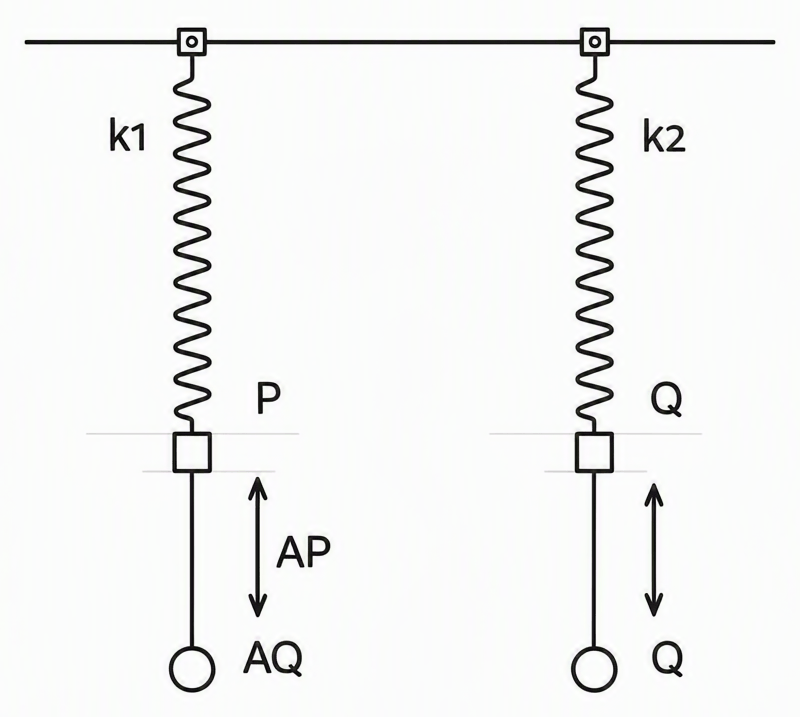
The stiffer spring produces larger ω. Its amplitude must stay smaller to keep peak speed the same.
What is the full official NTA step-by-step solution for this NEET 2025 spring-mass oscillations question?
The official NTA solution gives AQ/AP = √(k₁/k₂) as option D.
For simple harmonic motion, maximum speed is given by . Since both masses have the same maximum speed this gives . Therefore .
For a spring-mass system . The masses are identical so . Substituting yields . This simplifies to .
What exact mistake produces the wrong option in this NEET 2025 oscillations spring-mass question?
Students write AQ/AP = ωQ/ωP instead of the inverse. This yields √(k₂/k₁), which is option C.
The procedural flaw is pairing the larger ω with the larger A when vmax is fixed. They intuitively link stiffer spring to bigger amplitude, but equal vmax forces the opposite. The correct procedure is always to isolate the amplitude ratio from the vmax equality first, before touching ω = √(k/m).
This is an algebraic inversion error that appears the moment you swap the subscripts without writing the ratio step explicitly.
Why does this oscillations and waves NEET 2025 spring-mass question carry a hard tag?
This question sits in difficulty tier 3 (hard band) with expected solving time of 75 seconds. It requires flawless handling of the inverse relation between A and ω when vmax is kept constant.
It appears in the compulsory 45-question Physics section of the 180-minute offline paper.
What related oscillations and waves questions test the same maximum-speed concept?
Question 1: Two springs have identical k. Masses are m and 4m. Amplitudes are equal. Find the ratio of maximum speeds (lighter mass to heavier mass).
Start from vmax = Aω. A is same, so vmax ratio equals ω ratio.
Thus vmax1 : vmax2 = 2 : 1.
Question 2: Same vmax and same m. Amplitudes are in ratio 1 : 2. Find ratio of spring constants (first to second).
From vmax = Aω and equal vmax, A₁ω₁ = A₂ω₂.
Given A₁/A₂ = 1/2, then ω₁/ω₂ = 1/2.
Since ω ∝ √k, k₁/k₂ = (ω₁/ω₂)² = 4. Ratio k₁ : k₂ = 4 : 1.
Question 3: Same mass m and fixed amplitude A. Compare effective ω and resulting vmax when springs k1 and k2 are in series versus parallel.
Series:
Parallel:
ωp > ωs, therefore vmax parallel exceeds vmax series by factor (k1 + k2)/√(k1 k2) when A is fixed.
What direct faculty advice should Class 12 and dropper students follow for oscillations in NEET 2025?
Always start from vmax = Aω when speed is mentioned. Never begin with energy. Masses identical means m cancels immediately; check this first.
Practice writing the ratio step before substituting √(k/m) to avoid inversion errors. Target 160-plus in Physics by mastering all ratio-type SHM questions. Do not touch time-period formulas unless the question explicitly asks for T.
What key formulas must you recall in 10 seconds for these NEET 2025 oscillations ratio problems?
- When m is same:
- T = 2π√(m/k) is not needed here but appears in related questions that shift from speed to period.
Write AQ/AP = ωP/ωQ first on every identical-mass equal-vmax question. That single line decides the mark. You can search the past-paper archive by chapter to find every identical-mass equal-vmax variant from the last decade.
Next step: photograph a doubt on NEET JEEnius AI and photograph any question you are stuck on and get a step-by-step solution across Physics, Chemistry and Biology (20 free a month).
If that step was the hard part, work through Thermodynamics NEET 2025: Two Spheres Blackbody Radiation.
Frequently asked questions
What is AQ/AP when two identical masses P and Q have the same maximum speed in oscillations and waves NEET 2025?
AQ/AP equals √(k1/k2). This comes from setting vmax = Aω equal for both. With identical masses, ωP/ωQ = √(k1/k2) so the amplitude ratio is the inverse. The stiffer spring has smaller amplitude to keep peak speed the same.
What is the common mistake in the NEET 2025 spring mass same speed question?
Students write AQ/AP = √(k2/k1) instead of the correct value. They pair the larger ω with larger A when vmax is fixed. Always derive the amplitude ratio from the vmax equality before substituting ω = √(k/m). This algebraic inversion is the top error.
Why is the oscillations and waves NEET 2025 spring-mass question considered hard?
It sits in difficulty tier 3 because it demands flawless use of the inverse A-ω relation at constant vmax. Students must avoid subscript swaps. It appears in the compulsory Physics section and rewards precise ratio handling over rote formulas.
What formulas are key for oscillations and waves NEET 2025 vmax problems?
Use vmax = Aω and ω = √(k/m). When masses are identical, ωP/ωQ = √(k1/k2). Write AQ/AP = ωP/ωQ first on every such question. T = 2π√(m/k) is unnecessary unless the question asks for period.