What was the NEET 2017 heterogeneous equilibrium question on SrO and SrCO3?
The maximum CO2 pressure is capped at Kp the instant both solids coexist. This fact alone solves the heterogeneous equilibrium NEET 2017 question and delivers the critical volume of 5 L.
The question presents a 20-litre container at 400 K holding CO2 gas at 0.4 atm plus excess SrO solid. A movable piston compresses the volume while neglecting solid volume. Students must identify the largest container volume at which CO2 pressure reaches its highest possible value. Kp equals 1.6 atm for SrCO3(s) ⇌ SrO(s) + CO2(g).
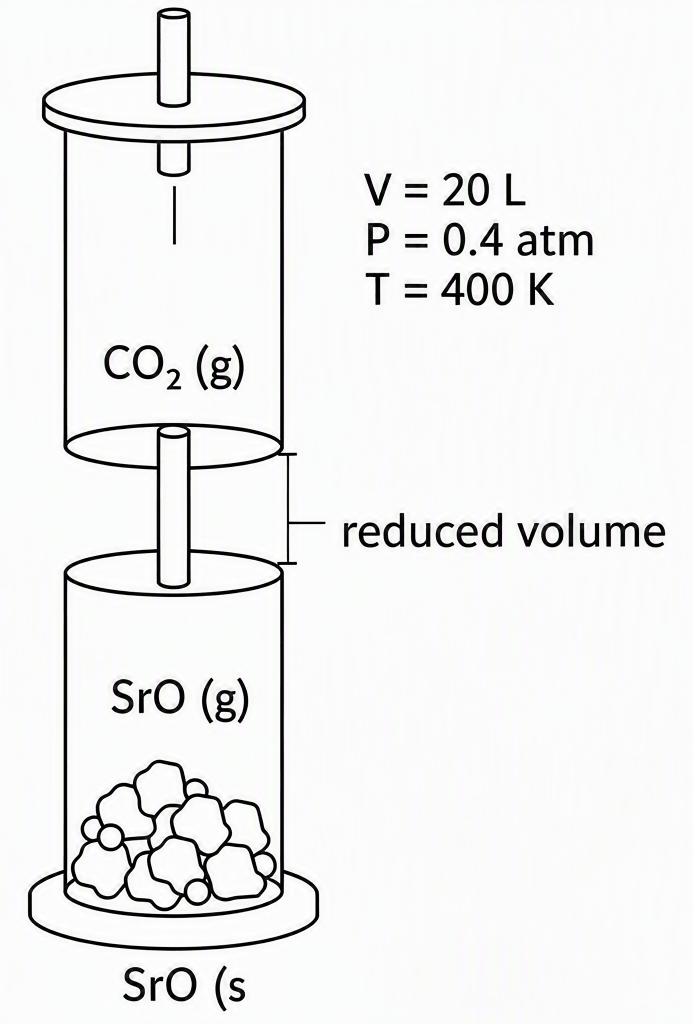
How do you solve the 2017 NEET heterogeneous equilibrium problem using the official method?
The official solution gives 5 L. At equilibrium the maximum CO2 pressure equals Kp so P_CO2 = 1.6 atm. The container is sealed and SrO is in excess therefore moles of CO2 remain constant.
Calculate initial moles from the ideal gas law.
At the point where pressure first touches 1.6 atm the same n applies. Substitute into the ideal gas equation again:
The correct option is therefore 5 litre.
Why does applying Boyle’s law give the wrong 10 L answer in this heterogeneous equilibrium neet 2017 question?
Treating the system as pure gas compression and applying Boyle’s law with an invented pressure such as 0.8 atm instead of locking P at Kp produces V = (0.4 × 20) / 0.8 = 10 L. This matches one of the distractors.
The flaw is failing to recognise that once P reaches Kp the reverse reaction activates to hold pressure constant, so moles are not fixed after that point. Boyle’s law assumes constant moles and changing pressure, but here pressure stops rising the moment both solids appear.
Why does heterogeneous equilibrium cap CO2 pressure at Kp?
For SrCO3(s) ⇌ SrO(s) + CO2(g) the Kp expression contains only P_CO2 because solids have activity = 1. As long as both solids are present, equilibrium pressure of CO2 cannot exceed 1.6 atm at this temperature.
Below 5 L the reverse reaction consumes CO2 to maintain P = 1.6 atm. Above 5 L the system is not yet at equilibrium and pressure rises with further compression. In homogeneous gas equilibria pressure would continue rising with compression.
Which two practice questions test the same constant-n plus P equals Kp method?
Question 1 gives a critical volume of 5 L. A 10 L vessel at 300 K contains 0.5 atm CO2 and excess CaO. Kp equals 1.0 atm for CaCO3 decomposition. Moles stay fixed until P reaches 1.0 atm.
Question 2 gives a critical volume of 10 L. It starts with 0.2 atm CO2 in a 40 L vessel and Kp equals 0.8 atm. Moles are conserved until equilibrium pressure.
Both problems collapse to the identical shortcut V_critical = (P_initial × V_initial) / Kp.
You can locate every past NEET equilibrium question in the past-paper archive and work through the official solutions there.
What checklist solves heterogeneous equilibrium PYQs inside the NEET time limit?
Check if Kp equals the pressure of the sole gaseous product. Confirm moles of gas are fixed until equilibrium pressure is reached. Use the simplified V2 = (P1V1)/Kp without needing R or T values. Compare result directly with the four numerical options.
Drill this exact sequence on every similar problem until the 5 L answer appears automatically.
If a calculation step remains unclear, photograph a doubt to receive the step-by-step solution.
Next step: photograph a doubt on NEET JEEnius AI and photograph any question you are stuck on and get a step-by-step solution across Physics, Chemistry and Biology (20 free a month).
Keep going with Lens and Mirror Combination NEET 2025: Object at R/(2μ-1).
Frequently asked questions
What was the NEET 2017 heterogeneous equilibrium question answer?
The official answer is 5 L. At the point both solids coexist the CO2 pressure equals Kp of 1.6 atm. Since the container is sealed and SrO is in excess, the number of moles of CO2 is constant until that point. This allows direct calculation of volume from the ideal gas law without needing R or T values.
Why does Boyle’s law give 10 L in heterogeneous equilibrium NEET 2017?
Many students incorrectly apply Boyle’s law assuming constant moles throughout and pick an arbitrary pressure like 0.8 atm. Once pressure reaches Kp the reverse reaction begins, reducing the number of CO2 moles to keep pressure constant at 1.6 atm. Boyle's law does not account for this change in moles due to the chemical equilibrium.
How is pressure capped at Kp in heterogeneous equilibrium for NEET?
For the reaction SrCO3(s) ⇌ SrO(s) + CO2(g) the equilibrium constant Kp equals P_CO2 since solids have unit activity. Therefore as long as both solids are present the CO2 pressure cannot exceed or fall below Kp at a given temperature. Any further compression below 5 L causes CO2 to react with SrO to maintain this pressure.
What is the shortcut for critical volume in heterogeneous equilibrium NEET questions?
The critical volume is always V_critical = (initial pressure × initial volume) / Kp. This shortcut works because moles of the gas remain fixed until the pressure reaches the equilibrium value. You do not need the value of R or temperature as they cancel out in the calculation.