What do the two statements in the Hydrocarbons NEET 2024 question ask?
Option B is correct: Statement I is false, but Statement II is true. The Hydrocarbons NEET 2024 diborane question tests two separate decisions: predicting a hydroboration product and oxidising a supplied borane. This statement-based Chemistry PYQ is classified as hard by the question bank, not by a measured student error rate.
Statement I claims that treating propene with diborane produces triisopropylborane. Statement II claims that alkaline hydrogen peroxide converts triisopropylborane into propan-2-ol.
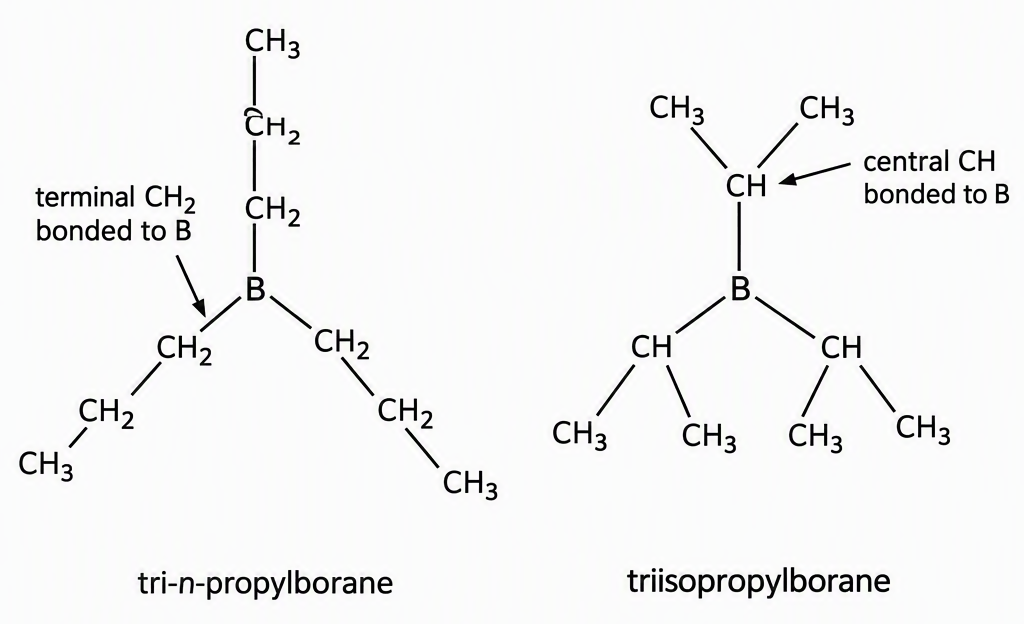
In tri-n-propylborane, boron bonds to the terminal carbon of each straight-chain propyl group. In triisopropylborane, it bonds to the central carbon of each isopropyl group.
The answer combinations are:
Why is the product claimed in Statement I wrong?
Propene forms tri-n-propylborane, not triisopropylborane, because boron attaches to the less substituted alkene carbon. Propene has this structure:
The terminal methylene carbon is the less substituted alkene carbon. In anti-Markovnikov hydroboration, boron attaches there and hydrogen attaches to the more substituted carbon.
Diborane supplies the reacting borane unit:
The resulting boron-bound group has this connectivity:
Three alkene molecules give three n-propyl groups attached to one boron atom. The overall hydroboration stoichiometry is:
Numerical check: suppose complete hydroboration consumes this amount of propene, with sufficient borane:
The equation gives:
The factor of three counts propyl groups attached to boron; it does not change their connectivity. The product is tri-n-propylborane, so Statement I is false.
Why does the compound in Statement II give propan-2-ol?
Start afresh with the supplied triisopropylborane, not the product calculated for Statement I:
Statement II is true because boron is bonded to the central carbon of each isopropyl group. Oxidation places the hydroxyl group on that same carbon.
Read one attached isopropyl group as:
The central carbon is bonded to boron and to two methyl groups. Under alkaline hydrogen peroxide oxidation, the carbon bonded to boron becomes bonded to the hydroxyl group.
The following is a per-group connectivity sketch, not a balanced molecular equation:
Written as a three-carbon chain, that alcohol is:
Each of the three isopropyl groups yields this alcohol. Statement II is true even though Statement I proposes an incorrect preparation of its substrate.
What is the final answer, and how should I check it?
The official answer is B: Statement I is incorrect and Statement II is correct. Keep the two checks separate:
- Actual propene route: hydroboration gives tri-n-propylborane; its oxidation gives propan-1-ol.
- Supplied triisopropylborane: oxidation gives propan-2-ol.
Use this sequence for related statement questions:
- Identify the substrate actually stated.
- Locate its carbon–boron bond.
- Apply the relevant reaction rule.
- Map the two truth values to the answer options.
Why does linking the statements incorrectly lead to option D?
Option D results from treating the false preparation claim as proof that the separate oxidation claim is also false. The faulty reasoning runs: “Propene does not give triisopropylborane, so its claimed oxidation to propan-2-ol must also be wrong.” That produces the false–false combination and therefore D.
The mistake is importing Statement I’s preparation claim into an independently testable Statement II. A compound can give the stated oxidation product even when the proposed method of making it is wrong.
Statement II does not ask which alcohol is ultimately obtained from propene. It asks what the explicitly named borane gives on oxidation.
Circle the substrate in each statement separately. Do not silently substitute tri-n-propylborane for triisopropylborane in Statement II. That substitution answers a different question.
How do I apply this method to related Hydrocarbons questions?
Track the carbon bonded to boron, then judge each statement on its own terms. Both questions below are original related practice, not additional NEET PYQs: the first changes the alkene, while the second changes the stated borane.
What alcohol forms when but-1-ene undergoes hydroboration followed by alkaline hydrogen peroxide oxidation?
Original related practice, Question 1. Answer: butan-1-ol. The starting alkene is:
Its terminal alkene carbon is less substituted, so boron attaches there. After hydroboration, one attached group has the connectivity:
Oxidation replaces the carbon–boron connection with a carbon–hydroxyl connection. The product is:
The hydroxyl group occupies the terminal carbon that was bonded to boron. It does not move to the neighbouring carbon during oxidation.
Which option fits the two claims about tri-n-propylborane?
Original related practice, Question 2. Answer: A, using the same A–D mapping as the main question. Judge these claims independently:
- Hydroboration of propene gives tri-n-propylborane.
- Oxidation of that borane with alkaline hydrogen peroxide gives propan-2-ol.
The preparation claim is true: boron attaches to propene’s terminal carbon. The oxidation claim is false: that terminal carbon receives the hydroxyl group, giving propan-1-ol rather than propan-2-ol.
The per-group connectivity sketch, not a balanced molecular equation, is:
Before selecting an option, write the carbon attached to boron explicitly. Then replace its boron connection with a hydroxyl connection.
Next step: photograph a doubt on NEET JEEnius AI and photograph any question you are stuck on and get a step-by-step solution across Physics, Chemistry and Biology (20 free a month).
For a worked example of the same idea, see Rotational Motion NEET 2012: Cylinder-Spring Solution.
Frequently asked questions
What is the correct answer to the NEET 2024 diborane question?
The correct answer is B: Statement I is false and Statement II is true. Propene forms tri-n-propylborane, not triisopropylborane, but the supplied triisopropylborane does give propan-2-ol on oxidation with alkaline hydrogen peroxide.
Why does propene form tri-n-propylborane instead of triisopropylborane?
During hydroboration, boron attaches to the less substituted, terminal carbon of propene. Three propene molecules react with one BH3 unit to give three straight-chain n-propyl groups attached to boron, forming tri-n-propylborane.
What does triisopropylborane give on oxidation with alkaline hydrogen peroxide?
Triisopropylborane gives propan-2-ol on oxidation with alkaline hydrogen peroxide. Boron is bonded to the central carbon of each isopropyl group, and oxidation places the hydroxyl group on that same carbon.
Why is option D wrong in the NEET 2024 diborane question?
Option D incorrectly treats both statements as false. Statement II independently asks about oxidation of the supplied triisopropylborane, not the actual product of propene hydroboration. The false preparation claim in Statement I does not make the oxidation claim in Statement II false.