What is the answer to the rotational motion NEET 2012 cylinder–spring question?
Option B, 0.6 m, is correct: the rotational motion NEET 2012 question requires both translational and rotational kinetic energy. A solid cylinder of mass 3 kg rolls along a level surface at 4 m/s, then compresses a horizontal spring attached to a fixed wall. The spring constant is 200 N/m; find the greatest compression.
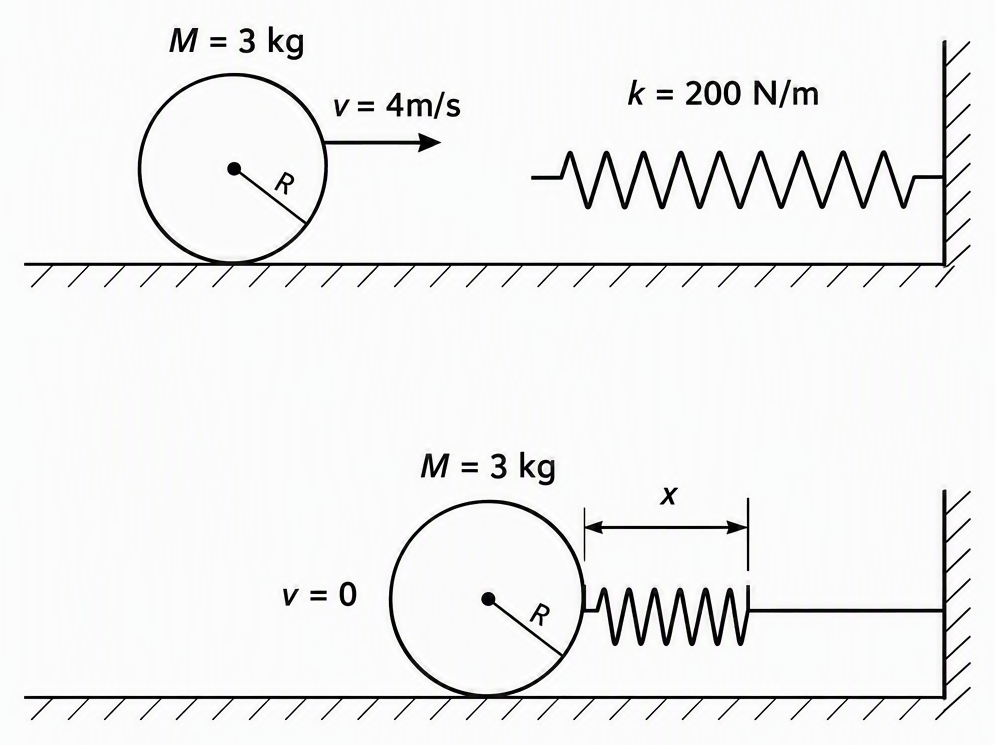
The choices are:
The energy ledger is 24 J of translation plus 12 J of rotation. Leaving out rotation leads towards option A. This question is rated hard on the question bank’s own scale, not from measured student performance.
Which rolling condition and moment of inertia should I use?
Use the solid cylinder’s moment of inertia about its symmetry axis and the condition for rolling without slipping. The official solution assumes that rolling without slipping continues during spring compression, with no dissipative energy loss. Under these assumptions, the complete initial kinetic energy transfers into the spring at maximum compression.
The symbols are:
For a solid cylinder:
For rolling without slipping:
The radius is not missing information. Its square in the moment of inertia cancels the radius squared in the denominator of angular speed squared. Substitute both expressions together before inserting numbers.
How do I calculate the cylinder’s total kinetic energy?
Add the kinetic energy of centre-of-mass motion to the kinetic energy of rotation about the centre. Here, those contributions are 24 J and 12 J, giving 36 J in total. They describe different parts of the same cylinder’s motion, so adding them is not double-counting.
Start with:
Substitute the moment of inertia and rolling condition:
The radius cancels explicitly:
Insert the given mass and speed:
The separate energy contributions are:
- Translation:
- Rotation:
How does 36 J give a maximum compression of 0.6 m?
At maximum compression, the cylinder’s centre-of-mass speed is momentarily zero. Because rolling without slipping continues, its angular speed is also zero. The surface is horizontal, so gravitational potential energy does not change; all 36 J of initial kinetic energy is stored in the spring.
Write the energy balance:
Substitute the spring constant, with compression measured in metres:
Take the non-negative compression magnitude:
Check by substitution:
Option B is correct. Momentarily at rest does not mean zero spring force or permanent equilibrium: the compressed spring still pushes back.
Why does ignoring rotation lead towards option A?
Using only translational kinetic energy gives approximately 0.49 m, which rounds to option A’s 0.5 m. The arithmetic follows from the incorrect setup; the mistake is treating a rolling solid cylinder as though its initial kinetic energy were entirely translational.
The incorrect balance is:
With the given values:
This is not exactly 0.5 m; it rounds to 0.5 m at the precision of option A. The omitted energy is 12 J out of the actual 36 J, one-third of the total, so the calculated compression is too small.
Write both kinetic-energy terms before putting in numbers, even when the question gives only the forward speed. The rolling condition supplies the angular speed; it does not remove rotational energy.
How do radius, speed and body shape affect compression?
Changing the radius leaves compression unchanged, doubling the speed doubles compression, and replacing the cylinder with a ring increases compression. These are original practice variations, not additional verified PYQs. Keep the same spring arrangement and ideal rolling assumptions; change only the quantity or body stated.
Would a different cylinder radius change the compression?
No. With mass and initial speed unchanged, the radius cancels:
A larger radius increases the moment of inertia but reduces the angular speed for the same forward speed. Total kinetic energy remains 36 J, so compression remains 0.6 m.
What happens if the initial speed doubles?
Maximum compression doubles to 1.2 m. Kinetic energy depends on speed squared, while spring energy depends on compression squared:
What if a thin ring replaces the solid cylinder?
The ring compresses the spring by approximately 0.693 m. At the original mass and speed, its larger moment of inertia gives more rotational energy:
Approximately 0.7 m belongs to this changed-body calculation, not the original solid-cylinder answer. Cover the solutions and redo all three checks, starting each with the body’s moment of inertia.
Next step: the past-paper archive on NEET JEEnius AI and search past NEET papers by year, subject or chapter, each with a worked solution (100 free searches a month).
If that step was the hard part, work through How to Crack NEET 2027: Daily Plan and Revision Roadmap.
Frequently asked questions
What is the answer to the rotational motion NEET 2012 cylinder-spring question?
Option B, 0.6 m, is correct. The 3 kg solid cylinder rolling at 4 m/s has 36 J of total kinetic energy. Assuming rolling without slipping continues and no energy is dissipated, equating this to half the spring constant times compression squared gives 0.6 m for a 200 N/m spring.
Why do we add translational and rotational kinetic energy?
A rolling cylinder has both centre-of-mass motion and rotation about its centre, so both contribute to its kinetic energy. In this question, translation contributes 24 J and rotation contributes 12 J, giving 36 J in total. Adding these terms is not double-counting.
Why is the cylinder's radius not needed to find spring compression?
For a solid cylinder, I = MR²/2, and rolling without slipping gives ω = v/R. Substituting both into rotational kinetic energy cancels R², leaving Mv²/4. With mass, speed and spring constant unchanged, the maximum compression therefore remains 0.6 m under the same ideal rolling assumptions.
Why is 0.5 m the wrong answer to the cylinder-spring question?
Using only translational kinetic energy gives 24 J and a compression of approximately 0.49 m, which rounds to option A's 0.5 m. This omits the cylinder's 12 J of rotational kinetic energy. Including both contributions gives the correct compression of 0.6 m.