What is the correct answer to the lens-mirror combination NEET 2012 question?
Option C is correct: the lens focus must coincide with the mirror’s centre of curvature, not its principal focus. The lens-mirror combination NEET 2012 question requires the light to leave parallel after passing through the lens again.
Parallel light first crosses convex lens L and then reaches a concave mirror facing it, with pole P. Find the lens–mirror separation that makes the returning light emerge as a parallel beam toward the incident side.
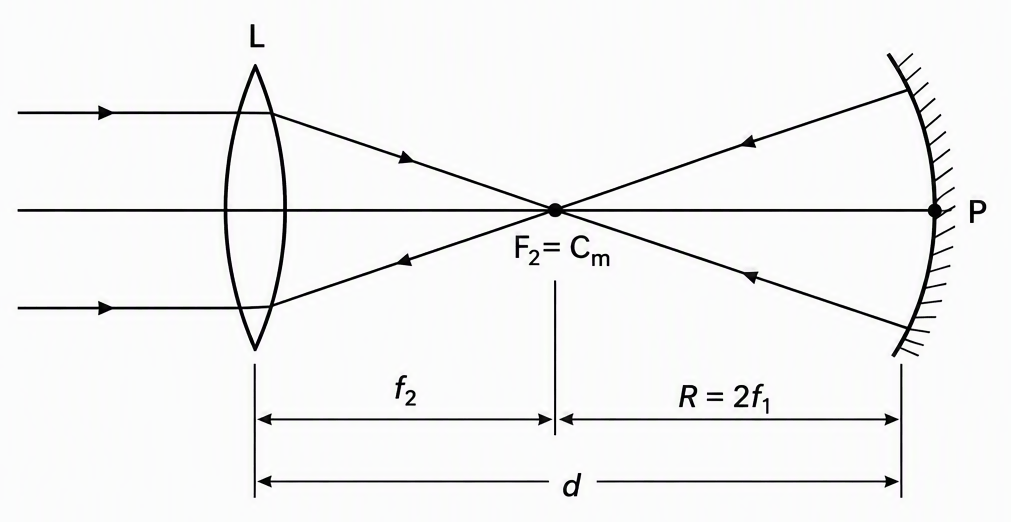
The mirror focal-length magnitude, lens focal-length magnitude and separation are labelled, respectively:
The supplied choices are:
Both focal lengths are magnitudes in the supplied geometric solution. The question bank rates this question hard and assigns an expected solving time of 90 seconds, not an observed student average.
Where does the convex lens first bring the rays together?
The incoming parallel rays meet at the convex lens’s right-hand principal focus. For the return journey, rays coming from that same focal point emerge parallel on the left, so the mirror must send the rays back through it.
Light arriving from infinity is represented by rays parallel to the principal axis. In the diagram, the first passage through the lens brings them to the point labelled:
Use the reverse optical path rather than a separate lens-formula calculation. The lens converts rays coming from its focus into a parallel beam, reversing the first passage.
The remaining task is to place the mirror so that reflected rays pass through this same right-hand lens focus again.
Why must the lens focus coincide with the mirror’s centre of curvature?
Placing the lens focus at the mirror’s centre of curvature makes each ray strike the mirror normally and retrace its path. The mirror then returns the rays through the point needed for the lens’s final refraction.
In the diagram, the shared point satisfies:
After crossing this point, the rays spread out toward the mirror along lines through its centre of curvature. Each line joins the centre to a point on the spherical mirror.
That line is a radius and therefore the normal at the point of incidence. Each ray strikes normally and reflects back along the same line, as the directional arrows show.
The reflected rays pass through the lens focus again, then spread toward the lens. The lens sends them out parallel toward the incident side.
The complete sequence is: parallel beam, lens focus, normal reflection at the mirror, same lens focus, parallel return beam. The final lens passage, not reflection alone, completes the required path.
How do the two distances give option C?
The separation is the lens-to-focus distance plus the mirror’s centre-to-pole distance. Since the shared point is the centre of curvature, the second distance is twice the mirror’s focal-length magnitude, not once.
For the concave mirror, the radius of curvature has magnitude:
The diagram gives:
Because the lens focus coincides with the mirror’s centre:
Add the lens focal-length magnitude to both sides:
Option C is correct. Keep these as positive geometric lengths; do not insert signed focal lengths into this distance sum.
For a numerical check, take these illustrative magnitudes, not values from the PYQ. Add the lens-to-focus and centre-to-pole distances:
Why does placing the lens focus at the mirror focus give the wrong answer?
Option A makes the mirror’s reflected rays parallel, but the question requires parallel rays after the final lens passage. Checking the mirror’s output alone applies the condition at the wrong optical stage.
The incorrect placement makes the lens focus coincide with the mirror’s principal focus:
Rays travelling from the mirror’s principal focus reflect parallel to the axis rather than retracing their incoming paths. Those parallel rays still have to cross the convex lens again. On that second passage, the lens converges them to its left-hand focus instead of sending them to infinity.
The two conditions produce different results:
- Mirror focus: produces parallel reflected rays.
- Mirror centre of curvature: produces retracing rays.
The method error is checking the mirror’s output while forgetting the final refraction through the lens, not faulty addition. When reviewing a wrong attempt, use NEET mock test analysis to record this as a missed optical stage rather than a calculation error.
Which three related optics questions check this method?
Use these original practice questions from Optics, not additional verified PYQs, to test the return path. They check collimation, the mirror’s self-conjugate point and the effect of changing its focal length.
- A point source is at the principal focus on the right of a convex lens. What happens to rays travelling left through it?
They emerge parallel to the principal axis because the lens collimates light coming from a principal focus. The direction of travel does not change this focus-to-parallel rule.
- An object is at the centre of curvature of a concave mirror. Where is its image, and what are its properties?
The image forms at the centre of curvature. It is real, inverted and the same size as the object. This is the mirror’s self-conjugate point: object and image occupy the same location, the return-point condition used in the main solution.
- The mirror focal length is halved while the lens focal length stays unchanged. What separation preserves retracing?
Recalculate the mirror radius first, then add the unchanged lens focal-length magnitude:
Original option A becomes valid here only because the mirror has changed. It remains wrong for the original arrangement. Before selecting an option, trace the beam through the final lens passage.
Next step: photograph a doubt on NEET JEEnius AI and photograph any question you are stuck on and get a step-by-step solution across Physics, Chemistry and Biology (20 free a month).
Frequently asked questions
What is the correct answer to the lens-mirror combination NEET 2012 question?
Option C is correct: the separation is d = 2f1 + f2, where f1 and f2 are the focal-length magnitudes of the concave mirror and convex lens, respectively. The lens focus coincides with the mirror's centre of curvature, so rays retrace their paths and emerge parallel after crossing the lens again.
Why must the lens focus be at the mirror's centre of curvature?
Rays travelling from the mirror's centre of curvature strike its surface normally and reflect back along the same paths. This returns them through the lens focus. The convex lens then sends them out as a parallel beam toward the incident side.
Why is d = f1 + f2 wrong for the original question?
This separation places the lens focus at the mirror's principal focus, making the reflected rays parallel before they reach the lens again. The convex lens then converges those rays to its left-hand focus. The question requires a parallel beam after the final lens passage, not immediately after reflection.
What happens to the separation if the mirror's focal length is halved?
If the original mirror focal-length magnitude is f1, halving it makes the new radius of curvature f1. With the lens focal-length magnitude f2 unchanged, the separation for retracing becomes d' = f1 + f2. This expression is valid for the changed mirror, not the original arrangement.