What is the correct answer to the Lorentz force NEET 2013 question?
Option C is correct for the Lorentz force NEET 2013 question: the electric field points east and the magnetic field points up. Subtract the electric force from the total force before calculating the magnetic field.
A proton released from rest in a room initially accelerates eastward. In a separate trial under the same fields, it is launched northward at a given speed and initially accelerates eastward three times as fast. Identify the electric and magnetic fields.
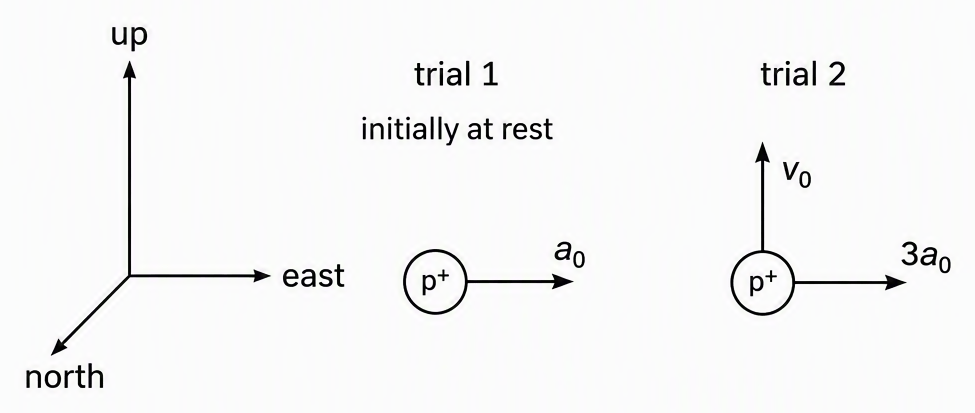
This NEET 2013 Physics question belongs to Magnetic Effects of Current and Magnetism. The question bank, not an official NEET classification, tags it hard and gives an expected solving time of 120 seconds.
The options list electric field first, magnetic field second:
- A
- B
- C
- D
How does the proton at rest reveal the electric field?
Only the electric force acts at release, so the first observation fixes the electric field. Start with the Lorentz force and Newton’s second law:
At the initial instant, the proton has zero velocity. The magnetic force is therefore zero, regardless of the magnetic-field strength:
The electric force supplies the entire initial force. Equate its magnitude to mass times acceleration, then divide by the charge:
Because the proton carries positive charge, its electric force points along the electric field. The eastward acceleration therefore fixes the electric field as eastward, eliminating A and B.
Zero magnetic force does not mean zero magnetic field. This result applies at release; it does not describe the proton’s later motion.
Why must we subtract the electric force before finding the magnetic field?
The moving trial gives the total force, not the magnetic force alone. Changing the launch velocity does not remove the electric contribution: the same electric field still pushes east. Subtract that contribution before calculating the magnetic field.
The northward-launch observation gives:
The electric contribution remains:
Subtract the forces as vectors first:
Every listed magnetic-field choice is vertical, hence perpendicular to the northward velocity. The magnetic-force magnitude is therefore:
Equate this to the remaining force, then divide by the charge and launch speed:
The change between these two initial forces isolates the magnetic force. This works because the charge and electric field are unchanged, and the rest trial has no magnetic contribution.
How do we prove the magnetic field points up and verify option C?
An upward field produces the required eastward magnetic force on a northward-moving proton. For this positive charge, use velocity crossed with magnetic field, in that order:
Use the axes in the diagram. Point your right-hand fingers north and curl them toward up; your thumb points east:
Final answer: option C. The fields are:
Check both observations rather than stopping at the matching option. Substitute the fields into each initial force calculation:
- Rest trial: zero velocity removes the magnetic force.
- Northward trial: both forces point east.
Both initial observations are reproduced. Checking the full force vectors catches a wrong direction even when the field magnitude looks correct.
Why does option D require two separate mistakes?
Option D gets the electric field right but requires two separate magnetic-force errors. It places the electric field east while proposing:
Its magnitude follows from the incorrect equation:
That assigns the entire net force to magnetism, ignoring the electric force already present. The electric contribution must be subtracted before calculating the magnetic-field magnitude.
The downward direction requires a separate sign error: reversing the cross-product order, or using the force direction for a negative charge instead of a positive proton. The subtraction mistake alone does not produce every part of option D.
Test D directly using the established axes. A northward-moving proton in a downward field has a westward magnetic force:
Adding the eastward electric force gives:
This gives westward acceleration, contradicting the stated eastward acceleration. Option D fails both the magnitude and direction checks.
How do you solve three related Lorentz force practice questions?
Separate the forces, calculate their magnitudes, then check directions. These are original related practice questions, not additional verified PYQs. They reuse the same east, north and up axes.
- What are the electric and vertical magnetic fields if the northward-launch acceleration becomes five times the rest acceleration?
Keep the original eastward rest acceleration and launch speed. The changed initial conditions are:
The rest trial fixes the electric field. Subtraction gives the magnetic force, and north crossed with up gives east:
For a numerical version, take:
Substitution gives:
- What happens initially if the proton launches southward at the original speed in the option C fields?
The electric force stays east, but reversing velocity reverses the magnetic force. Subtract their opposing magnitudes:
- What is an electron’s initial acceleration when released from rest in the original option C fields?
Let the electron mass be:
Its initial magnetic force is zero. Its negative charge reverses the electric force relative to the field:
Use the electron’s mass in Newton’s law, not the proton’s mass. Before checking any answer, write the electric and magnetic force directions separately.
Next step: photograph a doubt on NEET JEEnius AI and photograph any question you are stuck on and get a step-by-step solution across Physics, Chemistry and Biology (20 free a month).
If that step was the hard part, work through NEET Chemistry Important Chapters: A 14-Day Starting Plan.
Frequently asked questions
What is the correct answer to the Lorentz force NEET 2013 question?
Option C is correct: E = Ma0/e east and B = 2Ma0/(ev0) up. Here M is the proton mass, e its positive charge, a0 the initial acceleration from rest and v0 the northward launch speed. These fields reproduce the initial eastward accelerations of a0 and 3a0 in the two trials.
Why is the magnetic force zero when the proton is released from rest?
The magnetic force is e(v × B), so zero initial velocity makes it zero at release. The initial acceleration therefore comes entirely from the electric force. Zero magnetic force at that instant does not imply that the magnetic field is zero.
Why is the magnetic force 2Ma0 and not 3Ma0?
In the northward-launch trial, 3Ma0 is the total eastward force, where M is the proton mass and a0 is its initial acceleration in the rest trial. The unchanged electric field already supplies an eastward force Ma0. Subtracting this electric contribution leaves a magnetic force of 2Ma0 eastward.
How do we know the magnetic field points upward?
The proton moves northward and needs an eastward magnetic force. For a positive charge, the force follows v × B, and north crossed with up gives east. Among the listed vertical magnetic fields, the upward direction is therefore correct.