
Which NEET Chemistry chapters should you do first?
Among NEET Chemistry important chapters, the highest-count chapter is not automatically your best starting point. Weak foundations need a brief mole-concept check, then Periodicity, Chemical Bonding and Some Basic Principles of Organic Chemistry. With secure foundations, priority candidates are Organic Compounds Containing Oxygen, Coordination Compounds, Redox Reactions and Electrochemistry, and Chemical Kinetics. These are preparation priorities, not a universal sequence or a list sufficient for the exam.
How can you start Chemistry with two focused hours a day for 14 days?
Reserve two hours that include learning, questions and correction, rather than spending two hours reading and leaving practice unfinished. This plan provides 28 hours of foundation-led starting or revision work. It is not a promise to teach these chapters from zero in 14 days; progression depends on what you can solve and explain.
These are suggested clock times, movable around school or coaching. The two hours include review, not extra homework hidden outside the schedule.
Daily schedule: time, task and output
- 18:00–18:15 | Revisit due mistakes | Re-solve selected earlier errors without notes; identify anything still unclear.
- 18:15–18:55 | NCERT or concept study | Study one defined topic and recall its main rules without looking.
- 18:55–19:35 | Topic MCQs | Attempt a focused set, recording guesses and unanswered questions.
- 19:35–20:00 | Analyse errors and re-solve selected questions | Write the cause of each error and retry selected problems.
The blocks total 120 minutes. As a coaching target, try 15–20 carefully reviewed questions across the practice and correction blocks, not a guaranteed rate for every chapter. A difficult Bonding set may need fewer questions and longer explanations.
Starting cycle: days, chapter focus, hours and completion evidence
- Day 1 | Mole-concept diagnostic and repair | 2 hours | Explain mass-to-mole conversions and solve basic stoichiometry questions.
- Day 2 | Periodicity | 2 hours | Explain trends using electronic configuration, rather than recalling arrows alone.
- Days 3–5 | Chemical Bonding | 6 hours | Solve and explain Lewis structures, geometry and bonding questions.
- Days 6–8 | Organic fundamentals | 6 hours | Apply nomenclature, electronic effects and intermediate stability.
- Day 9 | Hydrocarbons | 2 hours | Explain representative reaction types and product choices.
- Day 10 | Organic halogen compounds | 2 hours | Distinguish substitution from elimination in studied examples.
- Days 11–13 | Organic oxygen compounds | 6 hours | Solve studied functional-group reactions and explain conversions.
- Day 14 | Mixed practice and error review | 2 hours | Complete the checkpoint and identify the next repair.
For first-time learners, days 9–13 are provisional progression slots: extend Bonding or organic fundamentals if the readiness check below fails. Students with secure foundations can reassign passed foundation slots to Coordination Compounds, Redox/Electrochemistry or Kinetics after checking their prerequisites.
How much time should Chemistry get beside Physics and Biology?
Two Chemistry hours fit an illustrative six-hour net self-study day, but only as a temporary Chemistry-repair allocation. Keep Biology’s block largest because it accounts for half the paper. This schedule excludes school, coaching and breaks; it is neither a marks-proportional formula nor a recommendation for every student.
Official subject split and suggested six-hour allocation
- Biology: 90 questions, 360 marks; 2.5 hours of self-study.
- Chemistry: 45 questions, 180 marks; 2 hours of self-study.
- Physics: 45 questions, 180 marks; 1.5 hours of self-study.
For a three-hour school day, use this smaller allocation:
- Biology: 75 minutes.
- Chemistry: 60 minutes.
- Physics: 45 minutes.
At one Chemistry hour daily, the same 28-hour cycle requires roughly 28 study days. Split each planned two-hour session across two days while retaining questions and correction.
Physics time must increase if numerical errors or unfinished prerequisites make it your weakest subject. Decide from recent timed work: inspect unfinished questions, repeated mistakes and time spent stuck, rather than choosing the subject that causes the most anxiety.
For Biology’s protected block, use NEET Biology Important Chapters: A 14-Day Study Plan. Coordinate both plans with Physics work already assigned by school or coaching instead of stacking three independent timetables.
What mistakes make this Chemistry chapter plan fail?
The plan fails when question frequency replaces prerequisites, or when the calendar matters more than solving questions correctly. Keep questions inside every session and let errors decide progression. Finishing a chapter’s videos is not the same as solving its questions without help.
- Starting oxygen compounds because they lead the counts. Without electronic effects, intermediates and reaction logic, reactions become disconnected facts to memorise. Return to the specific organic principle blocking the product prediction.
- Treating 14 days as a completion challenge. If prerequisite questions cannot be solved and explained, repair the prerequisite and move the calendar. Reading the next chapter does not remove the gap.
- Using the entire block for NCERT or lectures. This postpones retrieval, calculations and error correction. Stop reading or watching at the planned time and attempt questions.
- Treating priority as permission to omit chapters. The current paper has 180 compulsory questions and no optional Section B. This list organises preparation; it does not replace syllabus coverage.
- Assuming historical labels prove current coverage. Check the official syllabus for your exam year at neet.nta.nic.in, especially before studying older PYQs, broad P-Block content or large organic chapter buckets.
- Counting attempts rather than corrected misconceptions. Repeating one conceptual error across a large set is not progress. Identify the rule you misunderstood, then test it on an unseen question.
- Improving Chemistry by neglecting other subjects. Preserve Biology and Physics blocks, then adjust from timed evidence.
The supplied counts support priorities, not guarantees. Reject any claim that these chapters guarantee a particular Chemistry score or a fixed number of questions in the next paper.
What do the PYQ counts show about NEET Chemistry important chapters?
The counts make oxygen compounds, Coordination and Redox/Electrochemistry priority candidates, while also supporting Bonding and organic fundamentals. This evidence comes from a tagged question collection, not verified exam weightage. The full platform corpus contains 1,370 tagged Chemistry questions covering 2000–2026; the supplied chapter summary covers a 377-question slice, not the full corpus.
Source caveat: The source calls this a “last-five-years” summary, but its accompanying chapter breakdown lists six years, 2021–2026. Do not treat these figures as verified five-year exam weightage.
Chapter data: chapter, tagged questions and share of the supplied 377-question slice
- Organic Compounds Containing Oxygen | 35 | 9.3%
- Redox Reactions and Electrochemistry | 26 | 6.9%
- Coordination Compounds | 26 | 6.9%
- Chemical Bonding | 25 | 6.6%
- Organic fundamentals | 24 | 6.4%
- Chemical Kinetics | 20 | 5.3%
- P-Block | 19 | 5.0%
- Organic halogen compounds | 18 | 4.8%
- Hydrocarbons | 17 | 4.5%
- d- and f-Block | 17 | 4.5%
- Periodicity | 16 | 4.2%
- Solutions | 16 | 4.2%
Representation is unequal across the supplied years:
- 2024: 44 tagged Chemistry questions.
- 2025: 58 tagged Chemistry questions.
- 2026: 130 tagged Chemistry questions.
The current official Chemistry section contains 45 questions. The supplied material does not explain why some annual records exceed that count, so attributing the excess to particular papers, duplicates or another cause would be speculation.
These percentages are pooled corpus shares, not probabilities, expected questions per paper, unique official-paper counts or equal-year averages. Years with more tagged questions influence the pooled totals more heavily.
Chapter boundaries also matter. Redox with Electrochemistry combines substantial content, as does the oxygen-containing organic compounds bucket. Their totals do not measure return per study hour or establish which chapter is fastest to revise.
Use this list to choose destinations after checking readiness. Absence from the top 12 does not mean zero importance: mole concepts deserve early attention because later calculations depend on them, even though they are absent from this summary.
How should prerequisites decide your next Chemistry chapter?
Choose the next chapter whose prerequisite questions you can solve and explain. Bonding and organic fundamentals are gateway priorities; oxygen compounds and Coordination are high-frequency destinations in this slice. Kinetics or Solutions can be focused revision choices for students whose calculations and basic concepts are already secure.
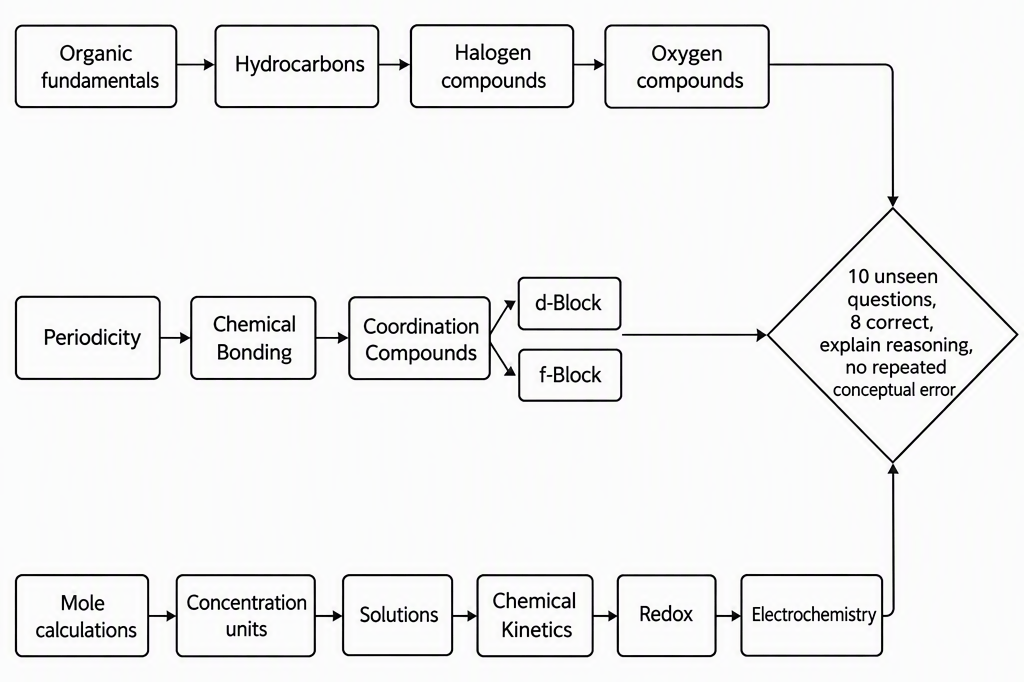
Before skipping a foundation chapter, attempt 10 relevant unseen questions without notes and explain your reasoning. I would use 8 correct out of 10, with no repeated conceptual error, as a practical coaching gate. This is not a validated exam benchmark.
In what order should you study Organic Chemistry?
Study organic fundamentals, then Hydrocarbons, halogen compounds and oxygen compounds. Nomenclature lets you identify the structure; electronic effects explain electron distribution; intermediates and reaction types help explain the product.
Naming a compound is not enough if you cannot explain a product choice. At the oxygen-compounds practice step, use Carboxylic Acids Practice Questions NEET: Best Free Resources to choose targeted practice after studying the relevant concepts.
What should you know before Coordination Compounds?
Study Periodicity and Chemical Bonding first, checking oxidation states, electronic configuration, geometry and bonding before Coordination. Study d- and f-Block alongside the relevant inorganic sequence, connecting configurations and oxidation states rather than memorising unrelated lists.
Use Chemical Bonding NEET 2025: Four Property Orders Explained as a diagnostic worked example: attempt the reasoning before reading the explanation. For P-Block and other recall-heavy portions, use current-syllabus NCERT study followed by repeated closed-book recall, not a universal completion-time claim.
What should you study first in Physical Chemistry?
Check mole calculations and concentration units first. Study Redox before Electrochemistry so oxidation numbers and balanced electron transfer do not become hidden obstacles.
Solutions and Chemical Kinetics become candidates when required calculations, units and formula interpretation are secure. During revision, test whether you can choose the correct relation and explain its conditions, not merely reproduce it.
Adapt these routes to your stage:
- Class 11: Follow the portion already taught, using the route to strengthen its prerequisites.
- Class 12: Repair the specific Class 11 weakness blocking your current chapter instead of restarting the entire subject.
- Droppers: Use the diagnostic before allocating days. Do not restart every chapter automatically.
How do you decide whether to move on or repeat a chapter?
Move on when you can solve fresh questions and explain the underlying rule without repeating the same conceptual error. At each chapter block’s end, record attempted, correct, wrong and unattempted questions. Tag the main error as concept, recall, calculation or misreading so the next session has a defined task.
For day 14, try 30 mixed Chemistry questions in 40 minutes, followed by analysis. This is a practice target, not an official Chemistry sectional time limit. Use the remaining session time to classify errors and re-solve selected questions.
Apply the official marking rule:
The letters represent the score, correct answers, wrong answers and unattempted questions, respectively. Award 4 marks for each correct answer, deduct 1 for each wrong answer and award 0 for an unattempted question. Do not extrapolate this small test into a predicted NEET score.
Choose the correction from the error:
- Recurring concept errors: Repair the prerequisite, then attempt fresh questions.
- Recall errors: Retrieve the relevant NCERT points closed-book, check omissions and retrieve again later.
- Calculation errors: Solve targeted worked problems, then test the method on unseen questions.
- Misreading: Mark the condition or qualifier you missed and check it deliberately in the next set.
Can I start with the highest-count chapter?
Yes, if its prerequisites pass the readiness check. The count alone is not permission.
Must a dropper repeat mole concepts and Bonding?
No. Pass the diagnostic with explanations, then reassign those hours.
Can these chapters be completed from zero in 14 days?
Not as a reliable promise. Keep days 9–13 provisional and extend foundations when needed.
Are these chapters enough for Chemistry?
No. They establish a starting order, not a sufficient syllabus.
For an optional way to run this review loop, NEET JEEnius AI’s free mistake notebook automatically saves wrong answers and returns them at 1, 3, 7 and 14 days until marked mastered. In your next review block, re-solve each due question without notes before deciding that the mistake is fixed.
Next step: daily practice problems on NEET JEEnius AI and get a fresh set on a topic every day (20 free attempts a month).
Frequently asked questions
Which NEET Chemistry chapters should I study first?
If your foundations are weak, begin with a mole-concept check, then Periodicity, Chemical Bonding and organic fundamentals. With secure prerequisites, prioritise candidates such as Organic Compounds Containing Oxygen, Coordination Compounds, Redox Reactions and Electrochemistry, and Chemical Kinetics. Choose your next chapter by what you can solve and explain, not question counts alone.
Can I complete important NEET Chemistry chapters in 14 days?
The plan provides 28 hours of starting or revision work at two hours daily, not a reliable promise of completion from zero. Each session includes concept study, MCQs and error correction. Extend foundation work if readiness checks fail; at one hour daily, the same cycle takes roughly 28 study days.
Are these important chapters enough for NEET Chemistry?
No. These chapters establish preparation priorities, not a sufficient syllabus or a guaranteed score. The current paper has 180 compulsory questions and no optional Section B, so use the list to organise preparation rather than omit other syllabus chapters.
Can a dropper skip mole concepts and Chemical Bonding?
A dropper need not repeat these chapters automatically if their foundations are secure. Before skipping a foundation chapter, attempt 10 relevant unseen questions without notes and explain the reasoning. The article suggests 8 correct with no repeated conceptual error as a practical coaching gate, not a validated exam benchmark.
Do the PYQ counts show official NEET Chemistry chapter weightage?
No. The figures describe a supplied 377-question slice of a tagged collection, not verified exam weightage. The source labels it a last-five-years summary but lists six years, 2021–2026, with unequal representation. Treat the percentages as pooled collection shares, not probabilities or expected questions per paper.