
Which Free Resource Gives the Best Carboxylic Acids NEET Questions?
NEET JEEnius free topic-wise carboxylic acids questions plus the 30 free full-length mocks per month is the clear winner for 2025-2027 aspirants. It matches the compulsory single-correct format, gives per-subject breakdown, and targets the exact mistakes students make on acidity order and mechanism-based questions. Previous-year papers alone are insufficient because they still contain old assertion-reason styles discontinued after 2024.
This bank trains decisive choice between similar options on pKa trends and HVZ selectivity. It aligns with the 45 Chemistry questions under +4/-1 marking. Students who finish NCERT still lose marks on these exact traps.
How Do the Top Free Resources Compare for Carboxylic Acids NEET?
NEET JEEnius Free Bank + 30 Mocks beats every other free option on the parameters that decide your Chemistry score in the 180 compulsory single-correct MCQs. The rest fall short on pattern match, error analysis, or integration with full-length tests.
- NEET JEEnius Free Bank + 30 Mocks
Pattern Match: full (single-correct only).
Solution Quality & Error Analysis: details specific traps such as mixing phenol and carboxylic acid tests.
Coverage of High-Yield Subtopics: complete on acidity, HVZ, decarboxylation, tests.
Integration with Full Mocks: direct via per-subject breakdown.
Monthly Availability: unlimited topic questions with fixed mock quota.
- Previous Year NEET PYQs (free PDFs)
Pattern Match: partial (mixes old assertion-reason and multiple-correct formats dropped after 2024).
Solution Quality & Error Analysis: short answers without explanation of close-option errors.
Coverage of High-Yield Subtopics: basic acidity and decarboxylation but skips HVZ limitations and steric effects.
Integration with Full Mocks: none.
Monthly Availability: one-time download.
- Careers360 & similar free compilations
Pattern Match: low (ignores shift to 180 compulsory single-correct MCQs and offline OMR till 2026).
Solution Quality & Error Analysis: weightage articles but weak mechanism error analysis.
Coverage of High-Yield Subtopics: touches acidity order and tests yet lacks depth on decarboxylation selectivity.
Integration with Full Mocks: absent.
Monthly Availability: irregular PDF drops.
- YouTube/PDF one-shot question sets
Pattern Match: fails (solves old-format questions irrelevant to current 45 Chemistry questions).
Solution Quality & Error Analysis: rarely links pKa to reactivity or flags traps.
Coverage of High-Yield Subtopics: random with poor focus on relative reactivity or HVZ.
Integration with Full Mocks: none.
Monthly Availability: depends on creator uploads.
Which Carboxylic Acids NEET Resource Fits My Preparation Stage?
Match your stage to the resource that fixes your exact gap instead of adding more generic practice.
Class 12 student with 4 months left and weak in organic mechanisms should pick NEET JEEnius topic-wise carboxylic acids questions plus 2 mocks per week. The error analysis directly fixes confusion between alcohols and amines in reactivity.
Dropper who has already solved PYQs multiple times but still loses marks on application should pick NEET JEEnius mocks with focused carboxylic acid revision. The per-subject breakdown shows exactly which subtopic still costs marks under -1 penalty.
Student who only wants quick 20 questions before sleep should use PYQ PDFs but only after finishing the JEEnius bank. Standalone PYQs miss the mechanism depth now required.
Self-study aspirant avoiding coaching should choose Careers360 weightage articles paired with JEEnius mocks. Never rely on standalone YouTube sets because they skip the reasoning needed for close options in single-correct format.
How Does the 2025-2027 NEET Pattern Change Carboxylic Acids Practice?
The exam now uses 180 compulsory single-correct MCQs, no Section B, 45 Chemistry questions, +4/-1 marking, 180 minutes, and offline OMR till at least 2026. I expect carboxylic acids questions to appear only as single-correct application or reasoning types. This expectation follows the removal of older formats after 2024.
Old assertion-reason or multiple-correct questions from 2021-2024 are irrelevant and train habits that no longer score marks. Resources built for the old pattern therefore risk teaching wrong timing and approach.
Practice must include questions that force choice between close options such as formic acid versus acetic acid in reduction or decarboxylation selectivity. See the linked 1-year study plan from Class 11 for how to fit this into your timetable without overload.
What Are the Must-Know Subtopics and Pitfalls in Carboxylic Acids for NEET?
Acidity order with substituents, Hell-Volhard-Zelinsky reaction mechanism and limitations, decarboxylation (soda lime vs Kolbe), distinguishing tests (NaHCO3 vs alcohol), and relative reactivity with alcohols versus amines repeat every year.
Common student traps include confusing carboxylic acids with phenols in FeCl3 test, selecting the wrong major product in HVZ, and ignoring steric effects in esterification. These mistakes trigger the -1 mark exactly when two options look similar.
Full mocks are essential because carboxylic acids questions rarely appear in isolation. They combine with biomolecules or aldehydes and test concept switching inside 180 minutes.
How Do Sample Questions from Different Resources Compare for Carboxylic Acids NEET?
A typical PYQ on acidity order reads: Arrange formic acid, acetic acid, and chloroacetic acid in decreasing acidity. The generic solution says chloroacetic acid is strongest due to -I effect, acetic weakest due to +I effect, and ends there. It never explains why a student might pick formic over chloroacetic under exam pressure.
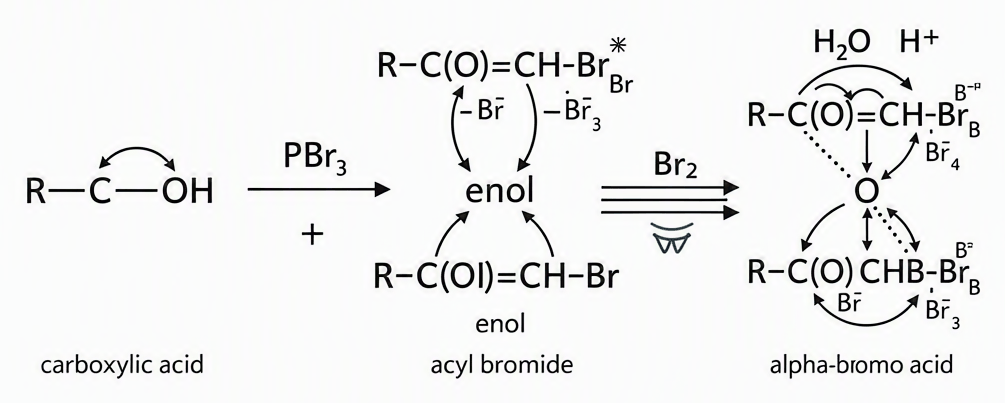
A NEET JEEnius-style question on HVZ selectivity states: Which acid undergoes Hell-Volhard-Zelinsky reaction more readily, propanoic acid or 2-methylpropanoic acid, and why does pKa matter? The explanation runs through the mechanism, notes that alpha-hydrogen acidity influences enol formation, links lower pKa of propanoic acid to faster reaction, and flags the common error of ignoring steric hindrance in the branched acid. It then shows the exact trap option that appears in mocks.
The JEEnius explanation links three concepts while the PYQ solution stays brief. This depth prevents the -1 mistake by making you see why the close option fails instead of memorising a trend.
What 30-Day Action Plan Should I Follow for Carboxylic Acids NEET?
Week 1: Finish all free carboxylic acids topic questions on NEET JEEnius.
Week 2-3: Attempt 2 full mocks per week (use the 30 free monthly quota) and revise only the carboxylic acid questions missed.
Week 4: Solve PYQs of last 5 years only for the subtopics still weak.
Keep a daily 25-minute slot for carboxylic acids until NEET 2025 on 2025-05-04 or NEET 2026 on 2026-06-21.
Next step: full-length mock tests on NEET JEEnius AI and sit a full 180-question, 720-mark, 180-minute paper, 45 Physics, 45 Chemistry and 90 Biology, and get a scored per-subject breakdown (30 free a month).
Frequently asked questions
What are the best free carboxylic acids practice questions for NEET?
NEET JEEnius free topic-wise bank combined with 30 full-length mocks per month is the top choice. It matches the single-correct format, provides trap-specific explanations for acidity trends and HVZ selectivity, and includes per-subject breakdown.
What are common pitfalls in carboxylic acids NEET questions?
Students commonly confuse FeCl3 test results between phenols and carboxylic acids, select wrong major products in HVZ due to steric effects, and ignore pKa links to reactivity in decarboxylation. Detailed solutions train you to spot these close-option traps.
Are previous year questions enough for carboxylic acids in NEET?
No. PYQs mix discontinued assertion-reason formats and lack depth on current single-correct application questions. Use them only after completing the NEET JEEnius bank to target remaining weak subtopics identified in mock analysis.
How has the NEET pattern change affected carboxylic acids practice?
With 180 compulsory single-correct MCQs and no Section B, practice must focus on reasoning and application questions. Old assertion-reason or multiple-correct formats from 2021-2024 are irrelevant and can build incorrect timing habits.
What are the high yield subtopics in carboxylic acids for NEET?
High-yield areas are acidity order with substituents, Hell-Volhard-Zelinsky mechanism and limitations, decarboxylation selectivity, distinguishing tests with NaHCO3, and relative reactivity versus alcohols or amines. These appear every year often combined with other chapters.