What was the NEET 2026 Laws of Motion question on elastic collision with a hanging bob?
h equals 5 m. A point mass A (mass m) moving horizontally at 10 m/s strikes a stationary hanging bob B (mass m) suspended by a 10 m massless string. The collision is elastic, the bob rises to height h metres, g = 10 m/s², bob size is neglected. Options are 8 m, 7 m, 5 m, 2.5 m.
The solution rests on NCERT velocity exchange for equal masses followed by pendulum energy conservation.
How do you visualise the collision setup?
Point mass A travels horizontally at 10 m/s and collides with bob B hanging vertically at rest from a 10 m massless string. Collision impulse is purely horizontal and perpendicular to the vertical string at the instant of impact.
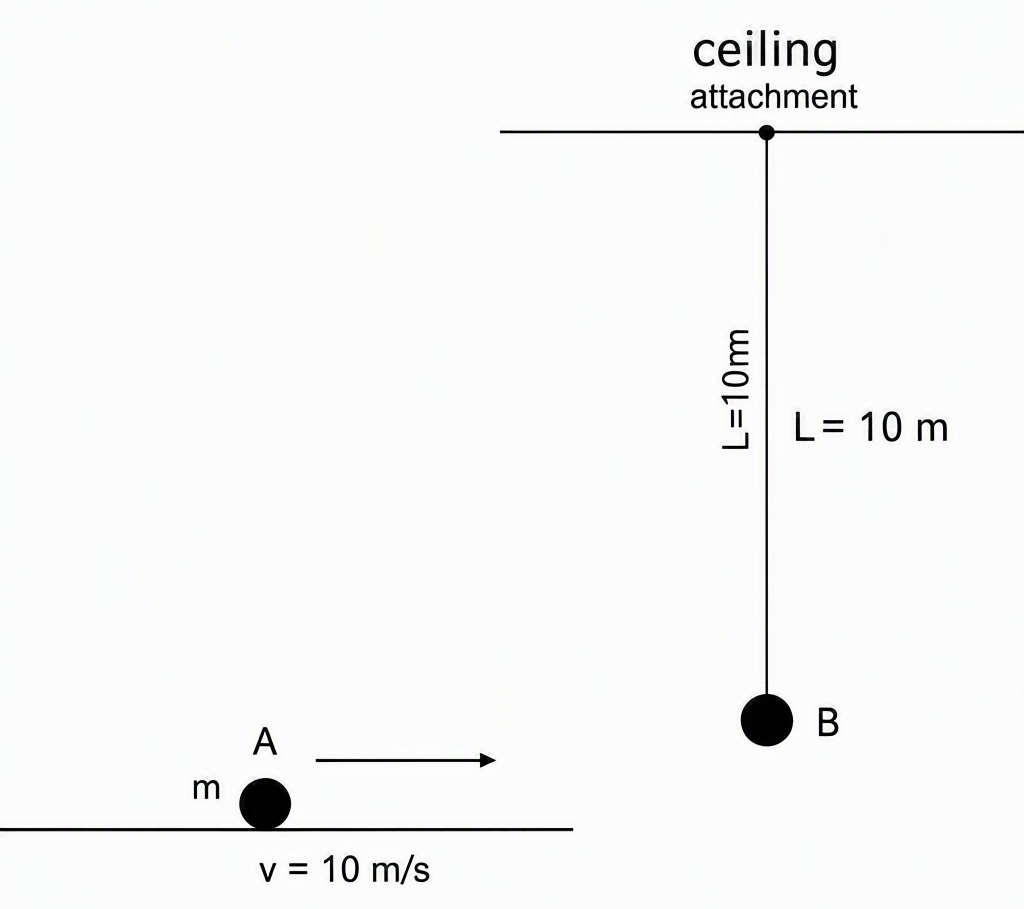
Tension acts vertically at that instant. It cannot affect horizontal momentum transfer during the brief collision.
What is the official step-by-step solution?
For elastic collision of two equal masses with one at rest, bodies exchange velocities so B instantly acquires 10 m/s horizontally and A stops. Tension cannot impart horizontal impulse during the brief collision, hence horizontal momentum is fully transferred.
Post-collision B moves as a simple pendulum. Mechanical energy is conserved because tension is perpendicular to velocity and does no work.
At highest point tangential speed is zero:
Solving gives h = 5 m.
L = 10 m confirms h = 5 m gives θ = 60° via h = L(1 − cos θ) and motion is possible without looping. Students who master this NCERT-derived two-step sequence can expect to solve any similar collision-plus-pendulum problem in under 90 seconds.
What mistake produces the 2.5 m option?
Option D (2.5 m) arises from mistakenly halving the velocity to 5 m/s before applying energy conservation (½ m (5)² = m g h → h = 1.25 m, then doubling or other arithmetic error to reach 2.5).
This is a method mistake of forgetting that in 1-D elastic collision of equal masses the target acquires the full incident velocity, not half.
What two related questions from Laws of Motion test the same ideas?
A 2 kg block at rest is struck head-on elastically by a 2 kg mass moving at 6 m/s. Final velocities are 0 m/s for the first and 6 m/s for the second. This repeats the exact equal-mass velocity-exchange rule.
A simple pendulum bob of mass m is given horizontal velocity 4 m/s at lowest point (L = 0.8 m, g = 10). Maximum height is 0.8 m from direct ½ m v² = m g h.
Contrast question: if the collision is inelastic with clay of mass m sticking to the hanging bob, common velocity is 5 m/s from momentum conservation. Height reached is then only half of the elastic case when the doubled mass is overlooked in quick calculation, producing 2.5 m. To see more solved examples from earlier years, search the past-paper archive by chapter for additional worked solutions.
What key insight does this question give for NEET 2026?
NEET 2026 remains 180 compulsory single-correct MCQs, 45 Physics questions, +4/−1 marking, offline OMR. The question tests simultaneous use of momentum conservation (no horizontal impulse from tension) and mechanical energy conservation in the pendulum.
Recognise the equal-mass elastic velocity swap from NCERT Class 11 Ch 6. No coefficient of restitution formula is required; the direct NCERT statement suffices. This exact approach scores +4 reliably because it avoids angular momentum and rotational kinetic energy.
If you photograph a doubt on any variant you will receive a step-by-step solution across Physics, Chemistry and Biology.
Next step: photograph a doubt on NEET JEEnius AI and photograph any question you are stuck on and get a step-by-step solution across Physics, Chemistry and Biology (20 free a month).
If that step was the hard part, work through Structural Organisation NEET 2024: Monocarpellary Ovary MCQ.
Frequently asked questions
What is the height reached by the hanging bob in the NEET 2026 elastic collision question?
The bob rises to a height of 5 m. For equal masses in elastic collision with one at rest, the bodies exchange velocities so the bob acquires the full 10 m/s horizontal speed. Mechanical energy conservation in the pendulum then gives 1/2 m (10)^2 = m g h, solving directly to h = 5 m with g = 10 m/s².
Why do the two masses exchange velocities in an elastic collision of equal masses?
In one-dimensional elastic collision of two equal masses where one is initially at rest, the velocities are exchanged. The incoming mass stops completely and the target takes the entire initial velocity. This is a standard NCERT result from Class 11 Physics Chapter 6 that avoids using the full coefficient of restitution formula.
Why does the string tension not affect horizontal momentum transfer in the hanging bob collision?
At the instant of impact the string is vertical and the collision impulse is horizontal. Tension acts vertically along the string and therefore has zero horizontal component. During the very short collision time, tension imparts no horizontal impulse so full momentum transfer occurs horizontally.
How do students arrive at the wrong 2.5 m answer in the NEET hanging bob collision problem?
The 2.5 m option appears when students incorrectly halve the velocity to 5 m/s before applying energy conservation. They forget that equal-mass elastic collision causes complete velocity exchange rather than splitting the speed. Correct use of NCERT rules immediately gives 10 m/s for the bob and h = 5 m.