Which pair shows monocarpellary ovary condition in NEET 2024?
Sesbania and Indigofera. The question listed five plants: Sesbania, Brinjal, Indigofera, Tobacco, and Asparagus. The task is to pick which pair alone demonstrates monocarpellary ovary condition. The four options are A) B and E only, B) C, D and E only, C) A, B and D only, D) A and C only.
This question requires exact mapping from plant name to family to gynoecium type. It rewards the strict template over vague recall of floral characters.
What is the official step-by-step solution for the NEET 2024 monocarpellary gynoecium question?
Sesbania and Indigofera belong to Fabaceae possessing monocarpellary, unilocular ovary with many ovules. Brinjal and Tobacco belong to Solanaceae possessing bicarpellary gynoecium. Asparagus belongs to Liliaceae and therefore does not represent monocarpellary condition here. Only options A (Sesbania) and C (Indigofera) are correct, hence answer is D.
Start with the plant name. Assign its family from standard NEET lists. Recall the fixed gynoecium formula for that family. Fabaceae is always monocarpellary with marginal placentation. Solanaceae is bicarpellary, syncarpous, axile. Liliaceae is tricarpellary, syncarpous, axile. Match the pair that satisfies monocarpellary only.
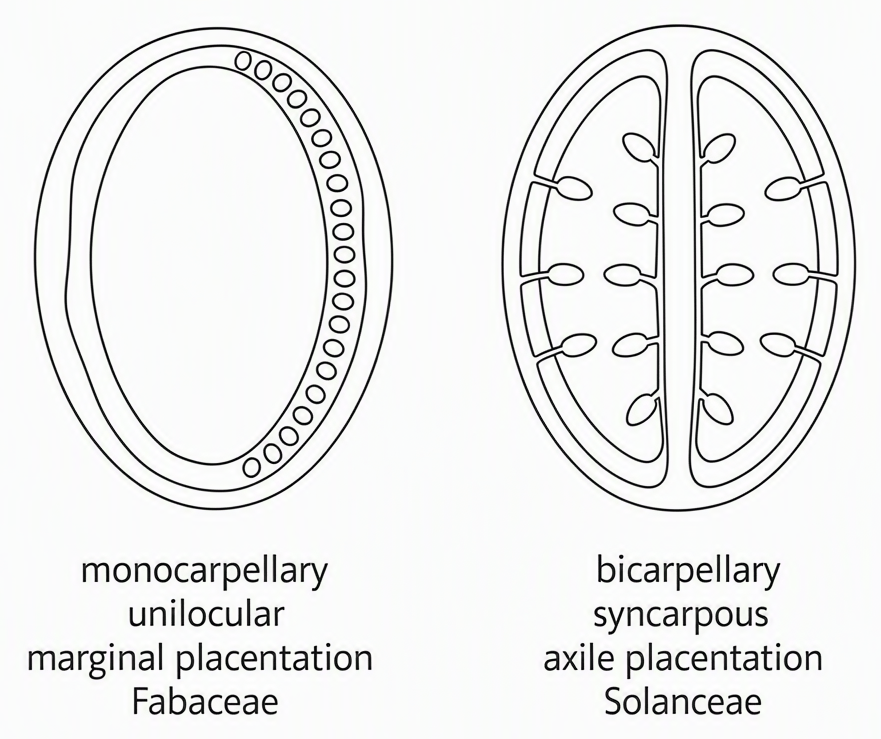
This mapping matches the official NEET 2024 worked solution exactly.
What mistake produces one wrong option in the NEET 2024 monocarpellary question?
The precise procedural flaw is assigning gynoecium type by common name or general legume association instead of strict family-level recall. This leads to incorrectly marking Brinjal (Solanaceae) as monocarpellary and selecting the option that mixes Fabaceae with Solanaceae examples.
The method fix is always map plant name to family to standard gynoecium formula before looking at choices. The official solution follows this sequence and discards every mixed option.
How does gynoecium differ across Fabaceae, Solanaceae and Liliaceae?
Use this direct contrast before every MCQ. It prevents the family-mixup traps seen in the 2024 paper.
- Fabaceae: monocarpellary, unilocular, marginal placentation; examples Sesbania, Indigofera
- Solanaceae: bicarpellary, syncarpous, axile placentation; examples Brinjal, Tobacco
- Liliaceae: tricarpellary, syncarpous, axile placentation; example Asparagus
Carpel number forms the first filter. One carpel selects Fabaceae only. Locule count confirms it: unilocular matches Fabaceae while bilocular or trilocular rules it out.
What practice questions test the same gynoecium logic from NEET 2024?
Question 1: Floral formula of family Fabaceae shows which placentation and carpel condition?
The formula shows marginal placentation and monocarpellary condition. This matches the official classification used for Sesbania and Indigofera.
Question 2: Gynoecium of Solanaceae members such as Petunia is described as?
Bicarpellary, syncarpous with axile placentation. This follows the same logic applied to Brinjal and Tobacco in the 2024 paper.
Solve both using the plant-name-to-family-to-formula sequence.
How can you solve floral character MCQs in 40 seconds for NEET 2025?
The repeatable routine is plant name to family (3 s), family to gynoecium formula (10 s), match to option (10 s). The three-family contrast list serves as the first mental check and immediately eliminates two wrong combinations.
For any Liliaceae edge case that still feels uncertain, photograph any doubt you are stuck on and get a step-by-step solution across Physics, Chemistry and Biology. Expect this sequence to classify any monocarpellary or bicarpellary example by family in under 40 seconds because it follows the exact official method used in the 2024 paper.
What exact facts from NEET 2024 must stay fixed in Structural Organisation revision?
Monocarpellary condition is diagnostic for Fabaceae in NEET questions. Never assume all listed legumes or nightshades share the same carpel number. Asparagus must be routed through Liliaceae before assigning any gynoecium trait.
After each mock test, revisit any missed floral character item using the same official sequence. Use the past-paper archive to search past NEET papers by chapter for more worked solutions on gynoecium and floral characters to lock in permanent recall.
Next step: photograph a doubt on NEET JEEnius AI and photograph any question you are stuck on and get a step-by-step solution across Physics, Chemistry and Biology (20 free a month).
Read next: Gravitation NEET 2021: Maximum Height Using Energy Conservation.
Frequently asked questions
Which pair shows monocarpellary ovary condition in NEET 2024?
The pair is Sesbania and Indigofera. Both belong to the Fabaceae family which has a monocarpellary gynoecium. The correct option is D) A and C only as per the official NEET 2024 solution.
What is the gynoecium in Fabaceae family for NEET?
Fabaceae has monocarpellary, unilocular ovary with marginal placentation. This is used to identify Sesbania and Indigofera in the structural organisation neet 2024 paper.
How is gynoecium different in Solanaceae and Liliaceae?
Solanaceae members like Brinjal and Tobacco have bicarpellary syncarpous gynoecium with axile placentation. Liliaceae such as Asparagus has tricarpellary syncarpous with axile placentation. Only Fabaceae is monocarpellary.
How to solve monocarpellary questions in structural organisation neet 2024?
Use the sequence: identify plant name to family (3s), recall the standard gynoecium formula for that family (10s), then match to the given options (10s). This method follows the official NEET solution exactly.