
What did the Organic Compounds Containing Oxygen NEET 2026 question ask?
The Organic Compounds Containing Oxygen NEET 2026 question must be solved by tracking the intermediate after each reagent. Its classification marks it as a hard, difficulty-tier-3 Chemistry question and sets an expected solving time of 120 seconds. NEET 2026 was re-held on 21 June 2026 after the 3 May sitting was cancelled.
This question appeared under Chemical Reactions of Alcohols and Carboxylic Acids in the re-examination paper. Restated in fresh language, the four required conversions are:
The available reagent sequences are:
- I:
- II:
- III:
- IV:
The answer combinations are:
- Option A:
- Option B:
- Option C:
- Option D:
Each match will be derived through its intermediate before the correct option is disclosed.
How are A-II and B-III derived step by step?
A matches II because oxygen forms the oxidised hydroperoxide intermediate used in the official route, followed by acidic cleavage to phenol. B matches III because methanol first converts ethanoic acid into an ester, which is then hydrogenated. Neither match can be established from the final reagent alone.
Why does conversion A match reagent set II?
The source structure for A is typographically compressed, but the official route identifies oxidation followed by acidic cleavage. Oxygen first produces the oxidised hydroperoxide intermediate represented in the official pathway.
Acidic aqueous treatment then cleaves this intermediate to produce phenol.
The complete sequence is oxidation to a hydroperoxide followed by acid-assisted cleavage. Therefore:
Why does ethanoic acid conversion B match reagent set III?
Methanol in acidic medium does not directly reduce ethanoic acid. It carries out acid-catalysed Fischer esterification, producing methyl ethanoate and water.
The intermediate is methyl ethanoate.
Catalytic hydrogenation then reduces the ester. The ethanoate portion gives ethanol, while the methoxy portion gives methanol.
Ethanol is obtained through ester formation followed by ester reduction, not through direct reduction of ethanoic acid by the first reagent.
How are C-IV and D-I derived step by step?
C matches IV because propan-1-ol first forms propene, which then undergoes Markovnikov hydration to propan-2-ol. D matches I because benzene first forms benzenesulfonic acid, followed by sodium phenoxide and phenol. These intermediates establish both matches without using option elimination.
Why does propan-1-ol conversion C match reagent set IV?
Concentrated sulfuric acid and heat first remove water from propan-1-ol. The intermediate is propene.
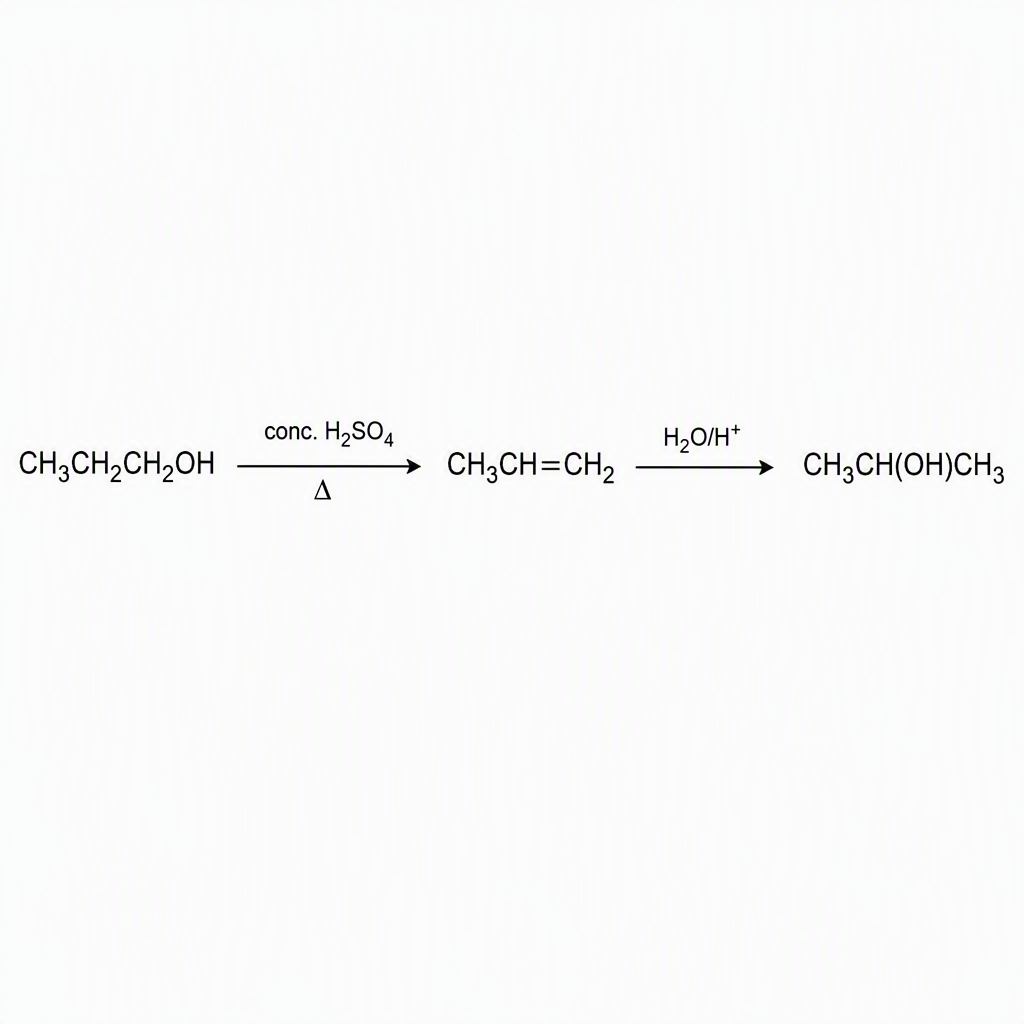
The second step is acid-catalysed hydration of propene. Markovnikov orientation places the hydroxyl group on carbon 2.
The hydroxyl group does not shift directly from carbon 1 to carbon 2. The propene intermediate permits the change in position.
Why does benzene conversion D match reagent set I?
Oleum reacts with benzene by electrophilic aromatic sulfonation. This first step forms benzenesulfonic acid.
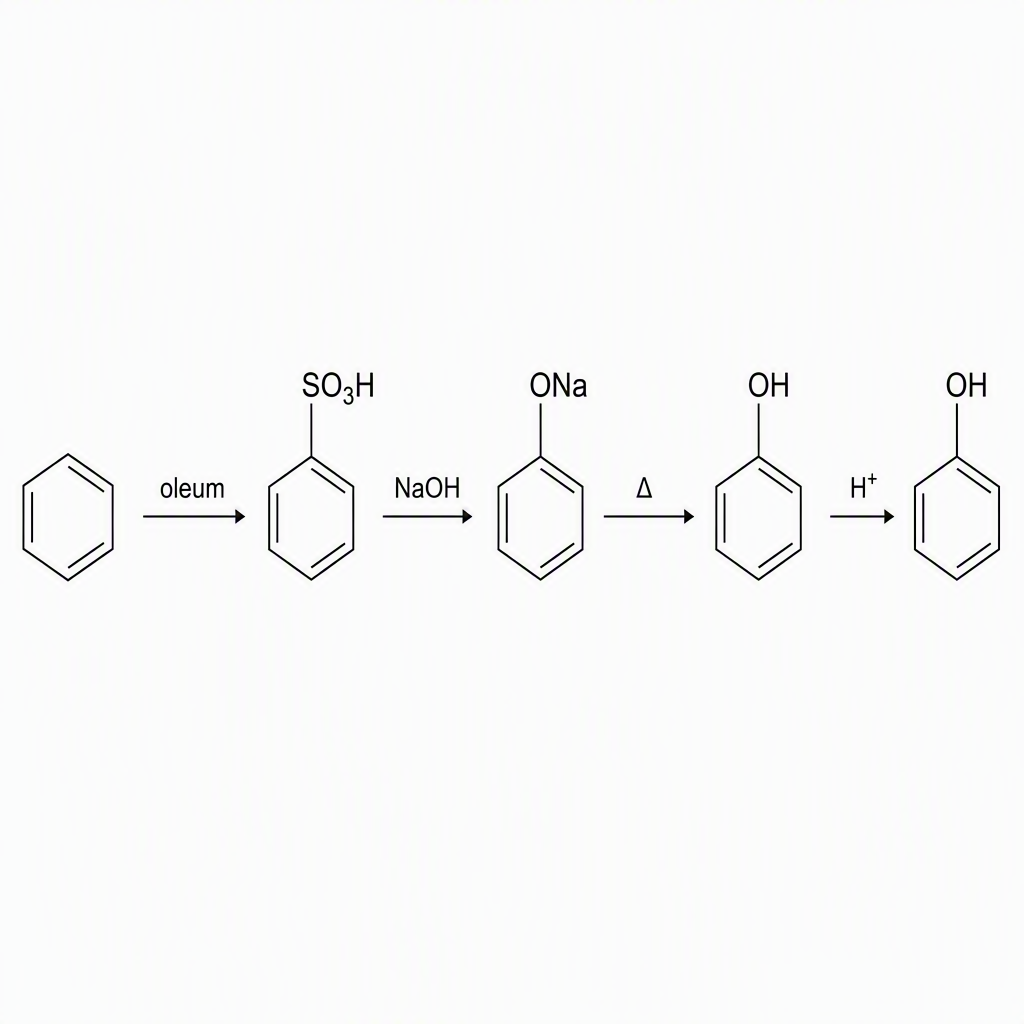
Fusion with hot sodium hydroxide produces sodium phenoxide.
Acidification converts sodium phenoxide into phenol.
Therefore:
The official matching is:
Option B is the official correct answer.
For a 120-second check, read each set as a reaction pathway:
- II: Oxidation followed by acidic cleavage.
- III: Esterification followed by reduction.
- IV: Dehydration followed by hydration.
- I: Sulfonation followed by alkaline fusion.
Why is the C-I and D-IV swap a method error?
The combination A-II, B-III, C-I, D-IV fails because it ignores the first intermediate and the substrate class. Set I starts with aromatic sulfonation, while set IV starts with alcohol dehydration. The corrective method is to check substrate compatibility and write the product after reagent 1 before considering reagent 2.
Set I begins with oleum. Its defining first reaction is aromatic sulfonation, which belongs to the benzene-to-phenol pathway.
It cannot carry out the required positional conversion of an aliphatic alcohol. Hot sodium hydroxide becomes useful only after benzenesulfonic acid has formed.
Set IV begins with concentrated sulfuric acid and heat. Propan-1-ol undergoes dehydration under these conditions to produce propene.
The next step hydrates propene in Markovnikov orientation, giving propan-2-ol. Set IV therefore belongs to C, not D.
Corrective rule: Verify substrate compatibility and write the product after reagent 1 before looking at reagent 2.
Recognising only sodium hydroxide followed by acid, or acidic water, while ignoring the preceding reagent is the underlying method mistake.
Which three related Organic Compounds Containing Oxygen questions should you practise?
These three original related practice questions use the same intermediate-first method. They are not previous-year questions. In each one, identify the product after the first reagent before applying the next condition. This separates familiar-looking reagent sets that lead through different pathways.
Which reagents convert benzene into phenol through sodium phenoxide?
Original related practice question 1: Supply the reagents and intermediates for the following pathway:
Key:
What forms after dehydrating and rehydrating propan-1-ol?
Original related practice question 2: Propan-1-ol is heated with concentrated sulfuric acid. The resulting alkene is then treated with acidic water.
The intermediate is propene. Markovnikov hydration gives propan-2-ol as the major product.
What forms after esterifying and hydrogenating ethanoic acid?
Original related practice question 3: Ethanoic acid is first treated with methanol in acidic medium. The ester is then hydrogenated using hydrogen with a catalyst.
The intermediate is methyl ethanoate. The alcohol products are ethanol and methanol.
For another verified organic Chemistry solution, use Hydrocarbons NEET 2026: Re-Exam Stereochemistry Answer. For every reagent sequence, write the first intermediate before reading the next arrow.
Frequently asked questions
What is the correct answer to the Organic Compounds Containing Oxygen NEET 2026 question?
The correct matching is A-II, B-III, C-IV and D-I. Therefore, Option B is the official correct answer.
Why does propan-1-ol match reagent set IV?
Concentrated sulfuric acid and heat first dehydrate propan-1-ol to propene. Acidic hydration then follows Markovnikov orientation and produces propan-2-ol.
Which reagents convert benzene into phenol through sodium phenoxide?
Benzene is treated with oleum to form benzenesulfonic acid. Heating with sodium hydroxide gives sodium phenoxide, and acidification then produces phenol.
How is ethanoic acid converted into ethanol in this question?
Methanol and acid first convert ethanoic acid into methyl ethanoate by Fischer esterification. Catalytic hydrogenation of this ester then produces ethanol and methanol.