What is the correct relation for n in the NEET 2014 oscillations question on a string divided into three segments?
The correct relation is . A uniform string under fixed tension and linear density is divided into three vibrating segments having fundamental frequencies n₁, n₂ and n₃. The question asks for the fundamental frequency n of the original undivided string. Only the reciprocal sum matches the physics.
This follows because frequency is inversely proportional to length at constant tension and linear density. The total length is the direct sum of the segments, which forces the inverse sum on the frequencies.
How does the physical arrangement look in the NEET 2014 oscillations string question?
The uniform string of total length L is fixed at both ends under constant tension T with uniform linear mass density μ. Two rigid supports divide it into three consecutive segments of lengths l₁, l₂ and l₃ that vibrate separately with frequencies n₁, n₂ and n₃ where L equals l₁ + l₂ + l₃. All three segments experience identical tension T and μ.
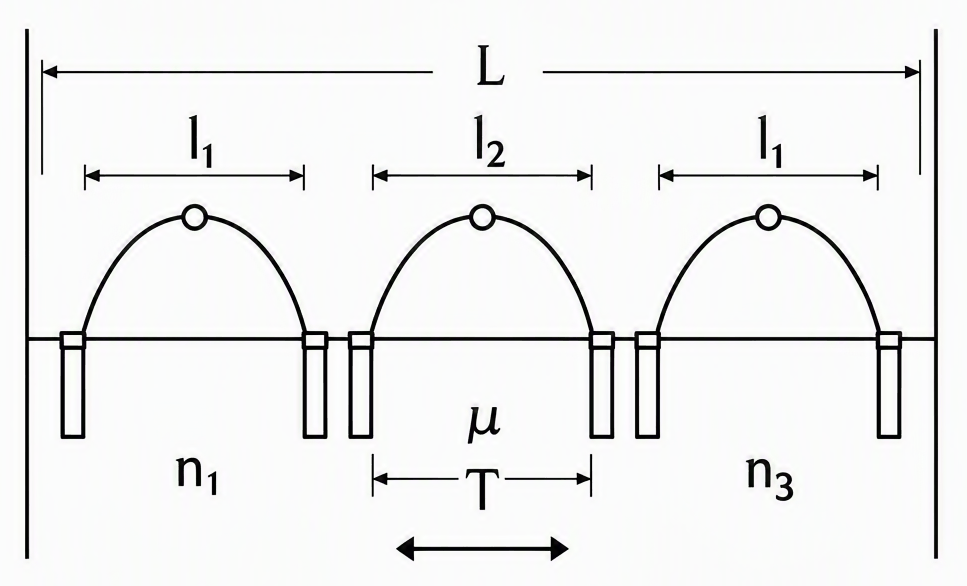
Each segment forms its own standing wave with nodes at the supports. Tension and linear density stay the same throughout, so frequency depends only on length.
What is the official NEET 2014 solution for the fundamental frequency of the undivided string?
The fundamental frequency formula is
For each segment the same tension T and linear density μ apply, so
The original length is the sum of the segment lengths:
Taking reciprocals yields
Adding these reciprocals:
The right side equals 1/n, therefore
Option A is correct. The derivation rests on nL remaining constant across all segments at fixed T and μ.
What algebraic mistake produces the wrong option n = n₁ + n₂ + n₃ in the NEET 2014 question?
Treating frequency as directly proportional to length instead of inversely proportional to length produces the distractor n = n₁ + n₂ + n₃ (option D). Students write L = l₁ + l₂ + l₃ then add the segment frequencies directly. This forgets to invert the frequency–length relation after writing L = Σlᵢ, which collapses the entire derivation.
The slip occurs under time pressure when the inverse step is skipped. Recognising that n ∝ 1/l forces the reciprocal sum eliminates the three wrong options in under 60 seconds.
How does the inverse-length principle apply to related oscillations and waves questions on strings?
A string is divided into two segments whose fundamental frequencies are n₁ and n₂. Because n ∝ 1/l at fixed T and μ the ratio of their lengths is l₁/l₂ = n₂/n₁.
If the same string is later divided into four equal segments, each new length is L/4. The new fundamental frequency in each segment is 4n because frequency scales as the reciprocal of length.
Compare the fundamental frequency of a sonometer wire before and after a bridge is shifted to change the vibrating length by 25 %. When length reduces to 75 % of original the new frequency is (4/3)n. The inverse relation decides the ratio without extra constants.
Search past NEET papers by chapter inside the past-paper archive to drill every variation that uses the reciprocal relation.
What are the key formula dependencies and NEET traps in string waves?
Frequency n ∝ 1/L when T and μ stay fixed, n ∝ √T, and n ∝ 1/√μ. The reciprocal sum appears only when lengths are added at constant T and μ. Any change in tension or density between segments breaks this exact form.
The same logic does not apply to air columns. End corrections alter effective length, and closed pipes carry only odd harmonics while open pipes carry all. These differences change the algebra completely.
When a fresh doubt appears during revision, photograph a doubt for an immediate step-by-step solution. Apply the inversion habit on every segmented-string problem.
Next step: photograph a doubt on NEET JEEnius AI and photograph any question you are stuck on and get a step-by-step solution across Physics, Chemistry and Biology (20 free a month).
If that step was the hard part, work through NEET 1 Year Study Plan from Class 11: Timetable and Milestones.
Frequently asked questions
What is the correct relation for n in the NEET 2014 oscillations and waves string question?
The correct relation is 1/n = 1/n1 + 1/n2 + 1/n3. This follows because frequency n is inversely proportional to length when tension T and linear density μ are constant. The total length L = l1 + l2 + l3 therefore translates into the sum of reciprocals of the individual frequencies.
Why is the answer 1/n = 1/n1 + 1/n2 + 1/n3 in NEET 2014 oscillations and waves?
Each segment has the same T and μ, so n = (1/(2l))√(T/μ) making n inversely proportional to l. Taking reciprocals gives 1/n ∝ l. Adding the segment lengths L = l1 + l2 + l3 therefore requires adding the reciprocals 1/n1 + 1/n2 + 1/n3 = 1/n.
What mistake leads to selecting n = n1 + n2 + n3 in the NEET 2014 string problem?
Students forget that frequency is inversely proportional to length and add the frequencies directly after writing L = l1 + l2 + l3. This algebraic slip ignores the inverse relation n ∝ 1/l. Recognising the proportionality forces the reciprocal sum and eliminates the wrong option instantly.
How do you solve the oscillations and waves NEET 2014 question on a string divided into three segments?
Write the fundamental frequency for the whole string and each segment using n = (1/(2l))√(T/μ). Express 1/n1, 1/n2 and 1/n3 in terms of lengths, add them, and substitute L = l1 + l2 + l3 to obtain 1/n = 1/n1 + 1/n2 + 1/n3. Option A is correct.